Posted on

the Good Times Skirt | the inspiration

Enjoy to the Good Times | the inspiration

As always it started with a conversation with a friend. This one was about how clothes and fabrics remind us of points in our lives, how they become part of our history and our identity.  The clothes you remember having a good time in. This skirt became one of those items. I have been wearing this skirt for over a year, more like 18 months, road testing and tweaking as I always do. Slow fashion at it’s finest and of course, it continues our ethos of making well thought out practical patterns to fill a need in your wardrobe for many years to come.

I was inspired to make a denim skirt based on my original favourite that I bought from the gap in 2001 (still wearing it – just – ’tis a smidge snug), and the fear that it would wear out and then ‘WHAT WOULD I DO?’. It is a traditional 5 pocket western style (like jeans) but it was very long, to the ground (on me) and straight with a big slit in the front to just above the knee so it was possible to walk. Very dark, unwashed denim. In the sale £9.99. It went in the drawer, came out, went back, it just wasn’t quite right. Eventually, I chopped it off to knee length, used the spare fabric from the bottom and put godets in the side to give a bit of flare so it’s now a very gentle, slim, A-line. And I have worn and worn and worn this skirt. In true jeans tradition, you can’t get much in the pockets. And I really wished it had a bit of stretch for extra comfort, you know? But of course, we can always improve a favourite, so say hello BIG GINORMOUS pockets!

Its very first official outing was a trip to Paris in January 2018 with friends to see the original Dior exhibition – last year was the year we all turned 50.

Then it came on a trip to New York – still celebrating turning 50 – with Mr.M. I’m actually wearing the same skirt/boot combo right now as I type this, a whole year later.

Then it sneaked into my case to visit Berlin. This has been one well-worn and well-loved skirt.

I should mention that at 5’2″ I’m on the shorter side for modelling, so I chopped my skirt off. I encourage you to do the same and make your skirt the way you like it, so you’ll keep wearing it. There are shorten/lengthen lines on the pattern if you are finishing your hem with the contrast facing, but for the raw edge hem option I just cut it off after making (you can trim the frayed white threads if you prefer).

My Good Times skirt has made several city trips, London, Birmingham … Ikea, Coventry. It’s done a shift at Sewing for Pleasure back in March because I needed to use those pockets and I see many more sewing shows in its future! This is a good practical skirt with pockets that can hold a big mobile phone and a travelcard and keeps your hands free. All without fear that they will fall out of your pocket and be lost forever on the underground. What a relief. Every time I wear this skirt, I do indeed have a good time.


Posted on

The Good Times Skirt | Hong Kong Finish Binding Tutorial

The Good Times Skirt | Hong Kong Finish Binding Tutorial

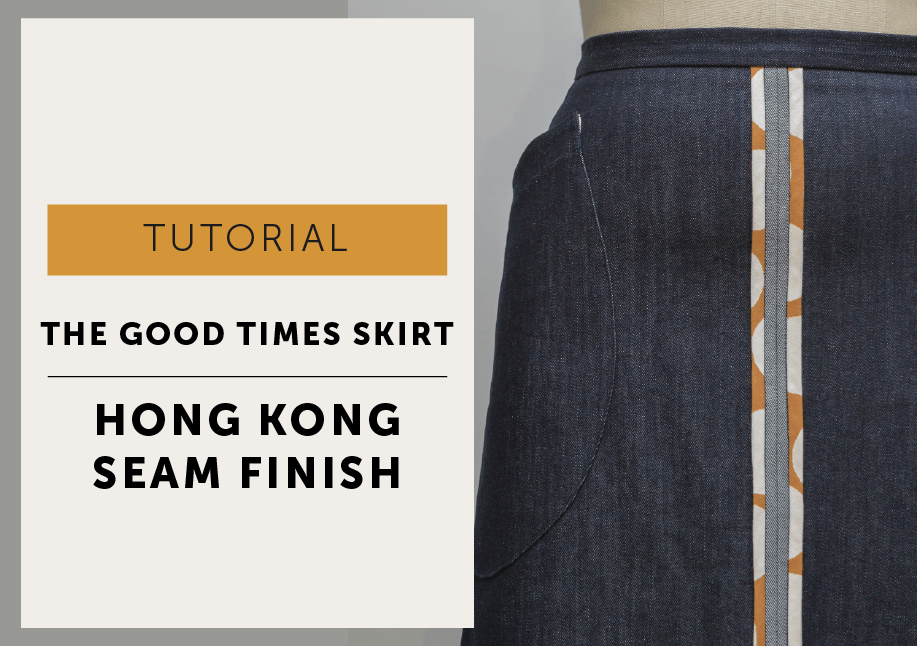
We have a few different methods of finishing the Centre Front and Centre Back seams for the Good Times Skirt. One of the seam options to use Hong Kong binding. You could also use this method to neaten the bottom of the waistband which gives a very professional look to the inside of your skirt (or any skirt!). This method is often used to finish the inside of jackets and dresses when you want the inside to be as pretty as the outside

Hong Kong binding is a very versatile design detail. You can make it pretty by using a small print…a bit of Liberty print anyone? Make a graphic statement with a contrasting colour or use a tonal fabric for a subtle stripe. You could use up your scraps of loved fabrics, just keep them of similar weight and fibre content for a cohesive look.

BUT WHAT IS IT? | What’s the difference between regular bias binding and Hong Kong Finish binding? With the usual bias binding method, all the edges are enclosed but with Hong Kong Finish the underneath edge of the binding is left raw and unfinished to reduce bulk.

FABRIC CHOICES | Hong Kong binding works best with a stable lightweight fabric, cotton lawn or a similar weight is perfect, but nothing too thick as you don’t want to add bulk to the seam. You can use pre-made bias just press it flat first.

CUTTING | the Good Times Skirt has optional Hong Kong Finish binding pattern pieces included in the ‘print at home’ pattern ready to cut and use to finish the waistband, Centre Front (CF) & Centre Back (CB) seams. If you are using this tutorial to bind a different garment (hello & welcome!) binding strips should be cut 3cm wide x the length needed plus a little extra for good measure. You can of course use ready made bias binding that has been pressed flat.

TOOLS | binding, standard machine presser foot, zipper foot (optional – see the tip below) iron and the usual sewing stuff!

ABBREVIATIONS | WS: wrong side | RST: right side together | RSU: right side up | RS: right side | SA: seam allowance

A TIP BEFORE YOU START SEWING|

I prefer to do the binding after closing the seam for accuracy and I’ve found using a zipper foot makes it a smidge easier (and that is is how I’ve written the instructions).

But, the binding can be attached BEFORE you close the centre front or centre back seam. It’s really a personal preference and in fact, it is slightly easier to stitch it first BUT you need to make sure you stitch it the right way for when the seam is reversed. Because the seam is reversed it’s very easy to stitch it the wrong way up – go on, ask me how I know….!!!

If you decide to attach it before you close the seam, be very accurate attaching it and very accurate again when you go back and stitch the CF/CB seams closed with the correct seam allowance. Potentially the extra thickness or width of the binding could mislead you and you could lose or gain a few millimetres per seam. That doesn’t sound a lot but they all add up if you lose a bit here and a bit there, and then your skirt is a bit tight!

SEW |

Close the seam and press with the SA open. I’ve already bound one side in these photos…

Take one side of the SA and push all other layers out of the way and with RIGHT SIDES TOGETHER (RST) align the edge of the binding with the raw edge of the SA.

TIP | At the bottom edge, if you want a neat finish with all the raw edges enclosed, fold over the binding over to the back of the seam. You may not need to bother with this step if the end of your binding/seam will later be hemmed, finished or caught into a facing.

Attach binding with 6mm SA – this will be finished binding width.

TIP | When binding the Centre Front & Centre Back seams you may find this step easier if you use a zipper foot.

Press the binding away from the seam. Note the (optional) neat finish at the bottom edge.

Fold the binding over to the WS of the SA, enclosing the raw edge of the seam. Make sure the binding is snug against the edge of the SA.

Press binding flat, take care not to stretch the seam.

With RSU stitch in the ditch through the binding and the SA only (use the zipper foot again if that works for you). Press again.

The binding will be raw to the underside of the SA and can be trimmed down closer to your stitchline if too wide for your SA.

You can ignore this step if you are just binding a seam but for The Good Times Skirt CF and CB seams, stitch in the ditch a second time, this time through ALL the layers to hold seam allowance flat against skirt. And you’re finished!


Posted on

The Good Times Skirt | sewing denim

The Good Times Skirt | tips for sewing denim

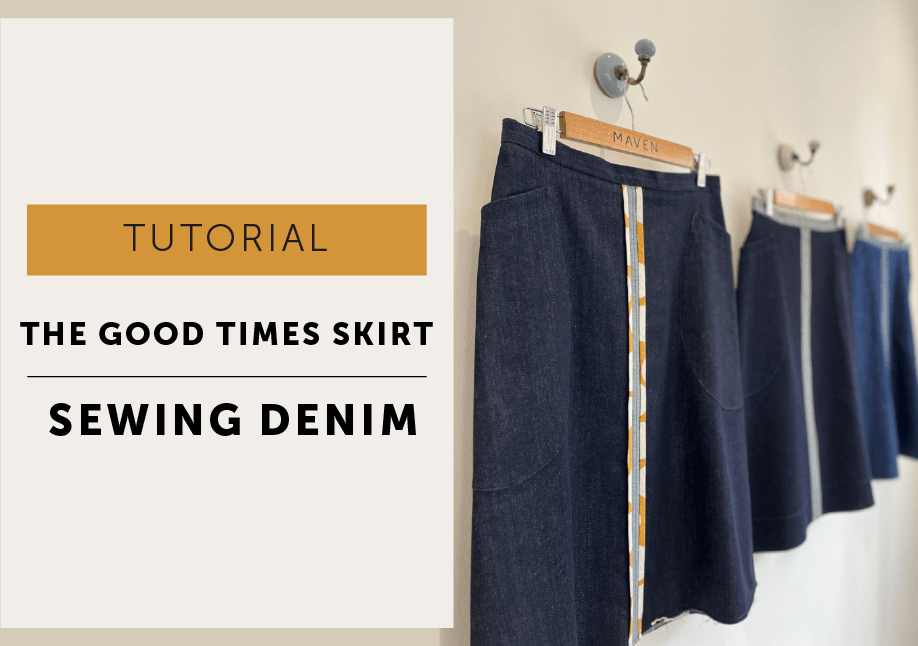
I like practicality and utilitarian in my design work so denim has always been one of my favourite fabrics. I like the way the fabric ages to tell a visible story of wear and history.

Denim is a very durable, strong fabric, traditionally woven in a twill weave and made from cotton with indigo dyed warp (vertical/lengthwise) threads and white weft (horizontal/across) threads that gives denim its characteristic look. In the last 20 years or so fashion and technology have had an impact on denim with the addition of other fibres such as elastane and Tencel to give a different feel and finish. Some of these fabrics will not be as hard wearing as traditional denim.

Denim comes in many weights but for The Good Times Skirt, you are looking at using 9-12oz denim, with around 2% elastane (lycra/spandex) for a bit of comfort stretch. Try and be thoughtful and intentional about the fabric you choose, the aim is to produce a garment that can be part of your wardrobe for years to come.

Denim is not a very difficult fabric to sew but it can get a bit bulky, so having a few tricks in your sewing arsenal can make sewing it a smidge easier.

PRE-WASH YOUR FABRIC | 

Denim will shrink, and the indigo dye on the darker denim will run. Wash separately at 30° with plenty of room in the machine and you can pop a cup of white vinegar in the wash with your denim to help fix the colour. I tend pre-wash dark unwashed denim twice to avoid blue fingers while sewing. Denim also frays quite a bit so consider neatening the raw edges before washing or sewing into a loop first. Washing your denim with room in your machine for the denim to move (don’t pack it tightly in!) and ironing whilst still damp will help prevent white lines appearing on the surface.

I prefer not to tumble dry anything, ever, as I think it breaks down the fibres (especially lycra) and that can’t be a good thing. That fluff in the tumble dryer must come from somewhere. I don’t actually have a tumble dryer anymore (but I also don’t have small children and I work from home so can time the washing for a sunny day – I’m in England and laughing as I write that optimistic statement) but if you’re likely to throw your denim in the dryer later it’s probably best to treat it the same way at the pre-wash stage but it’s advisable to check the wash care instructions for your cloth first.

There is, of course, the denim purist method of not washing and wearing denim for 6 months to a year and popping in the freezer occasionally to kill off any bacteria. I read that the other day that the freezer idea is under debate, but hey ho!

TIPS FOR SEWING DENIM |

  • Use sharp scissors or a rotary cutter with a fresh blade.
  • Denim can be quite sturdy and bulky, test interfacings on your denim to make sure you are happy with the result, many sewing decisions are just down to personal taste.
  • Facings are best cut in lightweight cotton, to help reduce bulk.
  • Use a Jeans needle – size 90/14 for lighter denim, 100/16 or 110/18 for heavy denim
  • Test topstitching and stitch tension on scraps of fabric before you start.
  • Topstitch with a slightly longer stitch than you usually use, around 3mm, but do a test to see what’s good for your machine.
  • Think about topstitching colours and weight of thread. Do you want your topstitching to stand out or blend in?
  • Topstitching with your usual weight in a matching or tonal colour thread gives a subtle look.
  • Consider using a heavier weight thread to make a feature of topstitching, use either Jeans or buttonhole thread and your usual thread in the bobbin. 
  • If your machine has an extra spindle on top can also use ordinary weight thread for topstitching but thread the needle with a double thread to give the appearance of a heavier thread.
  • Press as you go and use lots of steam.

BULKY SEAMS |

Reduce bulky seams by trimming and grading seam allowances. For very bulky corners and seam junctions, tap the area with a hammer! Protect your garment with a piece of folded denim below and cover with another scrap and just gently tap until it softens. A very useful tip for the corners of the waistband and if you are hemming jeans.

LEVELLING FOOT/BUMPER/HUMP JUMPER | honestly, I’ve heard all those terms so not making it up…

So what often happens with thicker fabrics like denim is the back of your presser foot isn’t level with the front when you sew (or vice-versa at the end of a seam). That’s when you get problems with uneven topstitching because the fabric is not feeding through evenly. It happens when your hemming jeans at the intersection of the seams or anywhere there is a lot of bulk to stitch over, and your stitching looks a bit messy with different length stitches.

All you need to do is fold a scrap of fabric and place behind or in front of the thick bit you’re stitching and under the machine foot to keep it level as you sew over thicker areas. You can buy a special gadget or use a piece of card, but I like a bit of fabric so I can fold it to the right depth.

My new machine has a levelling presser foot with this screw thing you can push in to keep the foot level. (I’ve got a Juki). It’s sometimes useful, but not always, so lo-tech scrap of fabric is still winning.

FINAL TIP |

Take your time! You can literally crank the wheel by hand and go one stitch at a time if necessary, especially over those thick tricky bits. Happy sewing!