Posted on

A Fresh Bloom

image of The Bloom Skirt-Narrow Fabric Hack

Recently, I had a little sewing dilemma with a new Bloom Skirt I was planning and had to quickly come up with a how to cut narrow fabric hack.

I had been gifted the most delightful vintage Italian brocade (thank you Sarah @OliveRoadLondon) but it was a little narrow for my skirt pattern. With a useable width of just 86cm (34″) the cloth was not wide enough to cut the front panel which normally is cut to the fold.

The obvious solution is to just add a front seam to make a 4 panel skirt. And if I had been working with a ‘casual’ fabric like denim that would have been a great idea. I could have made a really nice feature of the seam which would have looked like a deliberate design decision.

THE DILEMMA

This fabric, however, is a really gorgeous brocade and I didn’t feel that a centre front seam was going to look right whacked down the front of my skirt. And, obviously, the plan wasn’t to cut it in contrasting fabrics like the sketch above but the seam was still going to be more noticeable than I wanted. And yet, the fact remained that the only way to get the skirt out of the fabric is to cut 4 equal skirt panels instead of the front panel on the fold.

THE SOLUTION

As there is, in fact, no sewing law in the world that says you have to place those panels so the seams fall as expected at the centre front, centre back and the side seams, so I decided to rotate the skirt by 45° so the seams are ‘off-set’ and sit in a much more pleasing (to me at least) position.

You probably don’t really need a tutorial now you’ve seen the images, it’s all quite self explanatory, but I’ve started so I’ll finish*

CONSTRUCTION

Construction of the skirt will be the same as usual, but as the seams have moved keep in mind the pockets and zip will obviously not be placed in the side or back seam.

CUTTING

  • Completely ignore the front skirt pattern and cut your skirt using just the Back skirt pattern but cut 2 pairs instead of 1 pair.
  • Cut the waistband and pocket bags as originally directed.

POCKETS

The pockets can’t be placed at the side seams because there isn’t actually a seam at the side any more. They need to be placed on either side of the front panel. Use the template included in the pattern to mark the pocket notches on the panels.

TIP / I’m going to suggest you check the pocket bag placement before permanently sewing in place. I left mine in the original position and, while perfectly useable, they are a smidge low for me. If I make another I will raise their position by about 2cm (½”ish). I should point out I’m 5’2″ with short arms, so this may or may not be a problem for you. If you’ve already made a Bloom Skirt, slip it on and twist it around so the pocket is sitting roughly where the new seams will be and just see how it feels.

ZIP

As we no longer have a centre back seam, but now have 2 seams offset to each side of the Centre Back, you’ll need to pick a back seam to insert your zip into. I’m right handed so I have inserted mine into the seam on the right hand side (as worn), but again there is no sewing police so it’s your choice really.

SCALLOPS

I didn’t add the scallop hem to my skirt. Apart from being short on fabric, I don’t think my fabric particularly lent itself to sewing them, this brocade being quite bouncy and full bodied – not impossible but not a quick win either. And the scallop pattern wouldn’t fit across the width of the cloth anyway.

If you find yourself wanting the fancy scallop hem but lacking fabric width, consider cutting them on the opposite grainline so the paper pattern runs along the length of the selvedge – do check you are not going to have issues with the direction of any print design or fabric shading though.

The other option would be to keep the pattern on the original grainline but add seams to make each scallop section the same width as each panel.

I was really pleased with how my Brocade Bloom Skirt turned out, she’s be worn quite a few times already and I do hope this gives you a few ideas to experiment with your patterns!

* For my non-UK sewing friends: I’ve started so I’ll finish – is a little quote from Magnus Magnusson on Mastermind, a famous Brit quiz show.

Posted on

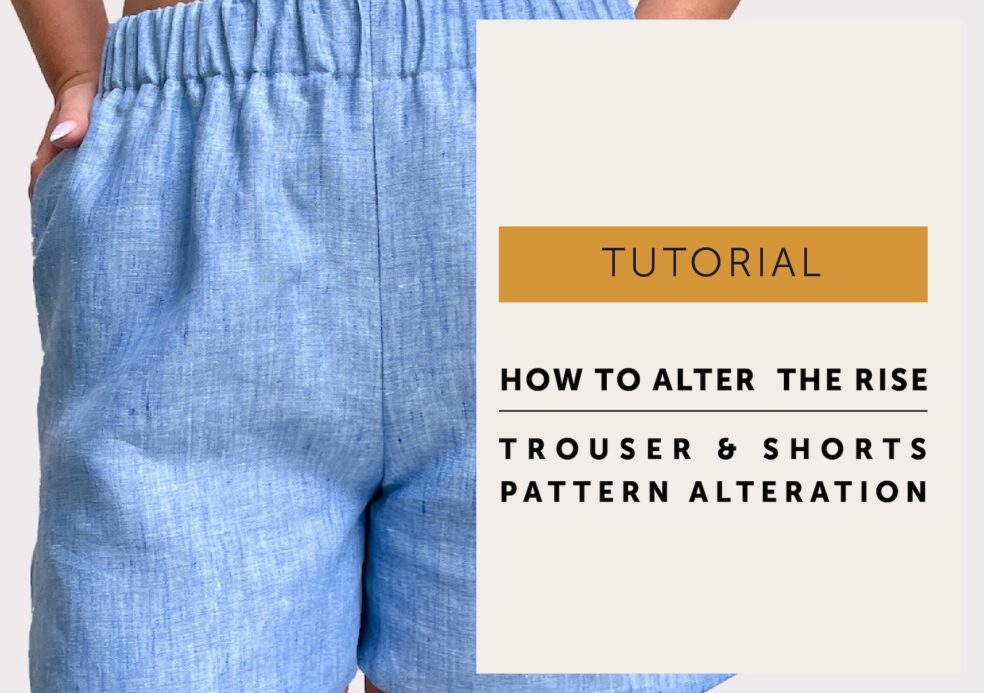
How to Adjust the Rise of a Trouser Pattern

image of text - How to alter a trouser Rise Tutorial

Lengthening or shortening the rise (crotch) of shorts or trousers (pants for my US friends) is easy enough to do with a bit of slashing and spreading of your pattern. That actually sounds much more dramatic than it is.

Having a few pattern adjustments options in your sewing tool box will always be handy as we are all different shapes and sizes, tall and short, or you might want to move the waistline for aesthetic reasons. 

As with most pattern alterations, think about where you need the extra fabric. And vice-versa remove fabric where you don’t need it. If you need more fabric to go over your bum, that’s where you add it. If you have an upsetting fold of fabric at the front rise , that’s where you don’t need it!

This alteration may be needed on the front rise or the back rise, or possibly both. And you may still need to make other alterations to your trouser pattern.

I’ve got 2 methods to alter the Rise (crotch length) of trousers to share with you. 

How to alter a Trouser Rise (crotch) – This will show  you how to alter a trouser rise without changing the side seam length. It can be done on the front or the back rise or both of the rises.

Long/short Torso Adjustment – The second method is a useful pattern alteration for those with a longer or shorter torso and shows how to alter both the front and back rise (crotch length) and the side seam length.

IF THE RISE IS TOO LONG – it’ll all be hanging too low and looks saggy (lovely) with excess fabric that you want to pinch out, you might even feel the need to pull them up all the time to make the rise sit comfortably, but then the trouser sits too high at the waist. 

IF THE RISE IS TOO SHORT – your trousers will be riding up uncomfortably high and you’ll be trying to pull the area down, the fabric may be pulling and creating drag lines. The waist won’t be sitting in the correct position and you’ll feel like you want to pull them up. 

This is quite a common alteration on the back rise. You’ll feel that it just isn’t long enough and too short over the seat area, and the trousers may be pulling downwards at the centre of the waist especially when sitting down. It’s an easy fix – you just need a bit more fabric to go over your bum.

Tools

  • A copy of your trouser or shorts pattern (it’s best practise to keep the original)
  • ruler
  • pencil
  • tape
  • Paper

Toile Time

Hopefully you’ve made a toile. That will give you a lot of information on the fit of your trousers.

  • Make sure that the waist and hips are not too tight, a tight garment will ride upwards and not sit correctly on your body.
  • Also take care not to overfit your garments, it’s usual to have some wrinkles as you need to be able to move and sit down.
  • Pop your Toile on with the waistline sitting where it should be – keep in mind not all trousers are designed to sit at the natural waistline. 
  • Pin or cut the toile to establish the amount you need to add/subtract from your rise. If I’m honest it’ll be a little bit of guesswork as it’s not easy to cut and pin a toile on yourself, be prepared to pull it on and off a few times but it will give you a good idea of how much to add to your pattern and you can refine it if you need too. 

How to Alter a Trouser or Shorts Rise

Lengthening or shortening the rise (crotch) of shorts or trousers (pants) is a very easy pattern alteration

Rise is too Long – Pin the excess wedge of fabric on your toile at the centre and reducing to nothing at the side seams.

Rise is too short – Slash the toile open from the centre to the side seam. Let the toile open as much as it needs, pin some fabric behind to establish how much you’ll need to alter the rise. (You may be able to just measure from the top of your trouser to where it should sit on your body but often you’ll need to slash the toile open).

How to Alter For a longer or shorter Torso

Lengthening or shortening the rise (crotch) of shorts or trousers (pants) is a very easy pattern alteration

Rise is too Long – Pin the excess wedge of fabric, try to keep it an even amount, on your toile all around the body. 

Rise is too short – You may be able to just measure from the top of your trouser to where it should sit on your body but often you’ll need to slash the toile open. Cut all the way through the toile and pin some fabric behind to help establish how much you’ll need to alter the rise.

Adjust the rise on a trouser pattern (without touching the side seam).

You can just alter the FRONT Rise or the BACK rise, or both rises using this method.

Lengthening or shortening the rise (crotch) of shorts or trousers (pants) is a very easy pattern alteration
  • Using a copy of your pattern piece mark the seam allowances so you know where the stitch lines are.
  • Draw a lengthen/shorten line across the pattern through the Rise, ensure it is perpendicular to the grain line. I prefer to do this so it intersects the rise seam on a straighter section rather than the curve.
  • Cut along the line, starting at the RISE seam and cut UP TO the side seam stitch line but NOT through it. Cutting from OUTSIDE of the pattern, cut through the seam allowance and up to the same point on the stitch line, leaving a 2-3mm hinge of paper. 
  • *If you hinge your pattern from the outside edge of the pattern instead of the stitch line, your seam increases in length and then your pattern won’t fit back together properly.

To Lengthen the Rise Seam

Lengthening or shortening the rise (crotch) of shorts or trousers (pants) is a very easy pattern alteration
  • Place some paper behind your pattern pieces and tape the lower section of the pattern securely in place.
  • At the Rise stitch line, mark the amount you need to increase the rise by above the lower pattern piece.
  • Pivot the top pattern piece upwards from the hinge to add the extra amount and tape in place. 
  • Redraw seam lines to give yourself a smooth line, and also redraw the grainline.
  • THE CHAIN EFFECT – remember you may need to alter any other pattern pieces affected such as facings & fly patterns

To Shorten the Rise Seam

Lengthening or shortening the rise (crotch) of shorts or trousers (pants) is a very easy pattern alteration
  • Place some paper behind your pattern pieces and tape the lower section of the pattern securely in place.
  • Mark the amount you need to reduce the rise by ON the lower pattern piece.
  • Pivot the top pattern piece downwards from the hinge, overlapping the pattern pieces and tape in place. 
  • Redraw seam lines to give yourself a smooth line, and also redraw the grainline.
  • THE CHAIN EFFECT – remember you may need to alter any other pattern pieces affected such as facings & fly patterns

Long/Short Torso Adjustment

To adjust the Front Rise, Back Rise and the side seams of your shorts or trousers.

Lengthening or shortening the rise (crotch) of shorts or trousers (pants) is a very easy pattern alteration

Use to lengthen the Front Rise, Back Rise and Side Seams 

  • Using a copy of your pattern piece mark the seam allowances so you know where the stitch lines are.
  • Draw a lengthen/shorten line across the pattern through the Rise, ensure it is perpendicular to the grain line. I prefer to do this so it intersects the rise seam on a straighter section rather than the curve.
  • Cut all the way along the line.
  • Place some paper behind your pattern pieces. Anchor the lower section of the pattern with tape.
  • Extend the grain line upwards. 
  • Draw a second parallel line above the your shorten/lengthen line the amount you need to lengthen the rise by. 
  • Tape the upper portion of your pattern to the new line, matching up the grainline. 
  • Redraw your seam line so they are a smooth line, and also redraw the grainline.
  • THE CHAIN EFFECT – If you have a pocket bag, or other pattern pieces such as facings or Fly zips, remember you may need to alter them too. 
Lengthening or shortening the rise (crotch) of shorts or trousers (pants) is a very easy pattern alteration

To shorten the Front Rise, Back Rise and Side Seams 

  • Using a copy of your pattern piece mark the seam allowances so you know where the stitch lines are.
  • Draw a lengthen/shorten line across the pattern through the Rise, ensure it is perpendicular to the grain line. I prefer to do this so it intersects the rise seam on a straighter section rather than the curve.
  • Draw a second parallel line below it the amount you’d like to reduce the rise by.
  • Cut all the way along the first line.
  • Overlap the pattern pieces to reduce the rises and tape the pattern matching up the grainline. 
  • If necessary, redraw your seam line so they are a smooth line, and also redraw the grainline.
  • THE CHAIN EFFECT – If you have a side seam pocket I’d suggest remarking the pocket position to maintain the original pocket mouth opening size or you may find your hand doesn’t fit. You may need to alter other pattern pieces too. 

As with all pattern alterations, check when you’ve finished that your pattern seams still match and are the same length, they run smoothly and test your finished alterations with another toile before cutting into your good fabric.

All done and now you know How Adjust the Rise on a pattern for perfectly fitting trousers! Mrs M x

Posted on

How to Make a Waistband Narrower

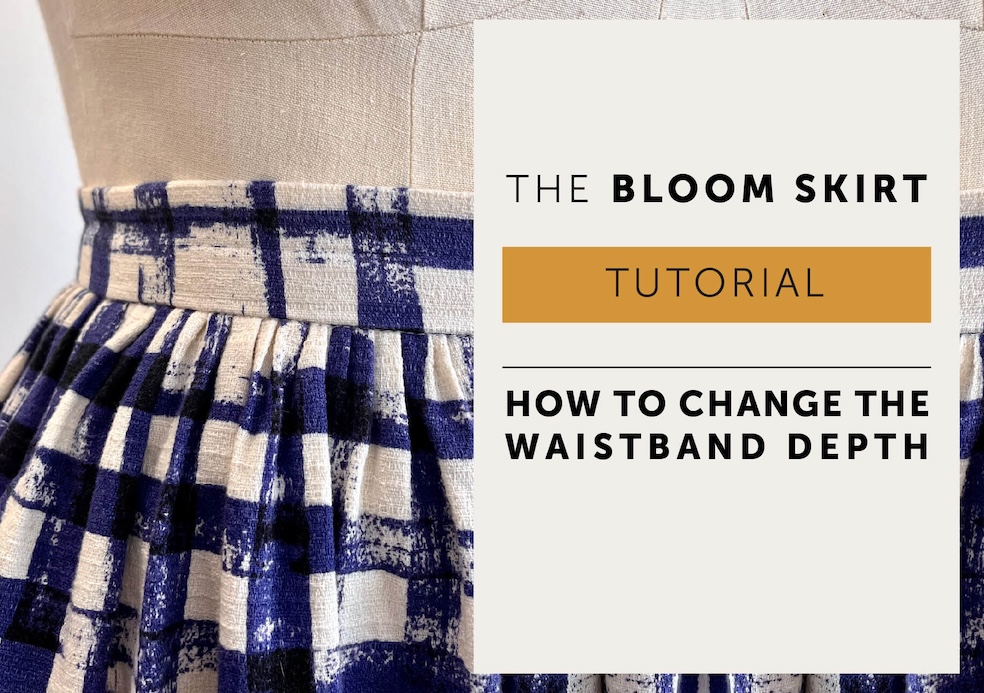
image of Learn how to change the depth of a waistband

Learn how to change the depth of a waistband pattern

The Bloom Skirt has a gorgeously wide statement waistband.

I’m not a big fan of mealy, mean little waistbands and so deliberately designed Bloom with 6cm deep waistband as I wanted her to feel glamorous and quite formal. Personally, I’m still fantasising about making one in an Emerald Green Silk Taffeta Bloom Skirt. I haven’t found the perfect fabric yet, but it’s a very enjoyable hunt!

But if you feel the waistband is too wide for you, or for your fabric don’t worry; the joy of sewing is that you can customise and personalise your sewing patterns until they look and fit how you want them.

Sometimes you might just fancy a little change just for the sake of change and something as simple as altering the depth of the waistband can give your skirt a whole different feel. The check skirt below definitely feels a little more casual with the narrower band.

I’m a very firm believer that sewing patterns can, and should, be just a starting point to sewing your own style. And I’m massively in favour of any changes to the pattern if it means you’ll use it and wear it more! Luckily, it’s the easiest thing in the world to change the width of a waistband, in fact this might be the easiest pattern alteration tutorial I have ever done.

I don’t recommend making your waistband wider than the 6cm finished width as you’ll need to start adding some shaping to the waistband but, a narrower waistband is a piece of cake.

You can of course just trace the original waistband, change the width and remember to add all the notches back on.

But this method is a non-destructive way to alter your sewing pattern, so you can always untape it and go back to the original width for a different cloth if you fancy.

A note for my fellow short people; you can use the same method to shorten the skirt pattern.

Learn how to adjust the depth of a waistband

Tools

  • Your waistband pattern
  • ruler
  • tape
  • Paper/pen/pencil
  1. Decide how much narrower you’d like your waistband. The blue check skirt has a finished band width of 3.5cm, making it 2.5cm narrower than the original pattern. You can of course make it any width you fancy.
  2. When I’m talking about finished measurements that’s the width of the completed waistband (or garment) when you’re wearing it and without any seam allowances. The thing to remember is the waistband pattern folds in half, for the outside and inside sections of a band. So you need to remove twice the amount (or the amount twice, depends how you look at it really). A very long way of saying; for the waistband to finish 2.5cm narrower you will need to remove 5cm in total from the width of the pattern.
  3. With the waistband pattern facing upwards, draw 2 adjustment lines 5cm apart (or your chosen amount) centrally and parallel to the grainline. (The red lines in picture with the shaded area being the bit I’m getting rid off).
  4. Fold one line to the other and tape to hold in place. We’ve literally folded a wedge out in the same way if you wanted to shorten a pattern.
  5. Remark the grainline and the centre fold notch and you’re good to go.

If you are not sure about how wide you’d like your waistband to be, before you start changing your pattern make a quick waistband toile and try it on. Think how will you be wearing your skirt? Are you going to a wedding or an event so quite formal or will you be sitting down all day or going on holiday and looking for something more relaxed? Take a look at skirts you wear and ones in the shops and have a little measure of the waistbands you like when you try them on.

What feels right? There is no right and wrong when you make your own clothes, you can decide and change anything!

Posted on

I want to Paint It Blue – Fabric Painting

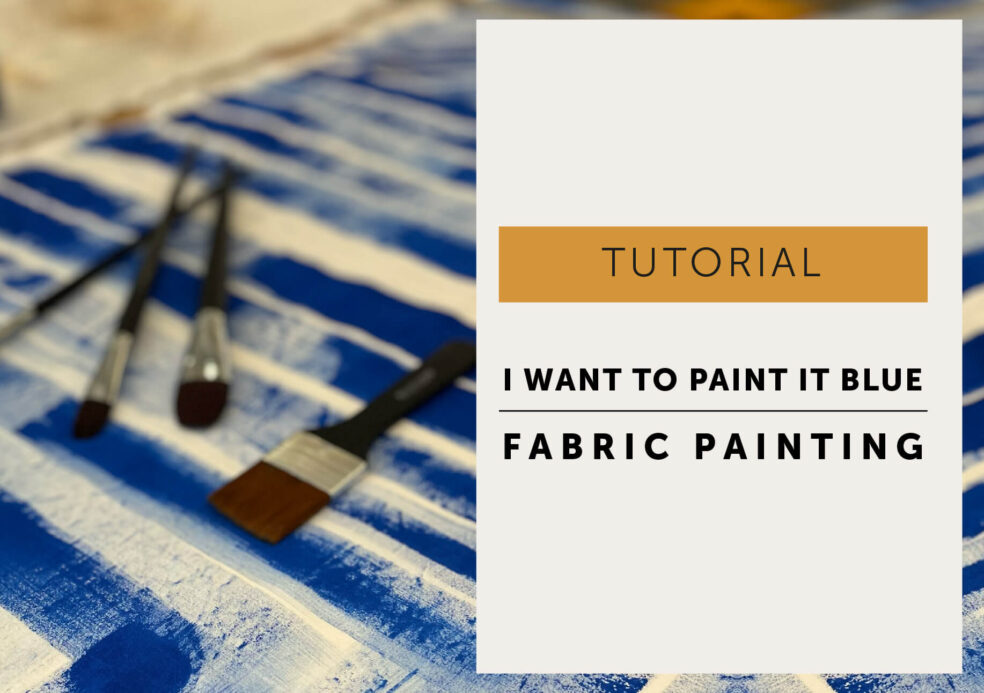
cover image for FABRIC PAINTING - I WANT TO PAINT IT BLUE

or How I hand painted this fabric.

Fabric painting – this post comes with a warning.

Fabric painting is hugely fun and addictive. Once you start painting your own fabric do not hold me responsible when you can’t stop!

What’s not to love about designing your own unique fabric? The paint was only £3 a pot and the brushes were about £5. If you work on stash fabrics or a pre-loved garment it’s potentially a very inexpensive way to update or create a really special garment.

Now, I’m just going to pre-face this post by saying I am not an expert at fabric painting or surface decoration. I got an idea into my head, thought about it quite a lot, bought the fabric paint and slapped it on some fabric.

Fabric Painting – Tools + Equipment

  • Fabric Paint in Royal Blue from Handprinted. I bought 3 pots, and used every single drop to paint the fabric for a full skirt.
  • Paint brushes from Søstrene Grene
  • Plastic sheets
  • Masking tape/brown paper tape
  • Frixon pens/fabric marker/ do a test for your fabric!

Protect The Area

No polite way of saying this – I am a messy worker. So protect the area and yourself. I covered or moved anything I didn’t want paint on and wore old clothes and an apron.

Protect your table as the paint will bleed through fabric. I taped old plastic wrappings that we had kept from fabric deliveries to the table.

Test Piece

I was a bit impatient to start painting and didn’t really have time to clear everything and paint-proof. So I did a quick test first on some scrap fabric to scratch the itch and to get a feeling for the brush stokes and how heavy/dense I wanted the strokes to look. I did a vague design by drawing with a Sharpie on pattern paper, which I could see through the fabric and gave me a guideline to follow. The ink did bleed through the fabric, rather obvious but reminded me of the need for plastic underneath the fabric. I’m not sure if the Sharpie plan was a good one, I have a niggling feeling the black sharpie ink could transfer to the fabric during fabric painting.

Fabric Painting Prep

I washed and ironed the fabric before laying it flat and wrinkle free on the table. Taped it down and made sure to keep it on grain. And, bonus points to me, I remembered to lint roller it. And remembered to put plastic sheets over the areas of fabric I wasn’t painting at the time to protect them from paint splatters. Because, as we have established, I’m messy. You could use a hairdryer to dry the paint a bit quicker but I didn’t have one with me.

I want to Paint It Black Blue

So my plan had always been to paint the fabric specifically for a Bloom Skirt, so I took quite a while to draw the skirt pattern pieces directly onto the fabric. I can recommend doing this if you are thinking of doing any kind of print placement. After which I marked a design/guidelines directly on the fabric with a Frixon pen so I could avoid crossing patterns over seams and having to pattern match at the zip and kind of line up the ‘stripes’. It was a bit vague and I didn’t follow it very precisely, and the pen did come off with the iron later.

I knew wanted a hand painted, painterly effect so you could see the brush marks, but sharp and graphic too. In the end I just starting painting and decided not to overthink it any further, not at all usual for me the queen of overthinking. That’s my best bit of advice, just start painting and don’t try to control the result too much. I played with different thickness of brushes and pressure for a variety of brushstrokes and just enjoyed the process.

And then patiently (again, highly unusual for me as I was a bit excited at this point) left it to dry overnight before I could move it to make room to paint the other bits of fabric. By this point, I was having such a jolly time I’m ready to paint anything and everything blue.

Fixing The Fabric Paint

Once dry, the fabric paint needs ironing to fix it.

So, I did a shout out on Insta as I wasn’t sure how long to iron for (it’s 2 weeks later at this point and I’d thrown away the pots) and there was lots of great advice given in the comments of the reel HERE.

There was a few suggestions to use a tumble dryer, but I don’t have one, but do have a menopausal shoulder so ironed it for as long as I could be bothered while listening to a podcast. Keep in mind this is a sample skirt for The Bloom Skirt pattern so I’m probably not going to wash and wear it as much as normal garment (if at all). I can’t confirm how it will wash at this stage but I’d suggest being a little more pedantic about fixing it correctly than I was!

My top tip would be to check your iron is actually still clean after not only pressing the fabric but after making said skirt because the ink transferred to the bottom of the iron and then onto some white linen. Totally my fault, I was very slapdash about using a pressing cloth and fixing the paint and checking the iron was still clean which is actually quite an obvious thing to check when pressing freshly painted bright blue fabric paint!

Overall, I’m delighted how the fabric turned out and looking forward to painting more at some point. Give it a try, it’s great fun!

*The Bloom Skirt is coming soon!