Posted on

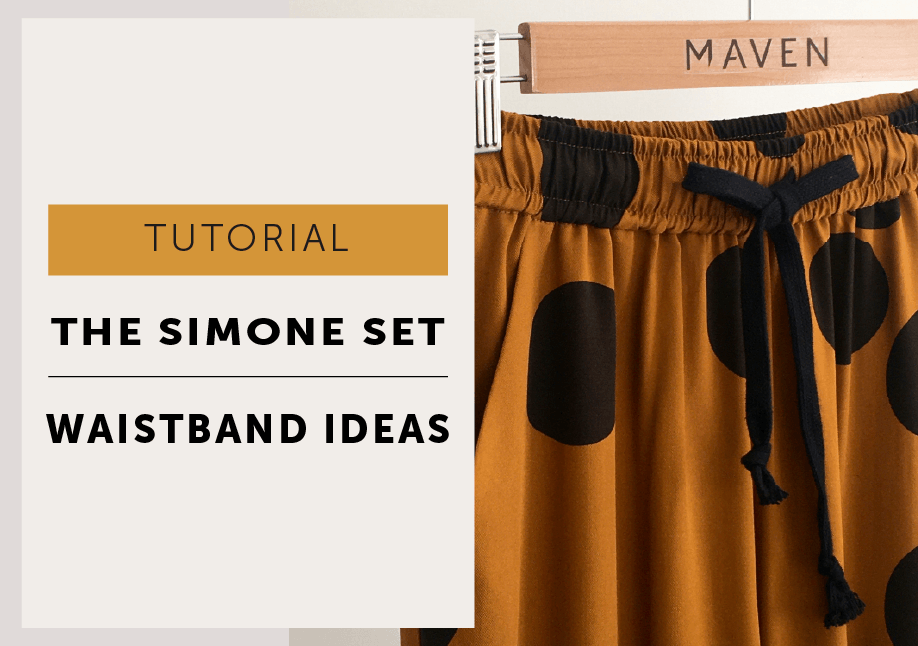
The Simone Set | the waistband

Before we start, this isn’t an actual “how to make an elastic waistband” tutorial, that’s all covered in the Simone Maker instructions, but this is a few extra ideas and options that I thought may be useful. And while I’m writing with the Simone pattern in mind, you can apply these ideas to any elasticated waistband.

Getting an elastic waistband to fit can be a bit of trial and error. All elastics will behave slightly differently and we all have a preference as to how we like our garments to fit. And we have the added joy of elastic shrinking and stretching. 

BUT OH MY, they can be so delightfully comfortable!

PRE-SHRINK | 

My first tip is to check if your elastic is pre-shrunk. If not, pre-wash your elastic (check the wash instructions first but I chuck it in the machine with my fabric, start as I mean to go on as it were) or at the very least give it a jolly good steam with the iron to shrink it as much as possible. Polyester will shrink less than cotton covered elastics, some may not shrink at all, but we might as well not deal with the hassle of shrunk elastic after we’ve finished our garment.

FIND YOUR ELASTIC LENGTH |

  • Generally finished elastic measurements are around around 2” smaller than your waist measurement 
  • Start with a piece of elastic longer than you need so you can try it on and adjust to fit if necessary.
  • Mark the elastic with your intended finished waist measurement. 
  • Wrap the elastic around in a loop and safety pin together.
  • Try it on, move and dance about a bit.
  • Adjust if you need to and make sure it’s snug and secure (keep in mind that topstitching the elastic can make it stretch a bit).
  • Allow an extra 2.5cm (1”) as an overlap.
  • Chop off the excess elastic.
  • Don’t overthink it, there is no right or wrong measurement, if it’s comfortable and keeps your trousers up – winner!
  • Remember to make a note of your elastic measurement so you have a reference for next time.

QUICK METHOD TO SECURE THE ELASTIC |  

The Simone waistband has a drawstring and 2 rows of topstitching through it, but sometimes you just want a quick clean finish. This is a good method if you are not adding a drawstring and prefer not to topstitch through the elastic and is a very effective way to prevent the elastic from twisting during washing and wearing.

  • Once you have completed STEP 42 in the Maker Instructions – you will have inserted the elastic into the waistband and stitched the opening closed.
  • Evenly distribute the gathering and elastic by pulling and stretching the waistband flat a few times. 
  • Pin through all the layers at the Centre Back, Centre Front and at each side seam to hold in place and simply stitch vertically through the waistband at these 4 points.

FAUX DRAWSTRING | 

If you use the quick method above to secure the elastic in the waistband you won’t be able to add a functioning drawstring, but you can add a fake one.

  • Cut your chosen drawstring to a length of around 65cm (26”)* You just need to be able to tie it in a bow and leave some tails hanging, so feel free to adjust the length to suit you and use what’s in your stash. 
  • Fold in half to find the mid-point and stitch on the waistband at the centre front of your trousers.
  • Tie in a bow!
  • *This is a suggested length for an adult. If you are sewing for a child the length should be shorter because dangling ties are a HAZARD. You will need to check and comply with the legislation for your area to get an appropriate length.

BUT I’D LIKE TO USE A DIFFERENT WIDTH ELASTIC!

USING A NARROWER ELASTIC AND ADD A FRILL | 

Got a narrower elastic in the old stash? Don’t go out and panic buy more elastic, here’s an easy solution that doesn’t involve altering the pattern.

  • Attach the waistband as described in the instructions and stop once you are at the point of inserting the elastic.
  • Stitch a channel for the narrower elastic. Stitch the channel 3mm (⅛”) deeper than your chosen elastic to allow the elastic to fit inside.
  • So if you have 2.5cm (1″) wide elastic stitch at around 2.8cm (1 ⅛”) above the waist seam.
  • Insert the elastic and close the waistband as in the Maker Instructions.
  • The excess at the top of the waistband will become a frill.
  • Easy peasy!

REDUCE PATTERN WIDTH | 

If you don’t fancy a frill, you’ll need to change the depth of your waistband casing pattern to use a different width of elastic. 

Use this formula to calculate your waistband casing depth (the pattern length will stay the same).

METRIC |  Elastic width x2 + 2cm seam allowance + 1cm ease = WAISTBAND CASING PATTERN DEPTH

INCHES | Elastic width x2 + ½” seam allowance + ⅜” ease = WAISTBAND CASING PATTERN DEPTH

EASE | There is 1cm ( ⅜”) ease allowed in the depth of the pattern to make sure (a) you have some wiggle room and can thread your elastic through the casing easily and (b) there is enough width to make sure the waistband will fold over to the inside of the trouser and cover the waist seam so you can ‘Stitch in the Ditch’ to secure during construction.

OPTIONS TO TOPSTITCH & SECURE A NARROWER ELASTIC | 

Any waistband elastic should be secured by stitching through all the layers as this will help stop it from twisting after washing and during wear. If you are using a narrower elastic than the 4cm width recommended, it’s not a problem, but you might have to use a slightly different method than the one in the Maker Instructions.

  1. Top stitch through the elastic as explained in the instructions. A narrower elastic can still have a drawstring, but you may want to make your buttonholes horizontally instead of vertically and adjust the topstitch placement.
  2. Just topstitch one row through the centre of the elastic and leave out the drawstring and buttonholes.
  3. Stitch vertically through CB, CF and side seams (as described above).

I hope you enjoy these extra ideas to make the most out of your Simone Set pattern!

Posted on

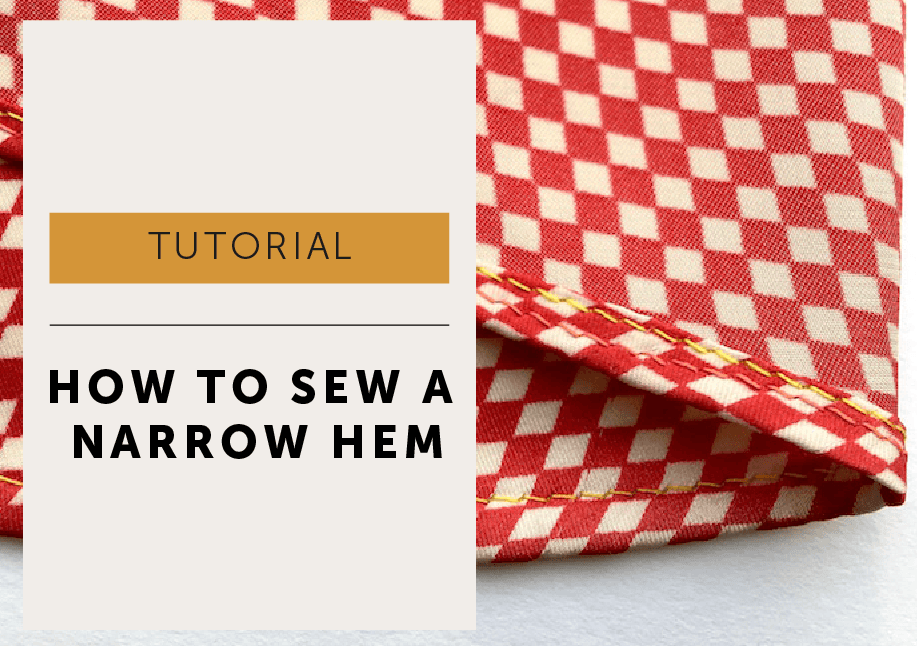
Learn to sew a narrow curved hem

One of my favourite details of The Simone Camisole is the lovely gently shaped hem.

A shaped or curved hem doesn’t really like having a big hem allowance, it’ll look twisted and ‘ropey’ so a narrow hem is the best option. They can be tricky to finish neatly if you are working with a delicate or lightweight fabric, which is often the fabric of choice for a camisole. Different fabrics can require different construction methods so it’s always nice to have a little arsenal of alternative methods in your tool box should the need arise.

If you are ever in doubt of the best method to use just do a little test on a scrap of fabric. If you are testing the best way to hem a curve, remember to do your testing on a similar shape.

| Sewing a Narrow Curved Hem |

WS | wrong side of fabric  RS | right side of fabric  SA | seam allowance

TIPS |

  • Press at every step.
  • If you have a ‘bouncy’ fabric that doesn’t hold the press line (like the one I used!) use a few pins to help, but first check they don’t damage your delicate fabrics.
  • If you carefully tack your hem in place along the top edge of the hem allowance, it will give you a guide to follow when you stitch the hem from the RS, ensuring you catch all the allowance.
  • A good final press and steam will shrink any stretching that may have happened on the curved areas.
  • For reference: the fabric I have used for this post is a fine, slippery, (allegedly) silk crepe de chine that was lurking in the stash.

Double Turn Hem | 1cm Hem Allowance

This is my usual method and the one that you will find in The Simone Maker Instructions. The benefits are it’s easy and works for most fabrics. It gives a small, neat hem with all the raw edges enclosed.

  • Machine a row of stitching 5mm from the raw edge all the way around the hem

  • With WS up, press up the raw edge of the hem using the stitch line as a guide.
  • The stitch line should roll to the WS. (I’ve held the hem in place with a pin for the photo).
  • Fold again and press, enclosing the raw edge
  • Stitch the hem, being careful to catch all the hem allowance. (You can see, above, I have partially stitched the hem).

We have a tutorial for the Maria Apron Hem HERE it’s the same principal but there are a few more photos.

Overlock and Turn |

An overlocker (a serger) makes the edge easier to fold neatly, especially if you are double turning the hem. If you don’t have an overlocker you could experiment and see how it looks with your neatening stitch on your usual machine. You can adjust the differential feed of your overlocker on curved hems so the fabric gathers slightly and this will help when you turn up the hem, but I didn’t find it necessary for The Simone pattern in this fabric.

Single turn | The first example is turned once so you can see the overlocking to the WS

  • Overlock the edge of the hem
  • Fold and press the hem the width of the overlocking to WS. Once you’ve done this a few times you may be comfortable to just fold and stitch in one go.
  • Stitch hem

Double turn | This example is turned twice so the overlocking is enclosed, giving a slightly more expensive looking finish.

  • Overlock the edge of the hem.
  • Fold and press the hem the width of the overlocking to WS and stitch.
  • Fold again and stitch on top of your first row, keep folding as you stitch.

  • Again, once you have done this a few times, and are comfortable with the method, it is possible to double fold and stitch in one go.

Traditional Narrow Rolled Hem Method |

This is the usual rolled hem tutorial you’ll often come across. I usually use the first method I listed above because I’m not a huge fan of trimming SA (that’s most likely due to my industry training as it’s not a thing we would have done and I’m a bit lazy if I’m honest), but the benefits of this method is you can make a very narrow hem on trickier lightweight, sheer or slippery fabrics. It would be your go-to method if you ever needed to hem a beautiful floaty circle skirt.

  • 1.5cm Total Hem Allowance
  • Stitch 1cm from raw edge of hem. (yellow stitching)

  • Use the stitch line as guide and press up the raw edge of the hem to the WS, the stitch line will be close but not right on the folded edge.

  • Stitch as close as you can to the folded edge and through all layers and on top of the first row of stitching. Press. (green stitching)
  • Trim away the extra hem allowance as close as you can to the stitch line.

  • Turn the hem again, so all raw edges enclosed and stitch. (blue stitching).
  • Voila! The tiniest tiny, neatest hem!

You can of course use a special rolled hem foot, but I don’t own one so you are on your own if you go down that route!


Posted on

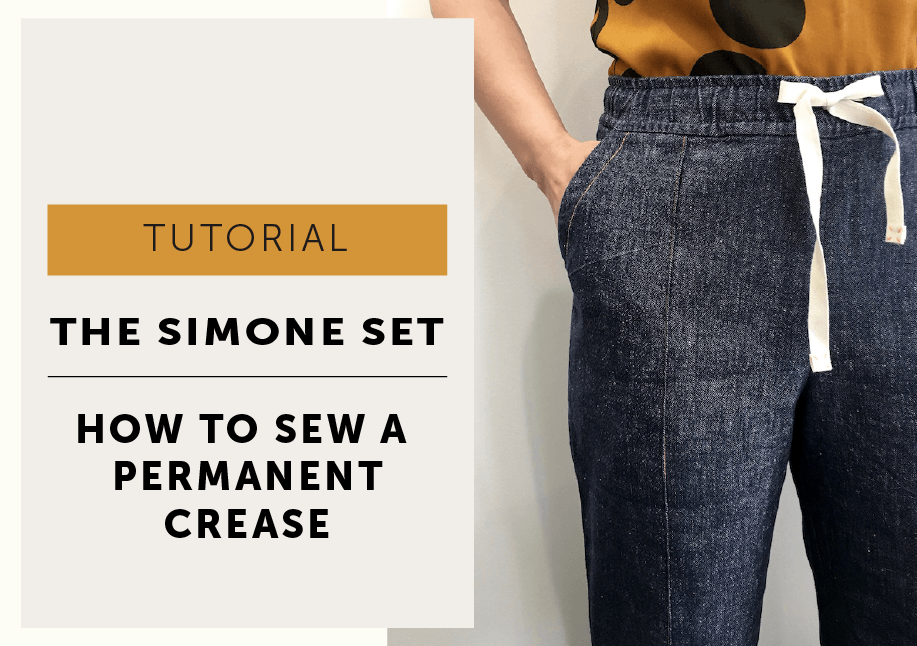
The Simone Set | add a permanent stitched crease

During one of the numerous samples I made while testing the Simone Set, it occurred to me a really nice detail to add to the trousers would be to sew a permanent crease down the front legs.

A stitched crease, which is basically a pintuck, is sometimes seen on on tracksuit bottoms and often on a tailored trouser but I liked the idea of adding it to Simone. Stylewise, it’s casual and relaxed but adds a thoughtful design detail.Pictures via pinterest – links: Trouser inspiration board

While I was having a little research on the old internet I found that there are a few names trouser creases are known by;

  • permanent stitched crease – a phrase which does remind me of Farah slacks from the 70s.
  • my favourite term I came across was the traveller’s crease. Somehow manages to conjure up images of travelling salesmen in varying tones of brown polyester and yet, at the same time, images of glamorous starlets on epic cruises in the 1930s and 40s.
  • and pintuck being the simplest term.

The stitched crease is often just on the front trouser leg, but can be added to the back leg if you want. We will be sewing our permanent crease all the way along the trouser leg but if you had a style of trouser with a dart you would finish your crease at the base of the dart and the back crease would finish at the crotch level.

According to the internet, The Crease has magical properties. The claim being that a vertical line, in theory, lengthens the leg. Hmmm. I’m a short 5’2″…I still look 5’2″ but with a sharp looking stitched crease.

Anyway, it really is quite a straight forward hack, but does require accuracy. The crease needs to be stitched before you start constructing your trouser.

| How to stitched a permanent crease |

This is the first time I’ve used a ¼ scale pattern to illustrate  – how cute are tiny trousers!

TIP | If this a totally new-to-you technique remember that you can always do a few a little tests on a scrap of fabric. That is something that is part of my sewing process; testing, sampling, a practise run, are all the same thing. It can save you from disasters, sometimes you just don’t know how a fabric will behave or if you will like the result and testing can give you some extra confidence.

WST | wrong side of fabric together  RSU | right side of fabric up  SA | seam allowance  WB | waistband casing

PRESS |

  • With WST, fold the front trouser leg in half.
  • Take care to line up at the hem and the lower legs and keeping the trouser leg on grain.
  • Press a crease along the entire length of the fold.
  • Use steam if suitable for your cloth and a lifting up and down motion rather than dragging the iron along the fold so you don’t mis-shape or stretch your fabric.

SEW |

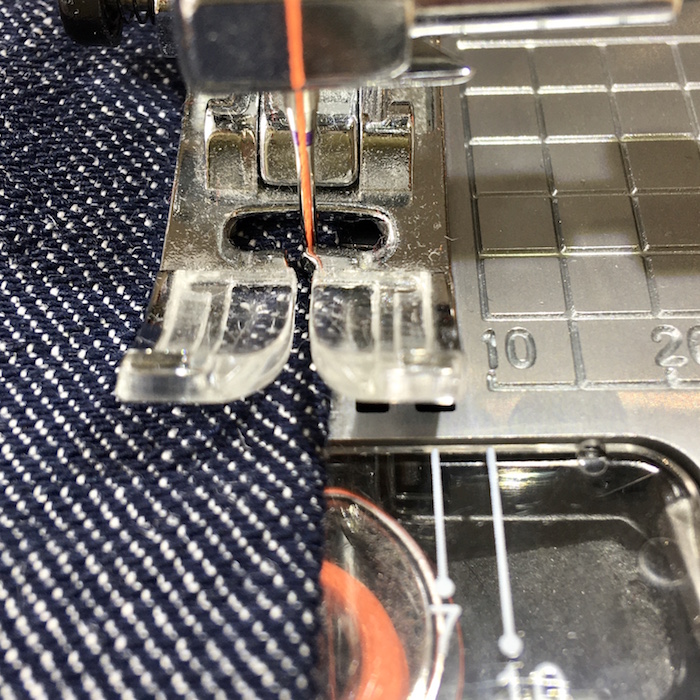
  • Set your stitch length slightly longer than usual to around 3mm, a longer topstitch length will help keep your stitches neater and straighter looking.
  • A matching coloured thread will be much more forgiving of any wobbles than neon orange!
  • Keep the trouser leg folded with RSU and position your needle 1.5-2mm (1/16″) from the folded edge.
  • Edge stitch all the way along the crease. I prefer to use my regular presser foot, but feel free to use an edgestitch foot if you have one.
  • Take your time. Go slowly and steadily to ensure your stitching is a straight as possible.
  • Press gently, the pintuck stands up rather than laying to either side.
  • Once both legs have their stitched crease, carry on and sew  your Simone trousers following the Maker Instructions.

A TINY PINTUCK VERSUS A BIG TUCK |

It’s important to sew a small pintuck. Visually it will look better but by sewing a permanent crease in the front we are actually reducing the width of the trouser and therefore the amount of ease in the width of the trouser. This means the garment measurement will be slightly smaller = the garment will be slightly tighter on the hips. It’s only a reduction of about 6-8mm in total so you won’t really notice but the bigger the pintuck the more you are reducing the trouser width by. You can see the difference in sizes in the photo above. The trouser leg at the bottom has been stitched with our small pintuck but the leg on top has been stitched using my machine foot as a guide and is stitched 7mm from the edge. You can see that’s quite the difference in width and will be doubled over 2 legs – a total of 2.8cm smaller in fact.

WAISTBAND NOTES |

It’s also worth noting that technically, your waistband pattern will now be a smidgette longer than needed as you have just removed a whisper of width from the trouser front. If your fabric has a little ‘give’ you probably won’t notice; it wasn’t an issue at all in this denim. But some fabrics are very solid and stable and can be less accommodating! If you do find your waistband casing pattern is a tiny bit bigger than your trouser body you could take a bigger seam allowance to close the waistband seam. Alternatively, ease the waistband onto the trouser body, it’s going to be elasticated so will look just fine.

I’m really excited to see your Simone Set, don’t forget to share your makes with us on Instagram.

Tag @mavenpatterns and we will share them with all our lovely Maven Makers!


Posted on

Introducing our new pattern – The Simone Set

Hello and welcome!

We are so excited to share our latest pattern with you … The Simone Set!

The Simone Set is a two piece ensemble that will take you from the (home) office, to the school run, a kitchen disco or even for sleeping… just about anywhere really!

The camisole top and the trouser set work perfectly together creating a pulled together, coordinated look with ease and they work equally hard as a stand alone pieces too. Each piece will become a wardrobe staple in their own right as invaluable mix and match separates to wear with your other makes. The Simone Set offers flexibility allowing you to make different size for your top and your bottom.

The delightful camisole top has bust darts, a gently shaped hem and two strap options. I hope you love the double rouleaux straps or the wider strap option (for a little bra strap coverage) as much as we do.

The trousers are slim fitting with front slant pockets and an elasticated waist and a drawstring. They are smart enough that you can wear these with confidence from the bedroom to the boardroom (if those are even separate things anymore), the perfect foundation for your holiday wardrobe (when that’s a thing again) or you could size up for a more relaxed fit and a spot of very glamorous lounging.

Designed for light to mid-weight wovens, you will be able to create many looks with this versatile pattern from Luxe-look Loungewear in a silky fabric such as bamboo silk, viscose, cool and smart in linen or create a co-ord set in a bold matching print for a faux jumpsuit look. Other suitable fabrics could be double gauze, soft flannel, ponte de roma, rayon, crepe de chine, cotton lawn, chambray.

The Simone Set is currently available in PDF only, but we hope to print her soon.

The Simone Set is and Advanced Beginner pattern and is available in UK sizes 8-22 (see listing photos for more detailed info).

As always, we will be donating 20% of the profit from our launch weekend. The charity we have chosen for the Simone Set is The Birmingham Children’s Hospital Charity who do such incredible work for children and families all over the UK.

Happy Sewing from Maven HQ