Posted on

The Beginners Sewing Summit – make a midi skirt with me!

Sew an Easy Midi Skirt with me!

We are teaching at the 2021 Beginner Sewing Summit, which is our first ever online sewing class! Come and sew an easy midi skirt with myself and Eve, it’s a great beginner project or take a look at one of the other classes – there are over 40 to choose from! Best of all the classes are FREE to watch May 3rd- 7th 2021, you could learn the basics and new skills while completing fun projects like fashion, home decor, and cute accessories.

UPDATE: Sewing Summit 2021 is over but this online class is still available to purchase with The Sewing Summit via the link below.

AD/AFFILIATE LINK: If you decide to purchase the lesson with Rebecca Page and the Sewing Summit through our link, we receive a commission.

CLASS DESCRIPTION | In this class you will learn to make a simple jersey midi-skirt with an elasticated waistband.

You will learn how to take your measurements, cut your fabric and create an easy to wear skirt to fit you and that you’ll love wearing. As sewing with knits can sometimes be a bit daunting, we’ll talk you through the whole process!

All of this information is in the class video but we thought it would be nice to have somewhere to refer to!

FABRIC REQUIREMENTS | 

Any knit fabric! We recommend using a cotton or modal knit fabric with at least a 5% elastane content. The elastane will help your skirt retain its shape.

SKIRT PATTERN |

The skirt doesn’t need a pattern! It’s just a rectangle that we can mark directly on the fabric and cut. The amount of fabric to buy will be based on your overall length of the skirt.

  • For simplicity we’ve used inches in the video but have added metric conversions below (we’ve rounded them up to make sensible measurements rather than exact conversions!)
  • SIDE SEAM ALLOWANCES | INCHES: we have allowed ½” seam allowance to join the side seams (so add 1″ seam allowances extra to width). METRIC: if you are team metric allow 1.5cm to join the side seams (so add 3cm seam allowances extra to width).

To work out your fabric requirement follow the guides below.

The amount of fabric to buy will be based on your overall length of the skirt plus some allowances.

When purchasing your fabric it’s a good idea to purchase extra fabric to allow room for cutting out and any shrinkage as you will need to prewash your fabric before before you begin.

LENGTH: Take your ideal skirt length and add 5″ (13cm)  to calculate the length of your fabric required. Not sure how long you want your skirt? Measure something you already own or allow a little extra and it can always be cut to length later.

WIDTH: Take your hip measurement, at your widest part, and add 1″ (3cm) for seam allowances to calculate the width of your rectangle.

  • For example – if you have a 40″ hip – you will need 1 rectangle measuring 41″ wide (40″ + 1″ seam allowance).
  • And in metric – 105cm wide rectangle (102cm wide + 3cm seam allowances)

Not covered in the video but…should your hip measurement be more than the width of your fabric you will need to cut 2 rectangles so buy twice the skirt length. Your skirt will have 2 side seams, just use the same method we describe in the video to join your seams. As you have 2 seams that’ll give you the option to have a split in each seam or on just one seam, whichever you prefer! The formula to calculate the width of each of  your rectangles will be – half your full hip measurement and add 1″ (3cm) extra as seam allowances.

  • For example – if you have a 66″ hip – you will need 2 rectangles measuring 34″ wide (33″ + 1″ seam allowance).
  • And in metric – if you have a 168cm hip – 87cm wide rectangle (84cm wide + 3cm seam allowances)

You will also need |

  • Polyester sewing thread.
  • Ballpoint, stretch or jersey machine needle.
  • 1″ (2.5cm) wide elastic – enough to wrap around your waist with an overlap (any width between ¾″ – 1½” (2-4 cm) will be fine if you have it in your stash!)
  • Safety pin
  • Marking tool – chalk or fabric pen
  • Ruler
  • Plus, the usual sewing equipment – sewing machine, scissors, tape measure, pins, iron

Looking for some tips on sewing with knit fabrics? Check out our tutorial here!

AD/AFFILIATE LINK: If you decide to purchase the lesson with Rebecca Page and the Sewing Summit through our link, we receive a commission. Thank you!
Posted on

The French Dart | Making more with your pattern

As we come to the end of our French Dart week I wanted to share a few more ideas to help you make the most of your pattern.

One of the most pleasing things to discover about The French Dart pattern was just how versatile it actually is as a pattern. I spoke early in the week about how perfectly The French dart pattern has worked as a jumper in cosier fabrics. But it also works beautifully in a lighter weight cloth for those warmer days.

Ah…warmer days…how I day dream of thee…

THE BUTTON BACK HACK |

I deliberately included the 3 sleeve options to give lots of choice for styling your FDS, but did you know it works so well as a sleeveless pattern too. These pictures are of our button back hack, but I did nothing to the armhole except bind it to finish. I was, of course, careful not to stretch it and I would suggest you do a quick toile to make sure you are happy with the armhole shape – is it high enough, or too high, is it gaping, are you happy with the shoulder width?

It does make a very elegant summer top in this lightweight linen.

THE FRILL SLEEVE HACK | 

FRILL HEM PATTERN HACK_MAVEN PATTERNSAnother way to use your pattern differently, would be to leave the collar off and bind to finish. There are bonus instructions in the pattern to show you how. This is a great option if you are short of fabric!

The Frill Sleeve hack gives you yet another sleeve option.

THE LINING TUTORIAL |

The French Dart has been made in so many different fabrics now, but for those special fabrics you may want add a lining. I certainly did for this gorgeous barkcloth*. Use our free lining tutorial to make yourself a lining pattern.

*The barckcloth is called ‘wavelength’ part of the In Theory collection by Cloud 9 fabrics, but sadly has been out of print for some time.

LINING TUTORIAL_MAVENPATTERNS_06


Another very useful tutorial is The 3/4 sleeve tutorial, that is certainly my most worn sleeve length! You can find all the French Dart Shift tutorials HERE. I’m sure to add a few more in the future so check back every so often!

This brings The French Dart Week to a close but we wanted to say a big thank you for taking part,

sharing your makes and for your support of our tiny pattern company.
Happy Sewing to you, my friends!

| #MAVENMAKERS |

Have you made a cosy French Dart, either a top or a dress?

We would love to see it! Old or new, share (or re-share!) them with us on Instagram Remember to tag us @MavenPatterns #FrenchDartMaven

Posted on

The French Dart Week | Jumpers

We have more ideas to share today to encourage you to get the most from your French Dart Shift pattern! It’s been so chilly here in the UK for the few weeks (it’s supposed to snow here ANY SECOND according to the weather app) that I’m quite delighted to share with you my love for the FDS as a jumper pattern.

I really like the idea of a pattern being an all rounder, so it could be a key piece in your wardrobe. What I hadn’t expected was just how creative everyone would get with the pattern and suggestions from a couple of Maven Makers led to 2 tutorials – one for a boiled wool French Dart and one for a knit French Dart. The boiled wool version really was just an experiment to see if it would work. And yes it did! It’s been one of my most worn items of clothing and actually does makes the perfect jumper!

When shortening to make a top or jumper I just chop the extra length from the bottom of the pattern. Nothing fancy – just remember to trace off your pattern first to keep your original in tact (or you can reprint a PDF), add a hem allowance and check that the hem line will run together in a nice smooth line when you join the side seams. I like my length to finish at about my hip but I sometimes cut them a bit shorter after making them, I find different fabrics need different proportions and I’ll just try them on before finally hemming them.

THE SWEATSHIRT  |

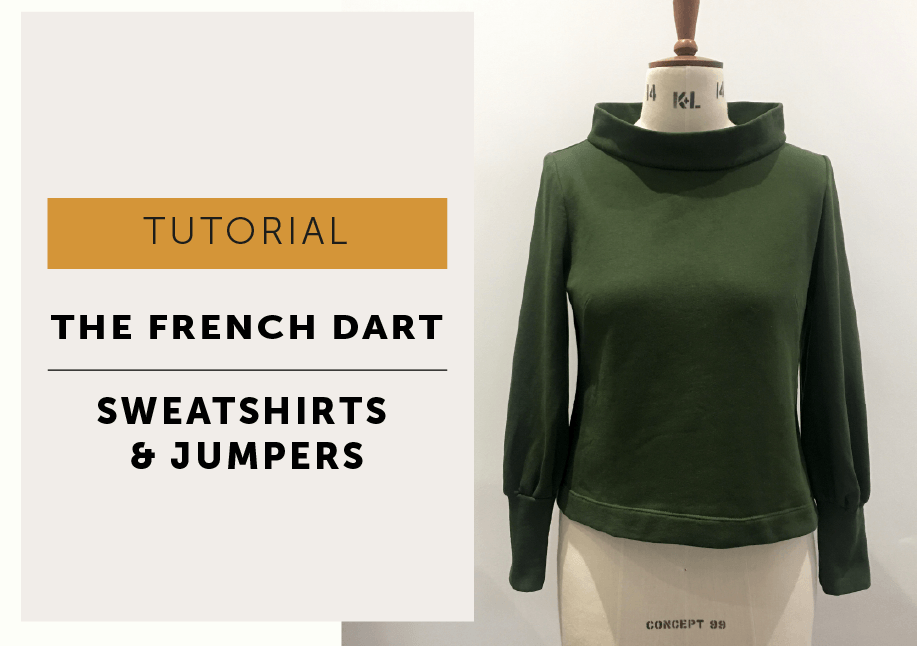
A recent make of mine was this sweatshirt in a Khaki green Mind the Maker brushed sweat shirting fabric  which became a French Dart & The Somerset pattern hybrid. Which, I must say, has been lovely and cosy for lockdown wear!

As the fabric was quite thick I decided to make the collar half the depth, so it doesn’t roll over but stands up rather nicely. And I decided at the last moment to topstitch the shoulder seams to hold them flat, again as the fabric was bulky but it makes a nice little detail. Other than that the construction was quite straight forward. I did not tape or stay stitch the armhole as the fabric was quite stable, but I did tape the neckline as usual. I often leave the darts out of the back when I’m making tops with The French Dart pattern, you still get a nice shape but slightly boxier. If you are not sure wether to dart or not, mark them on the back (use something non-permanent to mark them!), make up the body and see how you like the shape without them. That’ll still give you the option of sewing them in if you change your mind.

The sleeve is basically a mash-up of the FDS bishop sleeve (version 3) and The Somerset bishop sleeve. I followed the Somerset Maker instructions to attach the cuff, but found this fabric didn’t really like the shirring elastic method, so I went old school and pulled up gathering stitches. So far, at the time of writing, so good with no cracked stitches during wear.

WARNING | This is how I did the sleeve but it comes with a warning! It was never intended as a tutorial. I was just making a top for me because it’s a bit cold…so this method is best described as ‘quick and dirty’ or as my Dad would say ‘a proper bodge job’. So you follow at your own discretion and perhaps don’t try it on a really expensive fabric the first time.

  • Trace off your French Dart sleeve pattern before you begin to keep original in tact.
  • On both sleeve patterns draw a line straight across at the underarm.
  • Fold the Somerset sleeve along this line, and fold the sleeve head out of the way.
  • Place the Somerset sleeve on top of the French Dart sleeve.
  • Line up both patterns along the underarm line that you drew and centralise at the grain line.
  • Check you are going to be happy with the sleeve length as is, if you want it longer slide Somerset down a bit further. Don’t forget to consider the depth of the cuff.
  • Mark in the hem line of The Somerset pattern and a little bit of the side seam. It should be the same (mirrored) either side of the grain line.
  • Move the Somerset pattern out of the way and join the hem to the underarm point for your size with a straight line.
  • You’ll need to use the cuff pattern from the Somerset.
  • Good luck!

BOILED WOOL | 

MAVEN PATTERNS_FRENCH DART SHIFT_BOILED WOOL

Like I said before, this one has been a really good make. All the details of The Boiled Wool French Dart can be found HERE. It was written in 2018 and it’s stood the test of time as I’m actually wearing it right now!

KNITTED FRENCH DART |

The French dart pattern has been made quite a few times in knit fabrics too. Ponte de Roma has been especially popular as it makes up easily and is quite stable for a knitted fabric while being very easy and cosy to wear. #Secret Pyjamas. Bear in mind the pattern won’t give you a body-con style fit in jersey it’s more about comfort.

This is one I made in a knit that I bought from Anna at Eternal Maker. It is a 100% cotton jersey knit. For this one I cut the collar as the pattern.But first,  I did fold the fabric to ‘mock’ the collar, creating 4 layers, before I cut out to see if I thought it would be too bulky.

The The Knitted French Dart tutorial can be found HERE & The 3/4 length sleeve tutorial can be found HERE.


| #MAVENMAKERS |

Have you made a cosy French Dart, either a top or a dress?

We would love to see it! Old or new, share (or re-share!) them with us on Instagram Remember to tag us @MavenPatterns #FrenchDartMaven

and keep your eyes open for our PDF giveaway this week on Instagram!

Posted on

Creating Panels in the French Dart | by Jen Hogg – part 2

PAID POST | This article was  written by Jen Hogg after I saw her French Dart Hack on Instagram. I have paid Jen for her time, skills and effort, but all opinions are her own.

This part 2 of Jen Hogg’s panelled French Dart Hack!

I think we are all being about more thoughtful about our makes with a view towards sustainability and being more purposeful with our sewing. And the great thing about the panelling hack is it’s an excellent way to use up those smaller, left-over pieces of cloth. Think creatively and you can create something truly unique. If you are looking for a little inspiration take a look at the SewOver50 Instagram page for their March challenge and the hashtag #so50PatternMixing.

Over to Jen!

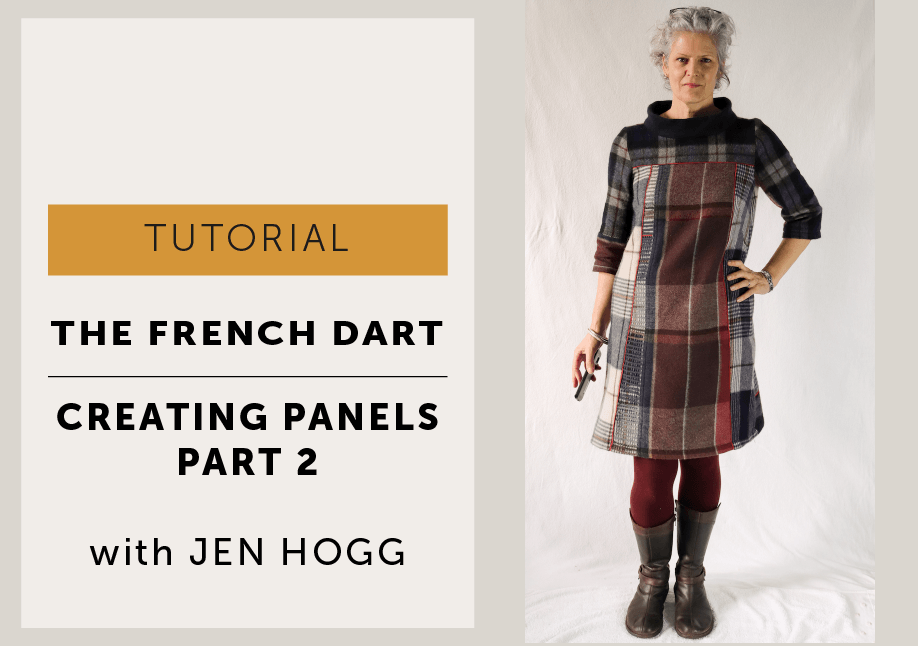
Version 5 | cashmere surplus, in panels and patchwork

The method I used to hack the Nani Iro version also works really well with surplus. I use a lot of cashmere surplus, and the pieces I get are usually small or an odd shape. I’m working on another French Dart dress using different patterns in the panels.

Here it is as a work in progress. I’ve added red bias between the panels, to add a bit of cohesion overall but handily it also shows where the panels of my hack are. It’s the same hack as the Nani Iro version, only I missed out the pockets on the front because the cashmere is too soft to cope with them.

In this version, though, my centre panel is also made up of two different fabrics. This time I joined the fabric pieces together before I cut out the pattern shape. Basically you make a patchwork of fabric first, then cut out the dress pattern as usual. There’s less control over how the fabrics are joined together this way, but that suited me for this panel.

In these photos you can see the red bias which delineates the separate “Nani Iro” panels.

But look at the fabric to the right of the red tape, that’s made up of two pieces of scarf surplus, a paler fabric right beside the tape overlaid with the blue / red fringed fabric. I stitched them together with 2 lines of stitching (yellow lines). Then the fringe on the blue / red fabric was sewn down to add some texture (green lines). It felt like a shame to cut it off and I’m toying with the idea of keeping some fringing at the sleeve cuffs, though I might change my mind!

When it’s finished I’ll share this dress on Instagram, under my own name @jenerates but also to join in with the @sewover50 challenge #so50patternmixing.

UPDATE: Jen has kindly shared her finished pictures with us!

Thanks Jen! What a wonderful & inspiring way to use up surplus fabric! The first part of this tutorial with the details for the pattern hack can be found HERE.

| #MAVENMAKERS |

We would love to see your French Darts! Old or new, share (or re-share!) them with us on Instagram Remember to tag us @MavenPatterns #FrenchDartMaven

All photos by Jen Hogg 

Jen Hogg lives in Glasgow with her husband and dog, and has two children at university. She now runs a small business selling the Jenerates sewing ruler and writes for a variety of magazines and blogs. A former solicitor, Jen reached the semi-final of The Great British Sewing Bee Series 5 (2019). In addition to sewing, she enjoys knitting, crochet and many other textile crafts, as well as silversmithing, photography and generally making things. You can follow Jen on Instagram and Facebook @jenerates, and at www.jenhogg.co.uk