Posted on

Fabric Shopping in Japan

A stack of Japanese fabrics - fabric shopping in Japan

Japan, Tomato & Textiles

This isn’t so much a guide to fabric shopping in Japan, more of a show and tell. A gentle meander with me, if you will.

Purple Kimono in Tokyo National Museum-fabric shopping in Japan with MAVEN PATTERNS
Purple Kimono In The National Museum, Tokyo

As you can imagine, we saw some beautiful textiles, they kind of just appeared as we were wandering about. I didn’t take photos of everything. It feels a little intrusive in some cases, especially when a person is just going about their daily life. Not everything is to be photographed with a social media strategy in mind (she says as if she has one). Somethings are supposed to just be quietly enjoyed.

But, I did promise to tell you about my visit to Tomato Fabrics, the famous fabric shop in Tokyo. 

Nippori Fabric Town

Nippori Town is the fabric district in Tokyo and home to many fabric, haberdashery and button shops. We walked there from the Tokyo National Museum and it took about half an hour meandering along. If you are going to Japan it’s actually quite easy to find your way around. We decided to hire a WiFi box, which we pre-booked and collected from the airport on arrival. And you just pop it back in the post box as you are leaving. It meant we had WiFi everywhere, even at Mount Fuji. We used google translate & google maps to navigate, it even tells you which underground platform to stand on. Nothing is fool-proof but it was pretty good!

Anyway, back to fabric town …

We got there quite late in the day after a full day of sightseeing. We’d almost skipped it completely. We had only been in Japan 2 days and were still finding our bearings a little bit. And there had been an earthquake on the first night so all in all quite eventful! But we toddled off and found it. I’m so glad we did.

Fabric Stash - a mixture of gren, black and pink floral and denim fabrics stacked on top of each other from NIPPORRI TOWN JAPAN- TOMATO FABRICS

The short version is it lived up to the hype and was hyperventillatingly, gloriously, filled with 5 floors of fabric joy! You pay on each floor, so there is no need to carry the bolts up and down the stairs. I think it’s a ploy to make it easier to buy more fabric! There were actually about 3 or 4 Tomato shops along the street. I unselfishly took one for the sewing team and visited quite a few.

You don’t really need a step by step guide of navigating a fabric shop. We all have experience in that department. I will say, I’m actually very fussy about the fabric I buy. I am very happy to leave empty handed if nothing speaks to me.

It spoke. Well, more shouted.

I came away with 12 metres, which I happily carried around for 2 weeks. So my advice is save room and take a bag with you!

Mokuba Ribbons

While in Tokyo, we also visited the Mokuba showroom. Mokuba are the designers of the most beautiful Japanese ribbons. If you ever wondered where the Couturiers and Designers get those beautiful trims and ribbons from – this is the place. Richard has been obsessed with these ribbons ever since he found them in our Kleins Deadstock Haul

Kyoto

We did happen across a costume museum in Kyoto (not The Costume Institute which would have been a really good one to go to!) when we were actually looking for a castle in completely the opposite direction. The Costume Museum was a series of 1/4 scale accurate dioramas depicting tales from 400 years ago. The level of detail was truly astonishing. There were also some glorious (full sized) Kimonos like this green & orange one. I hadn’t realised there could be so many layers to a Kimono. They had up to 12 layers, with the matching and toning colours visible at the sleeve and neck.

Once you start looking …

We found that textiles just found us as we meandered about. From the rope textile display that drew us into a building. I mean turns out it was actually an office block that we just had a little wander around. Hey-ho!

We came across street art. A gallery with a huge window full with a piece made of used tea bags in Hiroshima. Unfortunately, I don’t have the name of the artist. A Kimono forest. And of course actual beautiful Kimonos.

Orange Embroidered Kimono in Tokyo National Museum-fabric shopping in Japan with MAVEN PATTERNS

There is still so much that we didn’t see. I’d like to see an Indigo Dye Studio or farm and we didn’t even begin to explore Denim in Japan. But it’s nice to think we might get to go back again.

join the gang! NEWSLETTER SIGN UP!
Posted on 4 Comments

How to Print and Assemble a PDF Sewing Pattern

Learn How to print and tile a PDF sewing Pattern at home With this free Printing tutorial

This Maven Patterns tutorial explains how to print and assemble PDF sewing patterns at home. It details essential steps like testing print settings, trimming pattern tiles, and taping them together for accurate alignment. Additional tips include saving resources by printing selectively and using Adobe Reader for proper scaling.

Learn How To Print and Tile a PDF Sewing Pattern at Home.

The joy of PDF sewing patterns is that they are instant. PDF sewing patterns are also known as digital sewing patterns. They are designed to be printed at home on either A4 or US letter sized paper. They are made up of several pages (tiles) that are joined together to make a complete pattern. Once they are downloaded you can print as many patterns as needed. No problems making different sizes, or losing a pattern piece, no more fragile tissue paper! You can just re-print!

Just pick your PDF sewing pattern and download it. Now, you can start to use up that stash of fabric that is slowly threatening to take over the house. Admit it you’ve got one! I’ve got one, we’ve all got one…and if you don’t have a stash of fabric…you want one!

Putting your PDF sewing pattern together is a very simple process. Grab a cup of tea and follow this Printing a PDF pattern tutorial…

IMPORTANT UPDATE

  • We now include an A0 file with each PDF pattern. So you can print at a copy shop on a wide format printer.
  • Can you only see 2 pages to print at home? You have probably opened the Copy Shop File by mistake. Open and Print from the file that is included in with the Maker Instructions.
  • All patterns from The Somerset (pattern 08) onwards, the pattern and the instruction files are separate.
  • Save ink and paper. You will find a list of page numbers in the instructions so you can just print the pages you choose.

YOU WILL NEED


  • A printer
  • A4/US letter paper
  • Paper Scissors
  • Tape (transparent magic tape is the best – doesn’t yellow with age, it’s invisible, you can get pins through it)

How to Print Your PDF pattern

STEP 1

Download your pattern and save it to your computer.

Maven Patterns are also available through Etsy, and Etsy have a guide to help with downloading digital items.

To open your digital file you need an Adobe Reader, which you can download for free.

Please note: You can set your default PDF reader to one of your choosing on your computer. Apple computers often default to opening PDFs with ‘Preview’. Your pattern needs to be printed from Adobe Reader to make sure it prints at the correct scale.

Open your document and read it first!

You will find a set of instructions which include a cutting guide, fabric requirements, illustrated Maker Instructions and a glossary of terms as well as your pattern. It is not necessary to print everything. Save ink and paper by just printing the pattern and viewing your instructions on screen. You will find a list of page numbers on the CONTENTS page.

How to print and tile a PDF sewing pattern, printer settings image

Make a note of the page number for THE PRINT TEST SQUARE, this is ALWAYS the first page to print. 

A PRINT TEST SQUARE is included on all digital sewing patterns. It is important so you can check that your printer is printing your pattern accurately. My patterns have a square 10cm x 10cm / 2″x2″ square. Check the size for different pattern designers – it will be clearly marked.

STEP 2

How to print and tile a pattern: Adobe Acrobat screen shot to show printer settings

IMPORTANT: Ensure your print settings are correct, the pattern must print at actual size or it won’t fit you! These print settings all vary a little , on my computer (a PC) I use these options, yours may be different:

  • Select your printer in the top left corner.
  • PAGE SIZING AND HANDLING: CUSTOM SCALE: 100% (also might say ACTUAL SIZE/ SET SCALING TO 100%/ TURN OFF SCALING),
  • PAGES TO PRINT: PAGES and tap in the page number of the print test square (19 in this case),
  • ORIENTATION: AUTO/PORTRAIT LANDSCAPE to keep your pattern tile centralized.

STEP 3

Print the TEST SQUARE page.

How to print and tile a PDF sewing pattern, a print test square image

Check the square measures 10cm x 10cm, if it does great – you’ll print an accurate pattern. If it doesn’t go back and fiddle with the print settings again.

Troubleshooting

  • Check you are opening with the latest version of Adobe Reader.
  • If you’re using a Mac and your pattern is opening in ‘Preview’, the default reader. Reopen in the latest version of Adobe Reader. FREE FROM HERE.
  • Give your pattern time to download completely. Save it somewhere safe that you can find on your computer.
  • Be sure to print from the SAVED version.
  • Printing a pattern that is open from your internet browser will cause the pattern to not print out correctly.

Check the printer settings

  • ‘Actual Size/Scale 100% should be TICKED
  • Make sure:  ‘Choose paper source by PDF page size’ is UN-TICKED.
  • Still not printing OK? Click ‘ADVANCED PRINTER SETTINGS’ then click “PRINT AS IMAGE”
  • It is important to use the latest version of Adobe Reader.
  • Make sure your printer is set to print on Auto portrait/landscape.
  • If you are using Apple mobiles that might be the problem. They won’t download and open a pdf file without a pdf app installed.
  • If you still have a printing issue; it’s time to check your printer drivers are up to date

Tiling Your Pattern

STEP 4

Once you are happy with your test square, you can print your pattern. Refer back to the contents page so you print the right pages. Soon you will have a stack of pattern tiles in front of you.

How to print and tile a PDF sewing pattern. how to trim the tile page of a PDF sewing pattern

The grey square is the outside edge of your pattern tile. Trim away the excess overlap on two sides. For absolute accuracy cut on the outside of the grey line, so you can still see it. Carry on until all the tiles are trimmed.

STEP 5

How to print and tile a PDF sewing pattern. A tile layout diagram

Each tile has a large grey number in the centre. These run from left to right so you can put your tiles in order. A TILE LAYOUT DIAGRAM is included in the instructions as each pattern will vary a little.

STEP 6

How to print and tile a PDF sewing pattern. taping a PDF pattern together

Tape or stick tile 1 to tile 2. Line up the triangles and the pattern as you go. DON’T OVERLAP THEM just butt the grey frame edges next to each other. I always use transparent magic tape for patterns. Sadly, it’s a little TOO transparent to show up in a photo…hence the lovely washi tape! Some people prefer a glue stick. There is no right or wrong, it’s just a preference. Keep working your way across row 1, and then do the same for row 2.

STEP 7

How to print and tile a PDF sewing pattern. joining a pdf print sat home pattern together

Join rows 1 and 2 together. Continue until your  pattern is taped together, using the tile layout diagram as a guide.

STEP 8

How to print and tile a PDF sewing pattern. cutting out a pattern

A whole tiled pattern can get a little unmanageable in one piece. Roughly cut out completed sections of the pattern as you go. Once you decide on your size, carefully cut out each pattern piece ready to make your garment.

And that, my sewing friend, is it!

Soon, you’ll be printing your PDF sewing pattern with confidence and tiling your sewing pattern together like a professional!

Happy sewing! Mrs M x

join the gang! NEWSLETTER SIGN UP!
Posted on 1 Comment

How to Measure a Curve on a Sewing Pattern

Learn How to measure the curve of a sewing Pattern with this free sewing tutorial

Now, this might seem a little obvious to everyone, I’ve hesitated even posting and calling it a tutorial. But following conversations with my youngest daughter (15, studying textiles at school) and a friend of mine (long time sew-er), neither of them knew this shortcut – and to be honest I only discovered it when I was working after 4 years of studying fashion! It’s the easiest and most straightforward way I know to measure necklines, measure a sleeve head, armholes (or the armsyce if you want the industry term – I’m popping it in here for the benefit of Sir Google).

So on the off chance that someone, somewhere, needs to quickly measure the curve on a sewing pattern …

HOW TO MEASURE A CURVE

There are various gadgets and measurement tools around to measure curves on sewing patterns – flexible rulers and wheely things, and if they work for you, excellent! The great thing about sewing is there is always more than one way to solve a problem.

But, you see I’m not a great one for gadgets, so for this method, you’ll only need the basic pattern making tools – a tape measure, a pencil and a ruler.

Why would I need to measure a curve on a sewing pattern?

If you need to alter a pattern to fit you, you may find you need to adjust the armhole or neckline and then you are going to need to make sure the collar or sleeve fits again. For that, some pretty accurate measuring will be needed!

Here’s the method, I’m going to pretend you’re measuring an armhole.

How to measure a curve tutorial: Maven Patterns

Step 1:  

Before you measure the curve, you will need to use your ruler and mark the correct seam allowance accurately on your paper pattern in pencil. This represents your stitch line when you stitch your garment together. It’s this line, not the outside edge of your pattern that needs to be the same measurement.

How to measure a curve tutorial: Maven Patterns

You don’t need any Fancy Curve Measurement Tools …

Step 2:

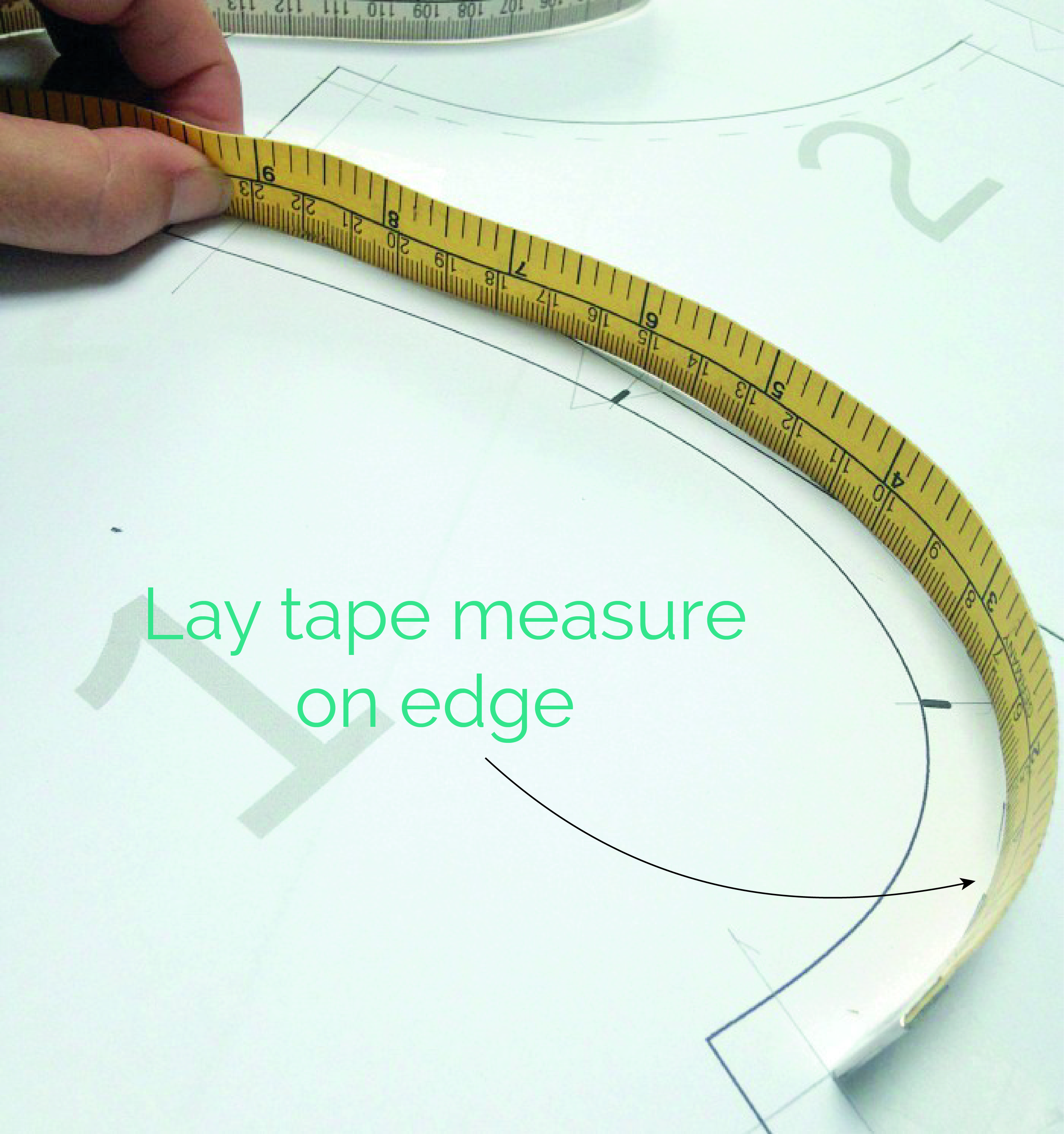
Next grab your tape measure. Here’s the trick. Stand it up on its SIDE and walk it EXACTLY along your pencil line to measure that entire length of armhole – EASY! Make a note of the measurement, I always write them straight on the pattern piece.

  • Now use the same method to measure the curve of your sleeve head. Remember it will be bigger than the armhole as it should have some ease in it.
  • You can see here that I don’t include the side seam allowances when I measure. As a general rule when measuring your pattern the trick is to just be consistent. It’s really easy to get confused and include the seam allowance in the armhole and then not on the sleeve head or sleeve cap. And then it takes a while to work out why the pattern pieces don’t fit together!
  • When I’m measuring a sleeve head to check it fits into the armhole I don’t measure the whole sleeve head in one go.
  • I’ll either measure from the underarm seam to the top of the sleeve head, where it would align with the shoulder seam. And then the other half of the sleeve head.
  • Or if I want to check the position of the notches I’ll draw a line from each notch to intersect the seam line. Then I’ll actually measure in-between each notch so I can check the notches are all in the right place and will match up at the same time as checking the sleeve will fit.

That’s it! It can take a little practice to do it accurately, but who doesn’t love a low (no!) tech solution to a problem?

Happy stitching and curve measuring,

Mrs M x

Posted on

Christian Dior ‘Designer of Dreams’  – TOKYO 

Green Kimono style Dress by Dior from The Designer Of Dreams Exhibition in Tokyo, Japan

Dior in Japan

So we are back from a wonderful trip to Japan! This trip has been on our wish list forever. We were about to book flights just as Covid took hold. But as Japan is now fully opened up to tourists, with all restrictions being lifted the day before we arrived, off we went on an adventure!

We did a bit of a tour using the Shinkansen (bullet) train starting in Tokyo, followed by Fuji, Hiroshima, Osaka , Kyoto before heading back to to Tokyo. And yes, the trains were every bit as efficient as you’d imagine!

Of course, it was a hugely inspiring trip. I’m a big fan of cities, much more than the countryside and Japan did not disappoint.

I thought you’d enjoy some of the things we saw. I’ll get around to posting them on Instagram too at some point. You can breathe a sigh of relief, I’m talking textiles, fabric shops and The Dior exhibition. Maybe some architecture and manhole covers. I’m not planning on boring you with my holiday photos, though the nodding deer were fun. There are so many photos and videos I actually had to buy extra storage on my phone!

I’m starting off strong with the wonders of Dior and the Christian Dior ‘Designer of Dreams’ exhibition. I think everyone can appreciate and enjoy the beauty of this exhibition. It’s been to 7 cities to date. I’ve seen it in Paris (thanks to very kind friends) and in London so this was my third time. I have enjoyed how the exhibition has reflected and changed in response to each place. You’ll see below the Dior and Japan room was made from wood and washi paper.

Lost in Tokyo.

Honestly, we had to practically run around as our ticket was for 5pm, and closing at 6pm, but it was our second day in Tokyo, so got a smidge lost!  If you are ever travelling with me and I say ‘we’ll just get on this subway train and get off at the next station if it’s going in the wrong direction and come back’. Do not listen to me – turns out wasn’t the subway but a local train going in the wrong direction out of Tokyo….

Anyway, we made it to see a little Dior in Japan, before closing and it was wonderful. I recognised some pieces from the London exhibition. The setting was designed as a tribute to Japanese culture by architect Shohei Shigematsu and the aim of the Tokyo exhibition was to explore further the strong links between Japan and Dior. I’m just going to share pictures but you can read more here at WWD, Museum Of Contemporary Art in Tokyo, Dezeen and DesignBoom

And the pièce de résistance … The Dior Ball was an oversized mirrored ‘staircase’ that had an impressive light show. The idea was that it was a ‘long processional staircase’ similar to the ones that lead up to traditional shrines and had a mirrored roof so seemed to go on into infinity.

Of course, my favourite room was The Toile Room. I think I’d be very happy if I never left there.

*updated to add – I’ll have to do a part 2 as I’ve just found more photos of some of the other rooms!


join the gang! NEWSLETTER SIGN UP!