


The Maria Apron is one of our most popular patterns, and named after Maria Thomas herself!
Join us for a fun day of sewing, with expert tuition and make your own Japanese inspired Makers apron.
Our apron has large pockets & cross-over back straps, she is so perfectly practical!
10 – 4 pm, Sunday 9th September 2018, Leek Wootton, Warwickshire.
Advanced Beginner.
You should be familiar with your machine and have completed a couple of simple projects.
Maria Thomas and Mrs Maven have been longtime friends, after bonding over a love of denim and making.
 Maria Thomas Textiles –
Maria’s work focuses on rehousing everyday objects that have a specific association or meaning to her. Notions of motherhood, shopping lists, food wrappers and graphic packaging – offering assistance to domestic chores – are carefully sourced, cut out and stitched before being absorbed into the fabric by patchwork and quilting techniques. Shaping memories and experiences into her own visual language Maria’s work is a response to the events of her daily life.
A love of fashion and sewing lead Maria to taking an ND in Printed Textiles at Mid-Warwickshire College, Leamington Spa in the late 1980’s. Keeping her connection with stitch she went on to Study BA Embroidery at Manchester School of Art and in turn completed an MA Textiles at the UCE in Birmingham.
Since graduating Maria has taught drawing, embroidery and printed textile design at degree and FE level. She has designed freelance for fashion, exhibited regularly and has work in public and private collections in the UK & overseas.
 Mrs Maven –
Sharon is the founder of Maven Patterns
Mrs M is old school, drafting each pattern by hand to create a balanced and considered garment – so you will want to re-use and re-create them again and again.
With a background as a professional ladieswear pattern cutter, creating clothes for many a high street store, Mrs M became slightly disillusioned with the high turn over of said fashions and the endless need to buy new. What was being lost, she felt, was the art of fitting and construction, and of clothes that made your heart sing, not just for a second, but every time you saw them. So she rebelled, quietly because she’s like that, but rebelled nonetheless and quit the rat race, deciding instead to make clothes that she loved to wear, that reflected her life rather than those generic fashions of the day. So she has dedicated herself to working at Granny’s table, to cracking open the spot and cross* and sharing her knowledge with you in the form of Maven Pattern
All workshops require payment in advance to confirm your place
WORKSHOPS ARE NON REFUNDABLE.
In the event of a cancellation, payments are non-refundable. If we can fill your place we will give you a credit for future workshops.
Our workshops are subject to a minimum number of bookings. In the unlikely event that we have to cancel or postpone your workshop due not have the minimum number of participants, or due to unavoidable circumstances we will give you as much notice as possible and an offer of an alternative date or a full refund will be made. We will not be liable for other costs, expenses disappointment that you may incur.
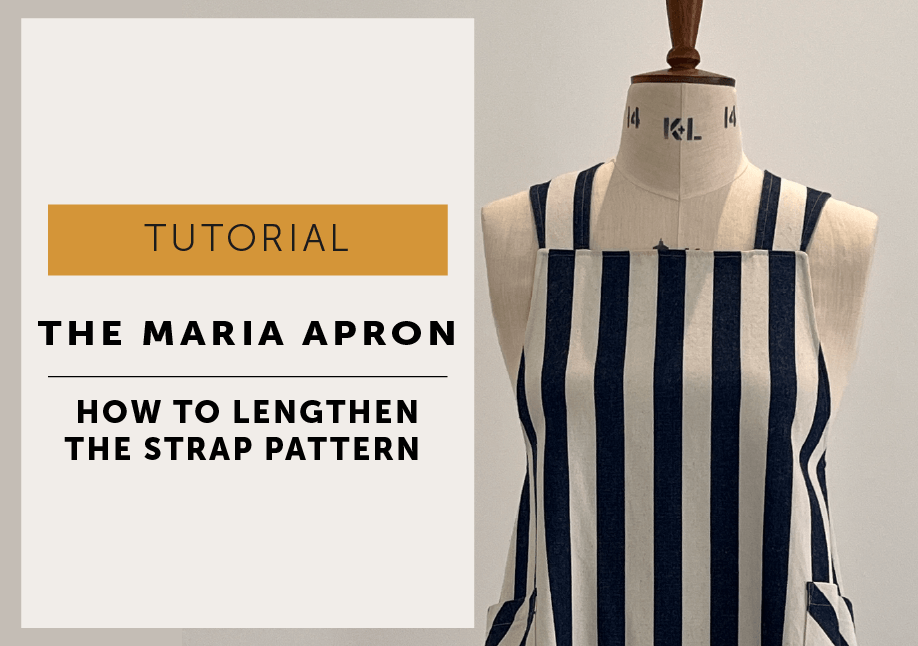
How do you lengthen the straps on the Maria Apron? That’s an easy pattern alteration and this tutorial shows you, step by step, how to add length to the strap pattern without changing the angled edge that attaches to the apron, so the pieces still fit together properly. It is a simple pattern adjustment that is especially useful if you want a little more room over the bust and shoulders, or prefer the neckline to sit lower.

This info actually appears in our How to Lengthen and Shorten a Pattern Tutorial, but I thought it might just be a bit easier if anyone was specifically looking for help in the apron straps department to give it its own little corner of the web.
This is a great method to use if you need to alter the length of the apron straps of The Maria Apron sewing pattern. It’ll show you how to lengthen the straps without touching the angled edge that attaches to your apron, so it still fits together! (And there is a cheeky pic at the end if you need to shorten a strap).
You may find you want to lengthen the apron straps if you have a bust that is bigger than a B cup (all Maven patterns are drafted for a B). Longer straps will give you a bit more room over the bosom and shoulders. The neckline of Maria is designed to sit quite high, a couple of ladies with a fuller bust have preferred the neckline to sit a little lower on them and chopping through the straps is an easy way to achieve that. Keep an eye on the underarm though, it’s quite a scooped shape, and make sure you are happy with where that is sitting on you. As always make a toile to see what works for you!

Draw an adjustment line horizontally across your pattern at a right angle to the grainline. If you want to add a lot of extra length (more than 2.5cm /1″) divide the amount evenly between 2 lines.

Cut along the adjustment line(s) and separate the pattern piece.
Place a piece of paper behind your pattern and tape the top portion of your pattern to it.

Extend the grain line. Draw a line parallel to the your adjustment line the amount you need to lengthen the pattern by.
Tape the lower portion of your pattern to the new line, matching up the grainline. Use a ruler and re-draw the seam lines so that they match up again.

You’ll notice you don’t have a smooth line at the edge of your pattern pieces, you’ll see that they stagger slightly. It’s quite usual after an alteration to need to blend the new lines together, adding a bit to one and taking a bit off the other.
Now do exactly the same to the understrap so they will be the same length!

Cut along the adjustment lines. Place a piece of paper behind your pattern and tape the top portion of your pattern to it.
On your pattern, draw a line parallel to the adjustment line the amount the pattern is to be shortened. Overlapping your pattern pieces, tape the lower portion of the pattern to the new line, matching up the grainlines. Re-draw the the seam lines so they match up again, in the same way as lengthening a pattern.

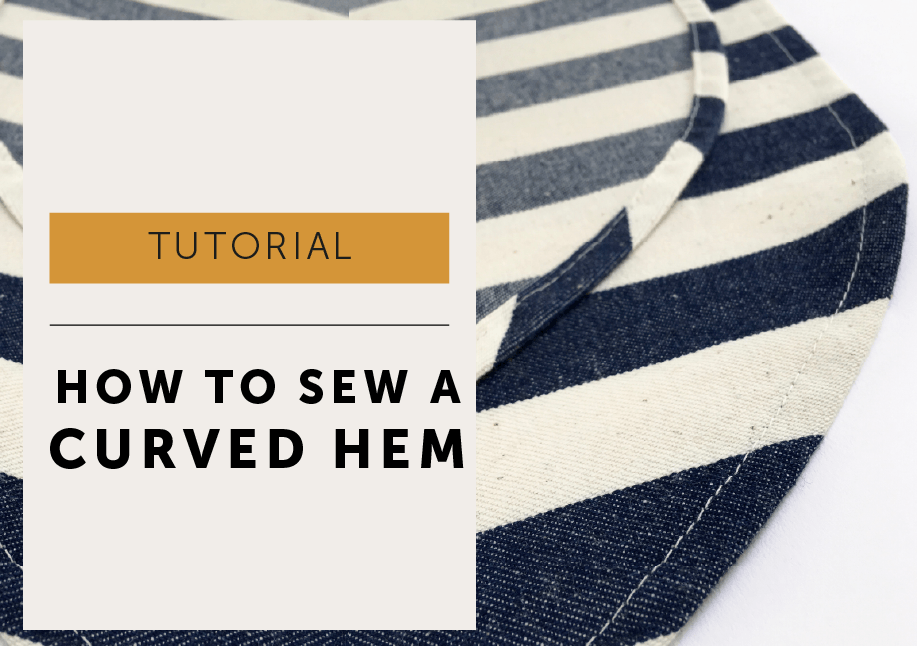
How do you sew a curved hem without puckers, stretching or uneven edges? In this tutorial, we guide you through an easy technique to get a professional finish on a double turned curved hem, helping curved hems sit smoothly and neatly with a clean finish. Whether you’re sewing The Maria Apron hem, shirts, dresses or skirts, these steps will help you achieve a clean, professional finish on even the trickiest curves.

You can’t help notice the beautiful sweeping curve at the hem of The Maria Apron. Because it is such a feature that curve does need to look smooth and they do need they match each other too!
This is my favourite way to make light work of turning and stitching the hem. At the time of writing I was stitching 4 stripey aprons. I was doing this factory-production-style and I found this to be the easiest way to stitch a curved hem. It gives a consistent result, so all the curves are lovely and even!
The hem of The Maria Apron has a 1.5cm SA that is double turned hem and footstitched. But you could do this little trick on any double turned curved hem.

So here is the back of the apron, the body has been stitched, pockets in place and facings attached. Just the hem to finish.

To help with double turning and pressing that hem, all we are going to do is add an extra row of stitching. Yep, that’s the tip – more stitching! But it does save a smidge of time as it’s a little easier to press the curve without having to constantly measure it. Start from under the back facing and machine a row of stitching 6mm from the raw edge all the way around the hem until you get to the other side. Finish underneath the facing again.

Press the raw edge of the hem to the WS using the stitch line as a guide. The stitch line should just be rolled to the WS as in the picture. It folds over very neatly and evenly without too much effort!

Fold again and press so the raw edge is completely enclosed. The stitch line is now hidden.

Tack the hem close to the folded edge, making sure you keep the hem width even.

Footstitch the hem. To do a footstitch, line up the foot of your sewing machine with the edge of your garment and topstitch. Make sure you catch all the allowance on the back. Give it a press and you’re finished!
You could use this on any double turned curve. My maths worked as follows 1.5cm SA – 6mm for stitch line guide, x2 for double turn hem = 1.2cm + 3mm to allow for the turn of the cloth (allowance for the thickness of the folded edges). You can easily adjust accordingly for different hem allowances but bear in mind that curved hems don’t like a very deep SA, and fine fabrics like chiffon won’t need an extra allowance for the turn of cloth.


