Posted on

A Fresh Bloom

image of The Bloom Skirt-Narrow Fabric Hack

Recently, I had a little sewing dilemma with a new Bloom Skirt I was planning and had to quickly come up with a how to cut narrow fabric hack.

I had been gifted the most delightful vintage Italian brocade (thank you Sarah @OliveRoadLondon) but it was a little narrow for my skirt pattern. With a useable width of just 86cm (34″) the cloth was not wide enough to cut the front panel which normally is cut to the fold.

The obvious solution is to just add a front seam to make a 4 panel skirt. And if I had been working with a ‘casual’ fabric like denim that would have been a great idea. I could have made a really nice feature of the seam which would have looked like a deliberate design decision.

THE DILEMMA

This fabric, however, is a really gorgeous brocade and I didn’t feel that a centre front seam was going to look right whacked down the front of my skirt. And, obviously, the plan wasn’t to cut it in contrasting fabrics like the sketch above but the seam was still going to be more noticeable than I wanted. And yet, the fact remained that the only way to get the skirt out of the fabric is to cut 4 equal skirt panels instead of the front panel on the fold.

THE SOLUTION

As there is, in fact, no sewing law in the world that says you have to place those panels so the seams fall as expected at the centre front, centre back and the side seams, so I decided to rotate the skirt by 45° so the seams are ‘off-set’ and sit in a much more pleasing (to me at least) position.

You probably don’t really need a tutorial now you’ve seen the images, it’s all quite self explanatory, but I’ve started so I’ll finish*

CONSTRUCTION

Construction of the skirt will be the same as usual, but as the seams have moved keep in mind the pockets and zip will obviously not be placed in the side or back seam.

CUTTING

  • Completely ignore the front skirt pattern and cut your skirt using just the Back skirt pattern but cut 2 pairs instead of 1 pair.
  • Cut the waistband and pocket bags as originally directed.

POCKETS

The pockets can’t be placed at the side seams because there isn’t actually a seam at the side any more. They need to be placed on either side of the front panel. Use the template included in the pattern to mark the pocket notches on the panels.

TIP / I’m going to suggest you check the pocket bag placement before permanently sewing in place. I left mine in the original position and, while perfectly useable, they are a smidge low for me. If I make another I will raise their position by about 2cm (½”ish). I should point out I’m 5’2″ with short arms, so this may or may not be a problem for you. If you’ve already made a Bloom Skirt, slip it on and twist it around so the pocket is sitting roughly where the new seams will be and just see how it feels.

ZIP

As we no longer have a centre back seam, but now have 2 seams offset to each side of the Centre Back, you’ll need to pick a back seam to insert your zip into. I’m right handed so I have inserted mine into the seam on the right hand side (as worn), but again there is no sewing police so it’s your choice really.

SCALLOPS

I didn’t add the scallop hem to my skirt. Apart from being short on fabric, I don’t think my fabric particularly lent itself to sewing them, this brocade being quite bouncy and full bodied – not impossible but not a quick win either. And the scallop pattern wouldn’t fit across the width of the cloth anyway.

If you find yourself wanting the fancy scallop hem but lacking fabric width, consider cutting them on the opposite grainline so the paper pattern runs along the length of the selvedge – do check you are not going to have issues with the direction of any print design or fabric shading though.

The other option would be to keep the pattern on the original grainline but add seams to make each scallop section the same width as each panel.

I was really pleased with how my Brocade Bloom Skirt turned out, she’s be worn quite a few times already and I do hope this gives you a few ideas to experiment with your patterns!

* For my non-UK sewing friends: I’ve started so I’ll finish – is a little quote from Magnus Magnusson on Mastermind, a famous Brit quiz show.

Posted on

How To Sew The Perfect V-neck

I made Eve this V-neck version of The Joy dress. The brief was a shorter Joy with a V-neck and in black. Mission accomplished!  The centre back length of New Joy is 69cm (27”) and we used the Mr.M’s organic black cotton poplin, which gathers beautifully for a frill!

You may have met Eve at one of the shows, she’s our eldest daughter and head of the studio here. I actually made this last summer (you know me, never like to rush into anything, the Queen of procrasination), anyway I thought now would be a good time to share how I did it as the UK is having a heatwave and I’ve actually taken my cardi off!

This is a good little tutorial to have in your sewing kit and not just suitable for The Joy Dress as this is a good way of stitching any V-neckline finished with a facing.

I changed the front neckline but there’s no reason why you couldn’t add a sassy little V in the back too! 

For the purposes of this tutorial I’ve just made a sample of the neckline to show the process of how to sew a v-neck, I haven’t made the bust darts so the neckline lays flat in a photo but you should follow the Joy Maker instructions and pop over here for the neckline sewing bit.

How To sew the perfect V-neckline.

The Pattern

First, you’ll need to alter the pattern. As always when altering a pattern trace off a copy so your original stays intact (if you have the PDF version you can always print another). You will only need to trace the front body and the front facing.


On the pattern draw in the SA (seam allowances) I’ve marked the original ones in red. 

Decide how low you’d like your V to finish and mark on the pattern. I lowered Joy 4cm (marked on my pattern with the arrow).

Redraw your new neckline, my new lines are in green. I used part of the original neckline and used a slightly curved line to join to the lowered point. 

You could draw a perfectly straight line if you wanted to but, and it is a personal choice, I always feel that a V-neck with a slight curve to it looks nicer and less harsh.

Add the 1cm SA( ⅜”) on and cut away the excess pattern.

Repeat for the facing. Just lay the facing and body pattern together, aligned at the top and Centre Front, and trace your new neck shape. You may know that facings should be a slightly different shape to the main body to allow for ‘turn of cloth’ but in this case, because of the straps, we are going to ignore that and keep them the exactly same neckline shape.

The Interfacing

Follow the Joy instructions (steps 1 and 2) and apply fusible stay tape to the wrong side the body at neckline and armhole. I haven’t added any to the facing but if you have a soft or drapey fabric that you would like to give a little more support to, apply interfacing tape to both the body and the facing. 

Sew!

Follow the Joy instructions until you get to step 19. 

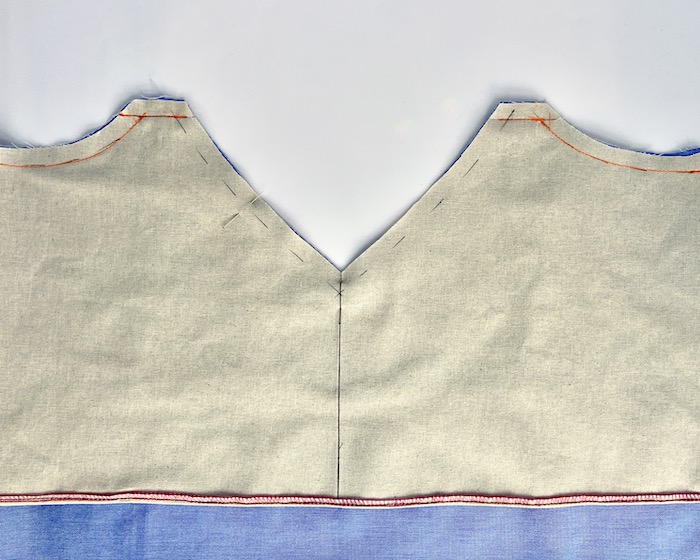
At this stage you will have the straps in place. The body and facing are made and placed with right side together, and stitched together across the back and around armhole with just the neckline left to stitch.

Tips for sewing a V-neckline

Make life easier and mark in the SA with a suitable fabric marker – i.e. one that is not going to leave a permanent mark! 

Nothing looks worse than an off centre V (that’s probably an exageration, but you know what I mean). I’ve marked the Centre Front line on the facing just so you can see it, you may want to mark yours.

Stitch with care so you don’t stretch the neckline.

Here’s the clever trick with stitching a ‘V’. 

Using 1cm S/A( ⅜”), start at the strap and stitch towards the point. Start with your normal stitch length, and about 3cm (1½”) up from base of “V” change to a smaller stitch length.

At the ‘V’ base, rather than stitching to a point, pivot (by keeping your needle in the fabric) and stitch HORIZONTALLY across one stitch and then pivot again to continue stitching back up the other side of the neckline.

Stitch for about 3cm (1½”) with the smaller stitch length and then change back to a normal stitch length. Press the stitchline.

Snip very carefully into the SA at base of the ‘V’, right up to but not through the stitch line. It won’t turn cleanly to the right side if you don’t clip in far enough but it will fray if you cut too far!.

Trim the excess SA to 6mm (¼”) so it will turn to the right side cleanly. I rarely use the ‘clipping’ seam allowance method, trimming the SA down to 6mm gives a much smoother curve and is quicker!

Turn to the right side and understitch. Press gently with the seam rolled to inside of garment so not visible on the right side.

There go … the perfect V neck!

Posted on

Our New Pattern Collection Bundles

Save & Sew with our New Pattern Collections

I’m so pleased to introduce our new limited edition pattern collections!

With up to 15% off you can happily Sew and SAVE with our exclusive and limited edition sewing pattern bundles. They are available in PDF and paper and also include our new MAVEN1832 patterns.

The Holiday Pattern Collection includes The Joy Dress, The Barcelona & The Simone Set, all perfect for the summer sun and make the ideal me-made holiday capsule wardrobe.

The Essential Collection Pattern Bundle contains 3 of my most favourite and most used sewing patterns; The French Dart, The Maria Apron & The Somerset.

And we do like you to make the most of your sewing patterns so don’t forget to take a look at our free tutorials for tips and pattern hacks.

There are many more collections to explore! I’ve had such fun putting together these little Mini Collections. I will be changing them so if there is a collection you’d like to see, let me know!

join the gang! NEWSLETTER SIGN UP!
Posted on

The French Dart | Creating Panels by Jen Hogg – part 1

I was delighted when this gorgeous French Dart by Jen Hogg popped up on the Maven instagram feed. So, I approached Jen and asked her if she would share all the details of her marvellous French Dart Hack and she kindly has!

The panelling idea is such a clever idea to show off a printed fabric – we all know how much I love a Nani Iro print – or to create smaller pattern pieces which are perfect for using up those scraps and odd bits of leftover cloth. Enjoy part 1, it’s full of ideas and inspiration and part 2 of this post can be found here.

PAID POST | This article was  written by Jen Hogg after I saw her French Dart Hack on Instagram. I have paid Jen for her time, skills and effort, but all opinions are her own.


Version 1 – the toile

I really like this pattern. In fact I’ve made it 4 times, so far. The first was a toile to check my standard pattern adjustments for my broad back and square shoulders. It was in yellow gingham sold as cotton, and it worked really well, except that I don’t suit yellow. So I had the bright idea of dying it teal, thinking that I’d end up with a lovely teal / turquoise gingham. Only of course it wasn’t cotton after all, the dye didn’t take, and the whole thing ended up in recycling. Can you tell I’m still a little bit bitter?

Version 2 – needlecord, with in-seam pockets

But it did confirm that my adjustments were good so I quickly made another in needlecord. My only hack was to add in-seam pockets. The method I used is my absolute favourite, I’ve seen it called a couture method, and it’s how you add a pocket beside an invisible zip because the whole construction is on the front of the garment. Click here for details.


Version 3 – Nani Iro, front panels with pockets


Next up, I had some lovely Nani Iro fabric from Minerva, in a black brush stroke with a wide silver border. The obvious thing to do would have been to use the border along the bottom of the dress, but it felt a wee bit formal for me, especially given that I was making it in lockdown when anything more than joggie bottoms feels formal.

I decided to divide the front of my French Dart into panels, and to use the border in different ways on each. This technique would also work really well for using up small pieces of fabric.

I wanted to keep the dart, because it’s so lush, and of course I wanted to add pockets. This time I thought I’d add them on the front of the dress, following the angle of the dart. I also decided to add quite a deep cuff to the pockets partly to add structure, but also to let me use the writing on the selvedge of the fabric.

Incidentally, this fabric is quite robust, allowing the pockets to keep their shape. If it was a softer fabric I’d have gone for in-seam pockets.

First of all, I traced my pattern piece and removed the seam allowances. By the way, the diagram is a rough sketch of the pattern piece – not to scale!

When you’re removing the seam allowance remember it varies, for example it’s narrower at the neck.


(first image)Next I divided the front into panels to suit my fabric. I decided to cut one piece above the bust, and to divide the lower part of the dress into three: one at each side and one in the centre. The side panels are wide enough to accommodate the whole of the dart, and also to add a decent sized pocket. The panels were only drawn in at this stage, I wanted to make sure I was happy with the look of the finished front before I started cutting the paper up.

(second image) Here’s the line of the pocket top. It’s parallel to the line of the dart once it’s sewn closed – to check that I literally closed the dart of the paper pattern.

Here are the panels separated. The neck and centre panels are going to be cut on the fold. (And yes, my cutting boards might be called well-used.)

Now I worked entirely on the two parts of the side panel.

First up, I added a pocket bag to the top part, which will form the back of the pocket. I made it long enough that I could reach the bottom of the pocket without stretching.

I then used that added-on section to draft the front pocket bag, shown here in yellow. I could have used the bottom panel itself to create the front, but I didn’t want to see the pocket bag stitching on the front of the dress so I decided to create it as a separate piece.

Here it is in real life with the seam allowances added back on.

These photos show the finished pocket, from outside the dress and inside. I used a scrap of Liberty lawn cotton for the front pocket bag.

The way I added the cuff was the same way I usually add bias binding:

  •  Interface the cuff
  • press the cuff in half and then press up the seam allowance on the front of the cuff
  • Pin the front pocket bag and the bottom panel with the right sides facing out (ie wrong sides together)
  • Lay the pocket bag / bottom panel so that the pocket bag is facing up. Line up the cuff with the pocket bag, right sides together. So now you have a sandwich: cuff – pocket bag – bottom panel.
  • Stitch through all three layers along the length of the pocket opening
  • Fold the cuff over to the front of the garment. This is where you’re glad you already pressed up that seam allowance – all you need to do is topstitch the cuff to the bottom panel.

Incidentally I didn’t bother cutting the cuff piece into the shape in the diagram. Instead I cut a piece of fabric longer than I needed, on the straight grain, and trimmed it after I’d sewing it in place. This let me make last minute adjustments to fully use the piece with the writing on.

Re-assembling the front of the dress

So, that’s the front pocket bag and cuff attached to the bottom panel. Next I sewed the bottom of the two pocket bag pieces together (I used a French seam for neatness and security). Then I added a line of stitching within the seam allowances at either side of the panel to keep everything in place.

And that’s the side panel reconstructed. All that’s left to do is to stitch the side panels to the centre panel, and then all three to the neck panel. The front is then fully put back together, complete with pockets, and the dress can be finished off per the pattern instructions.

Version 4 – cashmere top

I’ve also made the French Dart as a top, simply by chopping the pattern at hip height. Literally no other changes were required. This one is also made from cashmere surplus. I know, lucky!

I’ve not finished with this pattern. I have some lovely stretch wool, in a delicious shade of red, so I’m thinking a winter dress. I might alter the sleeves on that so they’re straight rather than gathered at the cuff, because I think the fabric will be too chunky to take the gather. I also think the pattern will look great in linen with short sleeves for the summer. Watch this space on Instagram!

Thanks so much Jen for such a great post! Part 2 can be read HERE!

We would love to see your French Darts! Old or new, share (or re-share!) them with us on Instagram Remember to tag us @MavenPatterns #FrenchDartMaven

All photos by Jen Hogg 

Jen Hogg lives in Glasgow with her husband and dog, and has two children at university. She now runs a small business selling the Jenerates sewing ruler and writes for a variety of magazines and blogs. A former solicitor, Jen reached the semi-final of The Great British Sewing Bee Series 5 (2019). In addition to sewing, she enjoys knitting, crochet and many other textile crafts, as well as silversmithing, photography and generally making things. You can follow Jen on Instagram and Facebook @jenerates, and at www.jenhogg.co.uk