Posted on

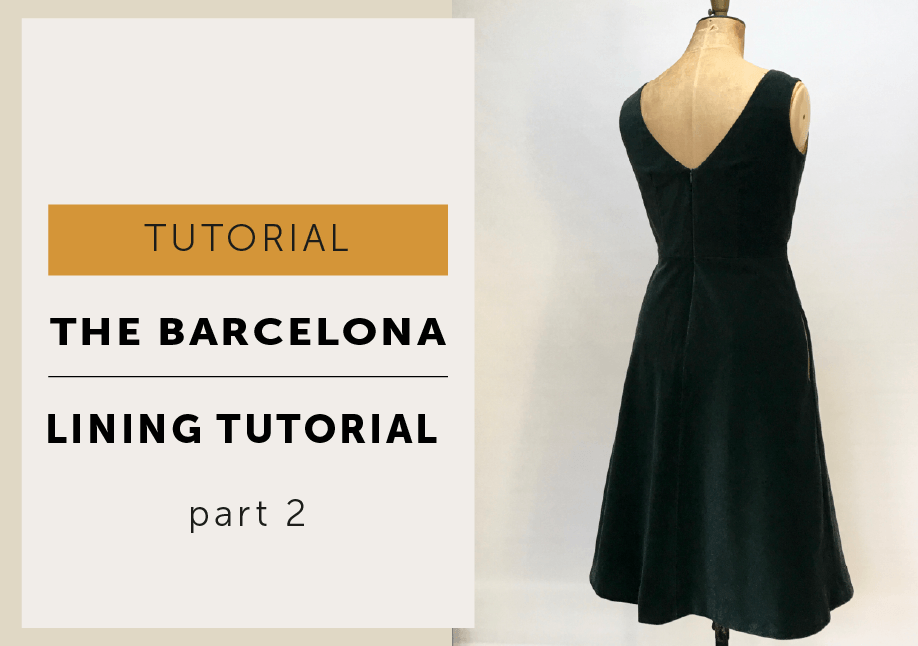
The Barcelona | lining tutorial – part 2

How to add a lining to the Barcelona Dress | part 2

| sewing the dress lining |

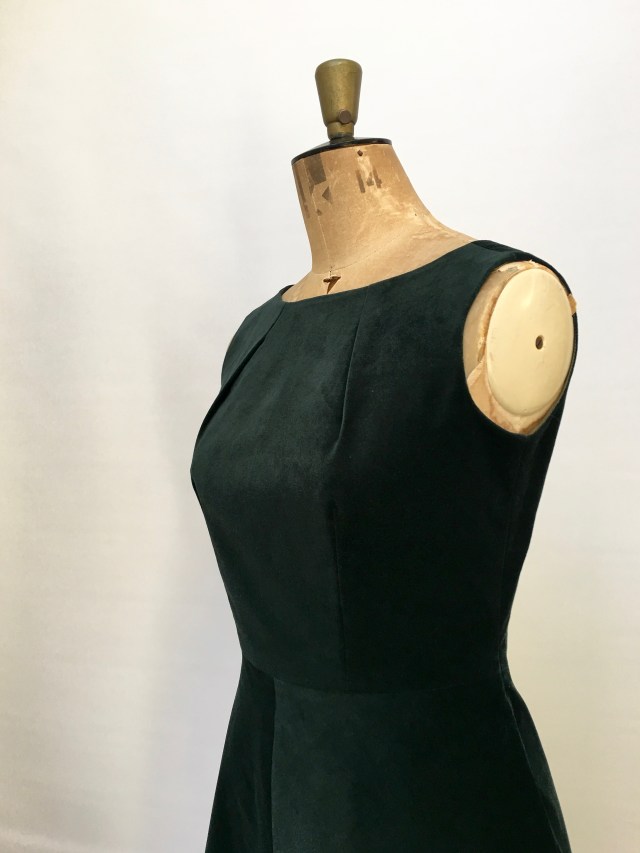
This is part 2 of our lining tutorial, in which we are adding a lining to the Barcelona dress. This is where we find out how to stitch her up!

You should already have your lining pattern ready, but if you missed it, off you go and do your homework! We’ll wait here for you…The Barcelona | Lining tutorial part 1

CUTTING & SEWING VELVET | Our dress is in (woven) cotton velvet, or as it’s sometimes called velveteen, so all the usual rules apply regarding sewing and cutting fabric with a nap (a pile). If you are working with a silk velvet or similar, these are even trickier, slippier fabrics and you are going to want to take more steps than I’ve listed below! Threads magazine has a good guide here. Of course, you are not obliged to use velvet, I’m sure your fabric of choice will be most delightful!

NAP | If you brush your hand up and down you can feel one direction feels smooth and one is rough. The smooth is the direction of the nap. I like to cut with smooth up and rough down as the fabric looks darker when it’s worn. Not everyone is going to agree with me here, many prefer to have the smooth running down the body, especially on a skirt as it does feel nicer when you smooth your skirt down during wear. With smooth running down it appears lighter, and I think it’s a bit too shiny, but it’s also supposed to wear better in the seat area. Whichever you choose, BE CONSISTENT and have all the hems of your pattern pieces facing in one direction.

CUTTING | Cut in one layer and one direction. Pin in the SA only so as not to mark the cloth.

PRESSING | Even though it’s velvet I did chuck it in the machine on a quick 30° pre-wash, as per the washing instructions. I was using curtains from Ikea with a washing label, so not really a risk, but do check the washing instructions of your fabric first! I then followed with a gentle pressing on the reverse only so as not to flatten the pile and make it go shiny. Use a spare bit of fabric as a pressing cloth underneath so the pile of your garment is always face to face with another piece of velvet. And PRESS rather than iron – lift in an up and down motion rather than dragging back and forth! Use steam, avoid over-pressing and use the tip of the iron when pressing seams. Gently press seam allowances (SA) open, avoid pressing the edges of the SA so as not to create an impression on the garment. If you do, lift the SA up and steam gently underneath and the impression mark may press away. And for the love-of-all-that-is-sewing allow your garment to cool before moving it after pressing! 

*In industry we used a needle board for pressing, which has hundreds of tiny needles poking up to support the pile of the fabric. I haven’t found it necessary to get one for domestic use, but useful to know if you are planning to sew a lot of this type of fabric.

POCKET BAGS | Cut them in lining – the velvet is will be too bulky.

SEWING | The seams can get quite thick, so press seam allowance open and grade the SA whenever necessary. Tack seams to prevent them from moving and shifting. Hold the fabric taut during stitching, but don’t stretch it. I used a walking foot to stitch the whole dress to help with creeping seams, but test to ensure you don’t get marks from the foot on the pile. A Teflon foot and a roller foot are also recommended but I don’t have either of those! With velvet be very careful with pins and pin in the SA. I pinned horizontally across a seam (as usual and without thinking) and it left an impression on the velvet. Test your stitching and choice of needle on a scrap of fabric to get the optimum results.

FUSING | The general advice is to use a sew-in interfacing so as not to crush the pile. I broke the rules and used a lightweight tricot iron-on interfacing, placing a scrap of velvet underneath so the pile is face to face before fusing. Again TEST on your fabric first!

Abbreviations |

SA | seam allowance    RS | right side    RSU | right side (of fabric/garment) up    RST | right sides together    CB | centre back    CF | centre front    WB | waistband

MAKE! | Start by making the main shell of the dress following the Maker Instructions included with your pattern.

THE MAIN SHELL |  Make the outer shell but leave side seams unstitched and the hem unfinished.

A little more info | I did not neaten the shoulder seams or the front darts. I neatened all the other seams open, as even though it’s lined the velvet was dropping messy bits everywhere. In a different fabric, I would have neatened the skirt seams open as the lining is loose at the hem, but would not neaten the bodice or waist seams.

  • Make the front bodice. Make neck dart tucks as instructions. Press front waist darts OPEN, do not neaten. (*If not making in velvet press darts towards CF as usual).
  • Make the back bodices with darts pressed towards CB.
  • Make the front skirt and attach pocket bags.
  • Make back skirt and attach pocket bags.
  • Attach the skirts to the bodices, neaten waist seam open.
  • Neaten back side seam (but not the front side seam) and CB seam.
  • Close back seam and insert the invisible zip (remembering you have a 6mm SA at the top edge).
  • Close shoulder seams, press open but do not neaten.
  • DO NOT CLOSE SIDE SEAMS

THE LINING | Make the lining but leave side seams unstitched and hem unfinished.

A little more info | Neaten the skirt seams open and the CB seam. No need to neaten the bodice lining seams. Press the darts in the opposite direction to the main shell to reduce bulk.

  •  Make the front bodice. Press the neck dart tucks towards the armhole. I pressed the front waist darts towards the side seam; if you are not pressing the main shell darts open, the lining darts will lay in the opposite direction to the main shell to reduce bulk.
  • Make the back bodices, making tucks instead of darts pressed towards SS.
  • Close the CF skirt seam and neaten SA open.
  • Attach the skirts to the bodices.
  • Close shoulder seams.
  • Neaten the side seams and centre back seams.
  • Close the CB skirt seam from hem to the zip notch.

ATTACH LINING | Now the fun starts!

This lining method bags out the neckline and armhole creating a clean finish with no exposed seams. The front and back armholes are sewn separately as it’s not possible to turn the dress through the armhole as with some other methods.

STEP 1 | NECKLINE

  • Place the shell and the lining with RST, and pin the neckline together, align at CF and shoulder seams.

  • To finish lining neatly at the zip; fold the CB lining SA to WS of lining. Place folded edge of the lining so it is set 1cm back from CB of the main shell.
  • Ease the back neck lining to fit the main shell if necessary.
  • At the CB/zip, fold the SA of the main shell to WS, so it lays on top and covers the folded edge of the lining.
  • Stitch neckline with 6mm SA.

  • stitch all the way around the neckline and gently press.

STEP 2 | ARMHOLES

The clever part of this method is that the front and back armholes are stitched separately.  It works really well as the dress is too bulky to pull through the armhole using a “burrito” method, and we have already closed the back seam with a zip – I always prefer to put a zip in a flat garment.

  • Line up the shoulder seams
  • Fold in SA at the shoulder so RST and pin to hold.
  • We are now working on HALF an armhole at a time – either the front or the back, it doesn’t matter which one you do first.
  • Follow your way along the edge of the dress from the shoulder to the armhole and at the underarm pin the SA so RST, making sure you haven’t twisted the bodice.

Hold together the bodice where you have pinned at the underarm and shoulder and pull the dress through so the WRONG SIDE is now facing you. Pin or tack lining and body RST along the armhole until you get to the shoulder.

  • Stitch the armhole seam closed with a 6mm SA from underarm and stop at the shoulder seam. Press the seam.

  • Pull the dress back through to the RS.

  • Now repeat to close the other side of the armhole, finishing your stitching EXACTLY at the shoulder seam to meet your first line of stitching.
  • Once you have completed both armholes, understitch on the lining. Start at the underarm and stitch towards the shoulder – you won’t be able to understitch all the way to the shoulder seam just go as far as possible.

SIDE SEAMS|

  • Pin the side seam of the lining and main shell RST, taking care to line up the underarm seam.
  • Close the seam with a 1.5cm SA – stitch around the pocket bag in the main shell as described in the instructions.
  • Neaten the front side seam (as explained in the maker instructions) but stop the neatening when you get to the lining.
  • Press the seam open
  • To stop the lining rolling out at the underarm it needs to be attached to the main shell. Line up up the side seams of the shell and lining so they are sitting on top of each other. Pin in the groove of the seam. Stitch in the ditch of the side seam just below the underarm for about 1.5cm (1/2″) to keep the layers together. Alternatively, you can stitch by hand on the inside of the dress through the SA to hold the layers together.

ATTACH THE LINING TO THE ZIP |

Turn in the lining SA at the CB and pin to the zip tape so it sits approx 1cm back from the zip coil.

Slip stitch the lining to the zip tape. You can then sew your hook and eye at the top of the zip.

HEM |

  • Allow the dress to drop for at least 24 hours before levelling and hemming.
  • The lining has a 2cm hem allowance and just needs the hem to be double turned and stitched; that is press the hem up once at 1cm, turn and press again so a total hem of 2cm hem has been taken and machine stitch. You can use the same method that is used to hem our Maria Apron pattern, shown here in this tutorial.
  • The main shell has a 3cm hem and is finished by hand.
  • Your Barcelona just needs a light pressing and you’re finished!

Don’t have the Barcelona pattern yet? Don’t leave it too late, party season is nearly upon us…


Posted on

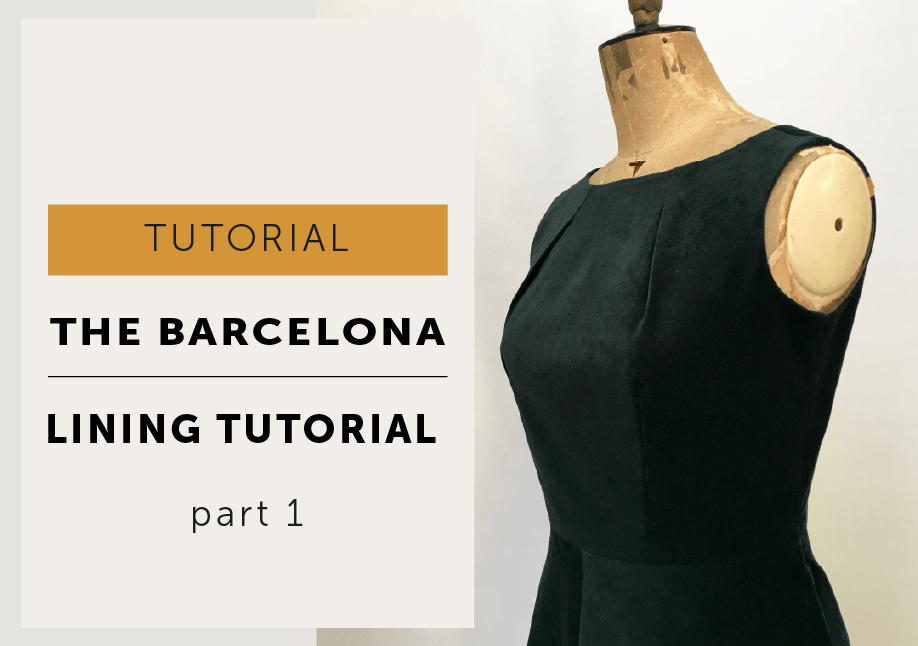
The Barcelona | lining tutorial – part 1

How to add a lining to the Barcelona Dress | part 1

| the lining pattern |

I had really wanted to include a lining pattern in with the Barcelona but there is only so much I can fit into a pattern and had to abandon that idea, but I decided to keep the idea for a lining tutorial. By adding a lining it means the Barcelona pattern can be made in a wider variety of fabrics, some fabrics just deserve a lining. Adding a lining can protect your modesty if your fabric is a tad sheer, or it can elevate a casual summer dress to a grand gown, just through the choice of fabric! And as you know, I’m all about getting the most use and variety from your sewing patterns.

I decided to make the Barcelona dress pattern in velvet and started to hunt around for some fabric as you do on the internet but was being quite lazy about ordering any swatches, so actually made very little progress. And then I found it – in Ikea! A pair of lovely green cotton velvet curtains – £40 for 5m. I shouldn’t have been surprised as I have bought quite a lot of fabric from Ikea over the years. Now, of course, a velvet dress really does deserve a lining, so a lining pattern was my first task.

Abbreviations |

SA | seam allowance    RS | right side    RSU | right side (of fabric/garment) up    RST | right sides together    CB | centre back    CF | centre front    WB | waistband   SELF | main fabric

TRACE | The first step is to trace off your original pattern and then put it away safely.

You need to trace these pattern pieces, but don’t cut them out yet.

  • front & back bodice (whichever version you wish to make)
  • the front & back skirt
  • bodice zip interfacing

The pocket bag pattern (to be cut in lining), pocket mouth interfacing and skirt interfacing patterns don’t change, so they can be used without alteration. You won’t need the binding pattern pieces!As the original pattern has a bound edge, we need to add a seam allowance (SA) to the neck and armhole to attach the lining. I always use a 6mm (¼”) SA on any seams that will be bagged out, or enclosed. That is a standard industry SA, if it’s bigger you just end up cutting it down again! If you make the lined version without adding any SA, the shoulder will be narrower and the armhole lower.

MAIN PATTERN | On the front and back bodice of your traced pattern add the 6mm SA and cut out the bodice patterns. These will be cut in your SELF (main) fabric to make the outer shell of the dress. Annotate the patterns with the name/LINED VERSION, the pattern piece – state clearly these are the MAIN pattern pieces to avoid confusion when cutting out your dress later, the size, cutting instructions and the date (helps keep track of alterations!). It would read something like this;

LINING PATTERN | Now trace another set of bodice patterns from your newly traced MAIN pattern with the SA, but don’t cut them out yet.

To make the lining roll inside of the dress at the shoulder, the lining pattern needs to be narrower than the main pattern. We are going to reduce the shoulder width by a total of 3mm (1/8″).

Mark the shoulder SA of 1.5cm (5/8″) on the pattern. Now make 2 marks on the shoulder seam, 1.5mm (1/16″) from the edge of the neck and again from the edge of the shoulder.

Then it’s just a case of drawing a new line, joining the marks to the neck and the armhole. You can use your MAIN pattern as a template, place on the mark at the shoulder and pivot it to draw and blend the line in further along the curve.

DART TUCK | Extend the lines of the dart tuck so they intersect with your new SA. The dart tuck in the lining will be pressed in the opposite direction to the one in the main body to keep bulk at a minimum.

SIDE SEAM | As lining fabric tends to have no ‘give’ like most fabrics it’s good to have a little extra ease. That’s why jackets have a pleat at the back, but that’s going to be too bulky for our fitted dress, we need just a little extra ease for movement. A lining that’s too tight is really uncomfortable and can rip quite easily too!

To add a bit of ease, measure out 5mm (or ¼” for imperial users) from the waist and then redraw the SS blending back in at the armhole point.

Repeat for the back bodice.

BACK DART | On the back bodices, the dart will be replaced as a tuck to give a little more movement. That’s not complicated, ignore all the dart markings except the notches along the waist line. The tuck will be made with the bulk towards the side seam, so it sits in the opposite direction to the dart of the main body.

BACK BODICE ZIP INTERFACING | The original pattern will now be too short as we have added a 6mm SA, so just add you SA on, and then check it against your pattern.

CHECK! | Compare your LINING pattern against your MAIN pattern, by laying it on top. The shoulder should be narrower and the waist should be wider.

Now just check your front lining bodice pattern against the back lining bodice pattern. Check the shoulder and side seams are the same length!

ANNOTATE | Remember to write all the relevant pattern info on your lining pattern pieces, especially that they are to be cut in lining!

SKIRT LINING | You can use the original pattern to cut your SELF fabric.

Take the traced skirt pattern and add 5mm at the waist so it will still fit onto your bodice! Blend the line down smoothly to the hip curve. Often linings have extra ease over the hips to allow some ease of movement, but it’s not really a concern with a bias cut skirt.

Move the notch on the CB seam, that indicates the base of the zip, down 1cm.

You obviously won’t need pocket bags in your lining layer, so you can block the lower pocket notch and use the top notch to help match your side seam.

Shorten the lining pattern by 3cm, this will give us a 2cm hem that we can double turn and stitch. This still may need to be shorter if the lining drops more than the main fabric after hanging.

So that’s the pattern done!

Go grab yourself a cuppa and biscuit and then on to the LINING TUTORIAL – part 2!

Not got the Barcelona pattern yet? Click below!

Posted on

A Little Inspiration and Philosophy

Do you ever wonder where the inspiration behind a sewing pattern comes from? Ideas can literally come from anywhere and everywhere. I mean, who hasn’t followed someone around a supermarket to get a better look at an interesting pocket or seam? Old films from the 50’s and 60’s are a constant source of joy for details and silhouettes. All of the little ideas just get tucked away subconsciously until it’s time for them to come into the daylight. You see, to be creative you have to put something in for something to come out. You have to take notice of the small stuff, the unusual colour combinations in the most random place, a shape, a silhouette of a shadow. Don’t just look at clothes, just look. Once you start looking at things with the eyes of a Maker, everything becomes a potential.

And then, of course, you find a fabric. Designs for me are often a response to a fabric…what does that cloth need to become? How will it drape? And this stripe was just begging to be made into a chevron. I made this skirt way back in 2014, when only the idea of Maven existed (the fabric was from John Lewis, but sadly no longer available). The skirt eventually developed into our Barcelona dress pattern. The Barcelona pattern was only released this year but she actually became a dress pattern in 2015 and gained her name when I did the classic make a last minute dress for a trip to Barcelona. I like to give the patterns time to develop naturally. We personally wearer trial everything so we know it works in the real world. I want garments in my wardrobe that are flexible and solve problems, not create them, not just for today but for years.

But above all for me, this quote by William Morris has resonated within my design work from the moment I first heard it. It made sense of my natural desire to make for purpose and practicality. I believe a garment has to meet the criteria of longevity and to function well within a wardrobe and within a lifestyle if we are to put the effort and time into making something. If we are going to use resources, we need to make consciously with a view to loving each garment for a lifetime. Here at Maven, that really is at the core of what we believe. 

The French Dart pattern as a top | The Barcelona pattern as a skirt

Posted on 2 Comments

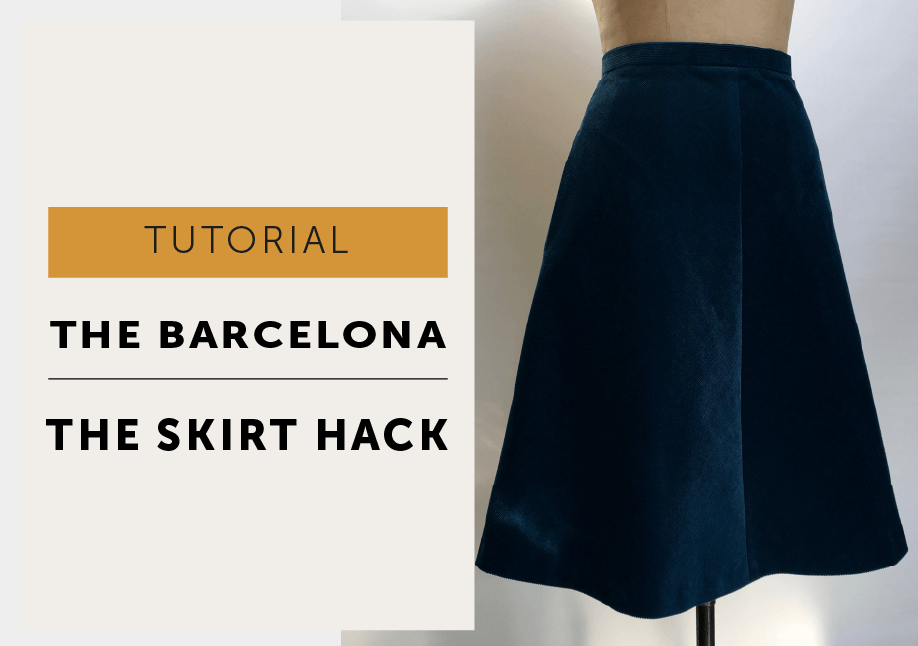
The Barcelona corduroy skirt hack.

So Autumn is truly here in the UK as I write this…all the leaves are brown(ish) and the sky is, in fact, grey…it could be a completely different story by the time I publish the post…the weather being somewhat unpredictable these days! And corduroy seems to be the fabric of the season. Useful because I was making this skirt anyway. Bloody irritating because a good solid basic staple of a fabric will be deemed ‘so last season‘ by some idiot ‘expert’ in the near future. Be a rebel…join my club of ignoring the idiots and consciously making what you please, to wear for long as humanly possible. So, this skirt is a hack of our Barcelona dress pattern. The idea is to just leave the bodice off and add a waistband and voila 2 styles from 1 pattern! Not that complicated as hacks go and many of you will not need to follow the instructions to do this, but here they are anyway and with a few tips for sewing cord too. Of course, you can make this in any suitable skirt fabric.

SEWING CORDUROY

NAP – Corduroy has a NAP, no it’s not tired, but has a pile like velvet. If you brush your hand up and down you can feel one direction feels smooth and one is rough. The smooth is the direction of the nap. I like to cut with smooth up and rough down as the fabric looks darker when it’s worn and I can also remember writing that in massive letters in marker pen in the front of my diary when I got my first proper job after college. Not everyone is going to agree with me here, many prefer to have the smooth running down the body, especially on a skirt as it does feel nicer when you smooth your skirt down during wear. It will appear lighter and I think it’s a bit shiny but it’s also supposed to wear better in the seat area. Whichever you choose, BE CONSISTENT and have all the hems of your pattern pieces facing in one direction.

CUTTING – Cut in one layer and one direction. Because of the wales (the raised ridges) be careful about keeping everything on grain or they can look as though they are running off skew. The wales can vary in size, the wider the wale the smaller the number, with needlecord being about 16 on the scale (16 ridges per inch). I’ve used cord with a very typical sized wale (I’m guessing around size 11) and didn’t worry at all about trying to match the wales while stitching. For a really wide chunky wale, I would have matched. For waistbands and other straight edges, you can always cut a straight line first following a wale and you will have a straight edge to line up your pattern piece with.

PRESSING – Pre-wash and then gentle pressing on the reverse only or you’ll flatten the pile and make it go shiny. Use a spare bit of cord fabric as a pressing cloth so the pile of your garment is always face to face with another piece of cord. And PRESS the cloth rather than iron – lift in an up and down motion rather then dragging back and forth! Gently press seam allowances (SA) open, avoid pressing the edges of the SA so as not to create an impression on the garment. If you do, lift the SA up and steam gently underneath and the impression mark may press away. *In industry we used a needle board for pressing, which has hundreds of tiny needles poking up to support the pile of the fabric. I haven’t found it necessary to get one for domestic use, but useful to know if you are planning to sew a lot of this type of fabric.

POCKET BAGS – Cut them in something else – cord is too bulky! I used a leftover cotton print, and they look OK but I’m tempted to take them out and have big patch pockets for the full-on ’70’s effect!

SEWING – The seams can get quite thick, so press seam allowance open and grade the SA whenever necessary – definitely the enclosed SA of the waistband. Take extra care with seams, they can creep or crawl during stitching, feeding through the machine at slightly different rates to each other. I used lots of pins, took my time. You could tack them or use a walking foot if you find it an issue.

FUSING – The general advice is to use a sew-in interfacing so as not to crush the pile while pressing it onto the waistband. I didn’t do that – for the waistband, I used slotted waistband iron-on fusing because that is all I had that was suitable.* The SA on the fuse wasn’t the same width as my pattern piece (1cm versus 1.5cm) so I just centralised it and carried on. I did use a spare piece of cord as a pressing cloth. I used very lightweight iron-on interfacing for the pocket bags and zip and pressed very gently with lots of steam.

*I have a hardcore policy of not leaving the house to buy more stuff unless I really have too – hence I used a black invisible zip too!

Abbreviations

SA | seam allowance    RS | right side    RSU | right side (of fabric/garment) up    RST | right sides together    CB | centre back    CF | centre front    WB | waistband

WAISTBAND PATTERN – It is just a straight rectangular pattern piece and once you know the formula for constructing one, you can add or alter waistbands as you like. A straight waistband shouldn’t have a finished width of more than 5cm (2″), if you want a deeper waistband you will need to make a shaped one to curve to your body. (That’s for a different day!)

WIDTH – the finished desired width (x 2) + the seam allowance (x2)

  • 2.5cm + 2.5cm + 1.5cm +1.5cm = 8cm wide pattern.

I made my finished waistband width 2.5cm (1″) as I was using slotted waistband fuse with this finished width and the SA are 1.5cm to match the Barcelona dress SA (BTW: I usually only do 1cm SA, but a bias skirt needs a bigger SA).

LENGTH – finished waistband length (waist measurement + wearing ease) + extension + SA at each end.

  • 76cm actual waist + 2.5cm ease + 2.5cm extension + 1.5cm SA + 1.5cm SA = 84cm pattern length

The finished band length is your waist measurement (e.g. mine is 76cm) + wearing ease (2.5cm) = 78.5cm Divide this by 2 to get the midpoint which is your CF. Wearing ease is so you have enough room to tuck in your top, move, sit, eat and generally feel comfortable. How much is really up to you, I allow 2.5cm (1″) because after doing alterations for 10 years that seemed to be an average comfortable amount for my ladies. I found the younger person likes it tighter with less ease, but the older we get the more we like to breathe easy! I wouldn’t advise doing less than 1.2cm (1/2″) ease. If you have a similar skirt you like the feel of (that SITS ON YOUR WAIST) measure that one.

The extension (or underlap) is the part of the waistband that extends beyond the skirt with the button on it so when you do the skirt up it sits underneath the buttonhole. I’ve gone with 2.5cm (you could go a bit bigger for a wider waistband with a bigger button).

Add notches to your pattern at the CENTRE FRONT, the centre fold, SA and the extension. Draw the grainline so it runs the length of the waistband, parallel to the longest side. Annotate your pattern piece with pattern name, pattern piece, cutting info, size/waist size, and date (helps to keep track of alterations). So, now you have a waistband pattern that fits you, you need to make sure it fits onto the skirt pattern. The skirt can be actually be eased onto the waistband and therefore can be slightly bigger than the waistband. Depending on the fabric you are using this can be about 3-5mm per ¼ skirt.

Cord, however, does not take kindly to too much ease, so you will most likely need to adjust your pattern to make the band and skirt the same measurement.

Mark the 1.5cm SA on the skirt pattern and measure the front & back waist. Multiply by 2 to find the total skirt pattern waist measurement. Compare with your finished waistband measurement to find the difference. If they are the same hurrah, you can sew your waistband on! If not, divide the difference by 4 (think of the skirt body in 4 quarters; left front, right front, left back, right back) as this is how much you will need to adjust each pattern piece. If the skirt pattern is too big for the waistband you’ll need to reduce your skirt pattern at the side seam. At the waist mark how much you need to reduce your pattern piece by. Draw a new stitchline and blend into the hip with a smooth line. Draw your new SA and trim off the excess pattern. If the skirt is too small for the waistband you’ll need to add a bit to your skirt pattern at the side seam to increase the waist measurement.

In these diagrams, the skirt pattern waist has decreased or increased at the side seam by 5mm per ¼ as the skirt was a total of 2cm too big or small for the waistband.

ATTACH THE WAISTBAND

So you join us here with your skirt body made with the zip and pockets done. All the instructions to get you that far are in the pattern. Just ignore any bits that refer to the bodice!

All that’s left to do is add the waistband and finish the hem.

With RST pin waistband to the skirt. Align at CF and make sure you leave the waistband extension, well umm, extended.

Stitch with a 1.5cm SA. Press SA and trim skirt SA to grade, so reducing the bulkiness of the seam. Press SA towards WB.

Go ahead and neaten the long free edge of the waistband with an overlock or zig zag stitch or a Hong Kong binding finish. You can also trim the SA down by 5mm, leaving you with a 1cm SA.

CLOSE EACH END

Extension | Fold the waistband in half with RST. Take a 1.5cm SA and stitch down from the folded edge and pivot across to finish stitching at the CB. Clip the corner and trim the SA.

With the WB folded again, close the other end of the WB with a 1.5cm SA. Clip and trim SA.

Press, turn WB to RS and carefully poke out the corners so they are nice and square.

CURTAIN WAISTBAND | this is a good finish for thicker fabrics like corduroy, as the SA hangs down (like a curtain) so the waist seam has less bulk.

Once the WB has been turned to the RS ‘Stitch in the ditch’ with a tacking row of stitches to hold the WB. At each end fold the SA at an angle away from the zip.

Machine stitch in the ditch from the RS. You will hardly notice any stitching.

Now you just need to finish your waistband with a button and buttonhole. Let your skirt hang overnight before levelling and hemming.

join the gang! NEWSLETTER SIGN UP!