Posted on 1 Comment

How to Measure a Curve on a Sewing Pattern

How to Measure a Curve on a Sewing Pattern tutorial

Now, this might seem a little obvious to everyone, I’ve hesitated even posting and calling it a tutorial. But following conversations with my youngest daughter (15, studying textiles at school) and a friend of mine (long time sew-er), neither of them knew this shortcut – and to be honest I only discovered it when I was working after 4 years of studying fashion. It’s the easiest and most straightforward way I know to measure necklines, measure a sleeve head, armholes (or the armsyce if you want the industry term – I’m popping it in here for the benefit of Sir Google).

So on the off chance that someone, somewhere, needs to quickly measure the curve on a sewing pattern …

HOW TO MEASURE A CURVE

There are various gadgets and measurement tools around to measure curves on sewing patterns – flexible rulers and wheely things, and if they work for you, excellent! The great thing about sewing is there is always more than one way to solve a problem.

But, you see I’m not a great one for gadgets, so for this method, you’ll only need the basic pattern making tools – a tape measure, a pencil and a ruler.

Why would I need to measure a curve on a sewing pattern?

If you need to alter a pattern to fit you, you may find you need to adjust the armhole or neckline and then you are going to need to make sure the collar or sleeve fits again. For that, some pretty accurate measuring will be needed!

Here’s the method, I’m going to pretend you’re measuring an armhole.

How to measure a curve tutorial: Maven Patterns

Step 1:  

Before you measure the curve, you will need to use your ruler and mark the correct seam allowance accurately on your paper pattern in pencil. This represents your stitch line when you stitch your garment together. It’s this line, not the outside edge of your pattern that needs to be the same measurement.
How to measure a curve tutorial: Maven Patterns

You don’t need any Fancy Curve Measurement Tools …

Step 2:

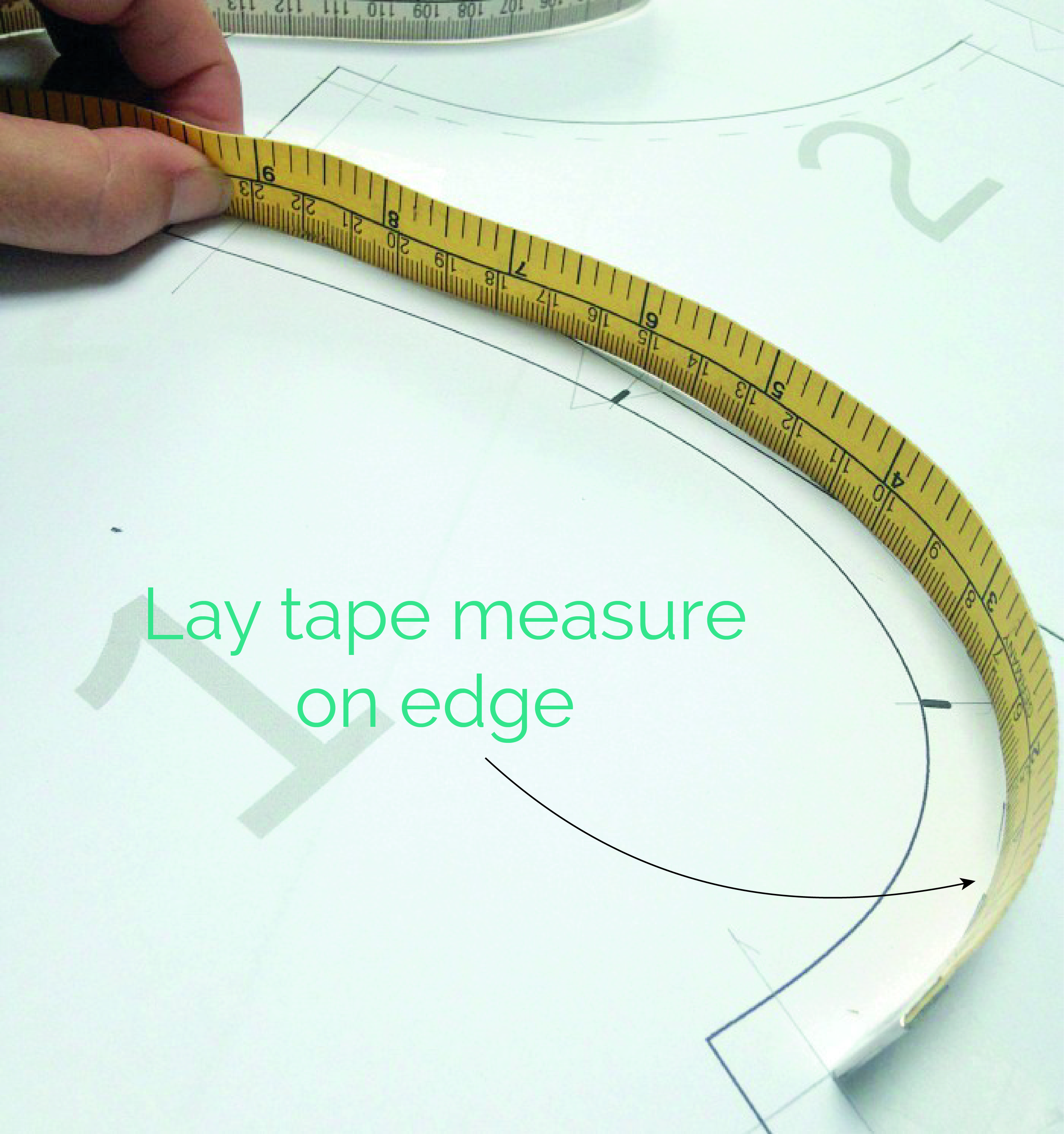
Next grab your tape measure. Here’s the trick. Stand it up on its SIDE and walk it EXACTLY along your pencil line to measure that entire length of armhole – EASY! Make a note of the measurement, I always write them straight on the pattern piece.

  • Now use the same method to measure the curve of your sleeve head. Remember it will be bigger than the armhole as it should have some ease in it.
  • You can see here that I don’t include the side seam allowances when I measure. As a general rule when measuring your pattern the trick is to just be consistent. It’s really easy to get confused and include the seam allowance in the armhole and then not on the sleeve head or sleeve cap. And then it takes a while to work out why the pattern pieces don’t fit together!
  • When I’m measuring a sleeve head to check it fits into the armhole I don’t measure the whole sleeve head in one go.
  • I’ll either measure from the underarm seam to the top of the sleeve head, where it would align with the shoulder seam. And then the other half of the sleeve head.
  • Or if I want to check the position of the notches I’ll draw a line from each notch to intersect the seam line. Then I’ll actually measure in-between each notch so I can check the notches are all in the right place and will match up at the same time as checking the sleeve will fit.

That’s it! It can take a little practice to do it accurately, but who doesn’t love a low (no!) tech solution to a problem?

Happy stitching and curve measuring,

Mrs M x

More to Sew …


Posted on

How to make an eye mask with our free eye mask pattern

Learn How to make an eye mask with our free PDF eye mask sewing pattern. It’s super easy and makes a lovey gift!

I do love a handmade gift, don’t you? The fact someone has chosen to spend their time on making something special for you is just such a wonderful feeling isn’t it? And to make something special for a friend who will appreciate it always makes me feel warm and fuzzy inside. Before I started Maven Patterns, I used to make these little eye masks and other fabric based gifts a lot for friends and family at Christmas (look out for the free peg bag pattern I’ll be sharing with you soon) and while I was moving some stuff around in the loft the other day I found my old patterns. Things being what they are in the world at the moment, environmentally and economically, it seemed like a really good time to share them.

You can download your FREE eye mask pattern HERE and learn how to make an eye mask or sleep mask with this free sewing tutorial. An Eye Mask or Sleep Mask could be that perfect little gift. Not only are they an easy make, making it a great beginner sewing project, but they are also really quick to make, 30-60 minutes depending on how quick you sew. And not forgetting, they a perfect scrap busting project for using up those left over bits and pieces. You could even join smaller pieces together creating a patchwork of your favourite scraps. I’ve included how to cover the elastic with a scrap of fabric which looks lovely, but it’s an even speedier make if you skip that step.

The Eye Mask would be a great addition to The Simone Set, I’ve used an old scrap so mine co-ordinates with our sample. For the younger (or older!) family members … why not adapt the pattern slightly to create a superhero eye mask!

How to Make an Eye Mask with our Free PDF Eye Mask Pattern

Tools

Suitable fabrics

MAIN FABRIC Silks, satins, cotton lawn, double gauze, soft jersey knits – any soft woven or knitted fabric in your stash will be fine but keep in mind it will need to be comfortable without irritating the delicate face and eye area. TIP: Slippy fabrics such as silk can be block fused with some interfacing to make them easier to manage.

BATTING FABRIC to help block out the light we will add an inner layer – again, if you’ve been sewing a while,  try to use what you have. I’ve used some quilting batting that was hanging around, but alternatives could be wadding, felt, fleece, you could even try a remnant of sweatshirting (I’m now fondly remembering an old Ikea fleece blanket that would have done nicely!)

Fabric Requirements & Haberdashery

MAIN FABRIC (Outer layer that faces the world): 1 piece x 22cm long x 11cm wide (9″ x 4.25″) – I’ve used a scrap of Mind The Maker viscose left over from The Simone Set.

CONTRAST FABRIC (Inner layer that faces your face): 1 piece x 22cm long x 11cm wide (9″ x 4.25″) -I’ve used a scrap of cotton lawn left over from The Wendy Smock.

BATTING: 1 piece x 22cm long x 11cm wide (9″ x 4.25″) – I’ve used a scrap of bamboo batting.

*OPTIONAL FABRIC COVERED ELASTIC: Cut a strip of fabric 60cm (24″) long x 4cm (1.5″) wide

NARROW ELASTIC: A soft narrow elastic 6mm (1/4”), if you have 1cm (3/8″) elastic that’ll work just fine. As a guide you’ll need between 34cm – 40cm (13-16”). I’ve used 38cm (15”) of our 6mm organic elastic, but all elastics and comfort levels are different so we’ll fit as we go!

BIAS BINDING: 60cm length of binding. I’ve used our cotton pre-made neon binding (HERE) for ease and speed but if you fancy making your own we have a Binding Tutorial.

MATCHING SEWING THREAD

01.

Cut 1 in main fabric

Cut 1 in contrast fabric

Cut 1 in batting (or similar)

Remember to make a small snip in the fabric at each notch to mark the elastic placement.

Optional – Cut the strip of fabric to cover elastic.

02.

Place the 3 pieces together, with the batting layer sandwiched in the middle and the outer fabrics with their right sides (RS) facing outward. Pin to hold.

03. STAYSTITCH

Stay stitch close to the raw edge to hold the 3 layers together.

04. FITTING THE ELASTIC

As a guide you’ll need between 34cm – 40cm (13-16”). I’ve used 38cm (15”). All elastics behave differently so you may need to adjust the measurements for differing elastics and your personal preference.

Cut the elastic a bit longer than you need and safety pin in place to try on and see how comfortable it is, with the aim to hold your mask securely in place but not be too tight on your head. Then make a note of it for next time!

PLAIN ELASTIC OPTION- With inner side of you mask facing you, place your elastic at each notch and stitch securely in place. You can now skip ahead to binding your mask.

05. COVERED ELASTIC

Take the strip of fabric to cover the elastic. With Right Sides Together, align the raw edges and fold the casing in half lengthwise. 

Stitch with a 6mm (1/4”) Seam Allowance. 

Press seam flat. 

06.

Use a loop turner or attach a safety pin to one end and turn the strap through to Right Side and press flat.

Attach the safety pin to the elastic and insert into the fabric tube. Pull through the tube so the elastic is enclosed, being careful to hold onto the free end so you don’t loose it in side the tube. Stitch through all the layers at each end to hold the elastic inside the fabric tube.

07.

Place your elastic to the inner side of you mask at each notch and stitch securely in place.

08. Attach the binding

Unfold the binding. 

Fold one end of the binding back on itself to create a finished edge.

On the front of the mask and with Right Sides Together align the raw edge of mask and the binding and pin into place all the way around the outside edge of the mask.

09.

Overlap the binding to finish and trim off the excess.

10.

Stitch in the fold of the binding to attach. Be careful not to catch the elastic as you stitch the binding.

Gently press the stitch line.

11.

Fold the binding over the of mask, enclosing the raw edge and covering the stitch line with the binding.

Use small stitches and slipstitch by hand to hold the binding into place. Be careful to make sure your stitches do not show through to the front of your mask and that you keep the elastic out of the way.

TIP: you could stitch the binding in place using a sewing machine, if you prefer, but I found it very pleasant to slow down and stitch by hand and it was just easier to keep the binding neat and tidy on the curved sections.

Give your Eye Mask a final press and Voila! You’ve made a beautiful gift for a special person!

shop Maven sewing Pattern CTA

Important Notice: The Eye Mask Pattern & finished eye mask are NOT SUITABLE FOR CHILDREN due to potential safety hazards, including choking risks from elastic bands or small embellishments and the absence of certification or testing to meet child-specific safety standards.

More to Sew …

Posted on

How to lengthen The Portland Shorts

How to lengthen or shorten The Portland Shorts with a curved hem

If you wanted to change the length of your Portland Shorts, don’t let the curved shape of the hem confuse you! It’s a really straight forward alteration. The trick is just to avoid cutting through the curved area, if you are making your shorts longer, so the shape doesn’t distort and the proportions of the curve stay the same.

But I’m also going to talk you through shortening The Portland Shorts and cutting straight through the hem detail, so the split doesn’t get too high on the thigh!

We have the adjustment lines already marked on The Portland Shorts. It’s a staggered line so you can decide which method works best for you. The same principal can be applied to any pattern where you have a detail you’d like to avoid changing; in this case a curve but it could be a placket or a side split that you want to keep the same length. If you don’t have an adjustment line on your pattern just draw one on, keeping it at a right angle to your grain line.

Learn how to lengthen or shorten a shorts pattern

Tools

  • Your pattern (or copy of your pattern if you don’t want to alter your original)
  • ruler
  • pencil
  • tape
  • Paper

Things to be aware of

  • If you are doing lots of alterations to your pattern, do any length adjustments first.
  • Keep the grainline or “place to fold line” IN A STRAIGHT LINE, do not allow them to stagger.
  • The Chain Effect: when altering one pattern piece, also alter the corresponding pattern piece in the same way and remember to check they still fit together after your alteration. In this case, the length of the side seams and in-seams will need to match.

ADD LENGTH TO THE PATTERN

First decide how much longer you would like your shorts. You can measure yourself or an old pair of favourite shorts.

Cut along the adjustment lines marked lengthen (highlighted in the picture) and separate the pattern piece. The line is staggered to avoid cutting through the curve of the hem.

LENGTHEN 

Place a piece of paper behind your pattern and tape the top portion of your pattern to it.

Extend the grain line. Draw a line parallel to the your adjustment line the amount you need to lengthen the pattern by. Tape the lower portion of your pattern to the new line, matching up the grainline. 

Join the pattern pieces back together by re-drawing the seam lines so that they are a smooth line. Then cut away any excess pattern paper.

SHORTEN

When shortening your pattern if you use the upper section of the adjustment line, the split will move upwards and potentially could sit quite high on your leg and possibly interfere with the pocket. To keep the upper most point of the split in the same place when shortening your shorts, use the lower section of the adjustment line.

First decide the amount you want to shorten your shorts by. You can measure yourself or an old pair of favourite shorts.

Cut along the adjustment lines marked shorten (highlighted in the picture) and separate the pattern pieces.

Place a piece of paper behind your pattern and tape the top portion of your shorts pattern to it.

On the pattern, draw a line parallel to the your adjustment line the amount you need to shorten the pattern by.

Overlap the pattern pieces to shorten, taping the lower portion of the pattern to the new line and matching up the grainlines. 

Re-draw the in-seam and the hemline to make sure they are a nice smooth line. Then cut away any excess pattern paper.

REPEAT AND CHECK! 

Make sure to do the same alteration to the front and back leg, and double check they are the same length before cutting out!

All done! Off you go and enjoy those shorts!

More to Sew …


join the gang! NEWSLETTER SIGN UP!
Posted on

Learn to how to sew a narrow rolled hem

Sewing a narrow, curved or rolled hem can sometimes be a little tricky, especially in a delicate fabric. But we’ve got you covered with our free tutorial!

A shaped or curved hem doesn’t really like having a big hem allowance, it’ll look twisted and ‘ropey’ so a narrow hem is the best option. They can be tricky to finish neatly if you are working with a delicate or lightweight fabric, which is often the fabric of choice for a camisole. Different fabrics can require different construction methods so it’s always nice to have a little arsenal of alternative methods in your tool box should the need arise.

If you are ever in doubt of the best method to use just do a little test on a scrap of fabric. If you are testing the best way to hem a curve, remember to do your testing on a similar shape.

Sewing a Narrow, Curved or Rolled Hem

WS | wrong side of fabric  RS | right side of fabric  SA | seam allowance

TIPS |

  • Press at every step.
  • If you have a ‘bouncy’ fabric that doesn’t hold the press line (like the one I used!) use a few pins to help, but first check they don’t damage your delicate fabrics.
  • If you carefully tack your hem in place along the top edge of the hem allowance, it will give you a guide to follow when you stitch the hem from the RS, ensuring you catch all the allowance.
  • A good final press and steam will shrink any stretching that may have happened on the curved areas.
  • For reference: the fabric I have used for this post is a fine, slippery, (allegedly) silk crepe de chine that was lurking in the stash.

Double Turn Hem | 1cm Hem Allowance

This is my usual method and the one that you will find in The Simone Maker Instructions. The benefits are it’s easy and works for most fabrics. It gives a small, neat hem with all the raw edges enclosed.

  • Machine a row of stitching 5mm from the raw edge all the way around the hem
  • With WS up, press up the raw edge of the hem using the stitch line as a guide.
  • The stitch line should roll to the WS. (I’ve held the hem in place with a pin for the photo).
  • Fold again and press, enclosing the raw edge
  • Stitch the hem, being careful to catch all the hem allowance. (You can see, above, I have partially stitched the hem).

We have a tutorial for the Maria Apron Hem HERE it’s the same principal but there are a few more photos.

Overlock and Turn |

An overlocker (a serger) makes the edge easier to fold neatly, especially if you are double turning the hem. If you don’t have an overlocker you could experiment and see how it looks with your neatening stitch on your usual machine. You can adjust the differential feed of your overlocker on curved hems so the fabric gathers slightly and this will help when you turn up the hem, but I didn’t find it necessary for The Simone pattern in this fabric.

Single turn | The first example is turned once so you can see the overlocking to the WS

  • Overlock the edge of the hem
  • Fold and press the hem the width of the overlocking to WS. Once you’ve done this a few times you may be comfortable to just fold and stitch in one go.
  • Stitch hem

Double turn | This example is turned twice so the overlocking is enclosed, giving a slightly more expensive looking finish.

  • Overlock the edge of the hem.
  • Fold and press the hem the width of the overlocking to WS and stitch.
  • Fold again and stitch on top of your first row, keep folding as you stitch.
  • Again, once you have done this a few times, and are comfortable with the method, it is possible to double fold and stitch in one go.

Traditional Narrow Rolled Hem Method |

This is the usual rolled hem tutorial you’ll often come across. I usually use the first method I listed above because I’m not a huge fan of trimming SA (that’s most likely due to my industry training as it’s not a thing we would have done and I’m a bit lazy if I’m honest), but the benefits of this method is you can make a very narrow hem on trickier lightweight, sheer or slippery fabrics. It would be your go-to method if you ever needed to hem a beautiful floaty circle skirt.

  • 1.5cm Total Hem Allowance
  • Stitch 1cm from raw edge of hem. (yellow stitching)
  • Use the stitch line as guide and press up the raw edge of the hem to the WS, the stitch line will be close but not right on the folded edge.
  • Stitch as close as you can to the folded edge and through all layers and on top of the first row of stitching. Press. (green stitching)
  • Trim away the extra hem allowance as close as you can to the stitch line.
  • Turn the hem again, so all raw edges enclosed and stitch. (blue stitching).
  • Voila! The tiniest tiny, neatest hem!

You can of course use a special rolled hem foot, but I don’t own one so you are on your own if you go down that route!