Posted on 2 Comments

Sewing The French Dart Shift in jersey!

|SEWING THE FRENCH DART SHIFT IN JERSEY |

I may have mentioned I like to get some mileage out of my patterns and when I was asked about sewing The French Dart Shift in jersey, a Ponte Roma knit to be specific,  I thought let’s see! (And Elfi did make a rather splendid jersey one.)

A few things to remember…

Firstly, this pattern is not designed for a jersey. So the darts are staying and the knit fabric is more for cosiness and comfort, rather then body con type fit!

Second point…I bought this Ponte online and I’m not a huge fan of it. It feels very acrylic-y but for a toile type garment, it does the job. This particular Ponte reminds me of my girls’ school uniform sweatshirt fabric, although it actually sewed up quite nicely.

I chopped my dress pattern shorter (by 12″) so it would be a hip-length top without pockets and made with a 3/4 length sleeve (tutorial here). I had ideas of looking Audrey Hepburn-esque. I stitched the hem in red so it would show up, but school uniform Ponte combined with red stitching actually makes this top look less Audrey in Paris and a little more like British Airways crew outfit. Enough of the styling tips and on with the tutorial…

Sewing The French Dart shift in Jersey

| SEWING JERSEY TIPS |

jersey machine needles

correct-needle-fds-jersey-tutorial

  • Always use a ballpoint needle so you don’t get skipped stitches.
  • I used a walking foot, which helped but I don’t think it was essential.
  • Use a stretch or ballpoint twin needle to create a faux coverstitch for the hem.
  • Use a stretch stitch.
  • Test your stitching on a scrap bit of fabric first. Stitch in both directions, along the selvedge and across the width of the knit, to make sure your stitches don’t crack when you pull them. Tension and stitch settings will vary dependant on your machine and your fabric. Sorry, but you need to get friendly with your manual!
  • Don’t pull and stretch your fabric as you sew.
  • If your seam goes a bit wavy after stitching, very gently steam and press flat.
  • My machine tried to swallow the garment into the footplate at the beginning of a seam, so I placed a piece of paper under the garment before stitching. I had some heavy tissue paper handy but the off-cuts from printed Indie sewing patterns would be perfect!

| STITCHES |

jersey-stitches-fds-tutorial

There are a couple of options for stitching your seams.

  • TEST YOUR STITCHES ON A SCRAP OF FABRIC FIRST! I have since written a post on SEWING WITH KNITS – HERE.
  • stretch stitch (sometimes called lightning stitch)
  • zig zag on a narrow width and 2.5-3mm length (I used this as was quicker than the lightening stitch, and set my stitch width to 0.5 and stitch length to 2).
  • I also tested just using a straight stitch, and it was OK on this fabric (stretch as you stitch) but probably not very reliable on a stretchier jersey.
  • Overlocker – you can cut, sew and neaten your seams all in one go.  3 threads are usually just used for neatening seams, 4 (or 5) threads for all in one seam stitching as it makes for a stronger seam. The pattern has 1cm allowances for the body and 6mm at the neckline so be sure not to cut off more than you should!
  • To neaten your seams either use a zig-zag or overlock together. You could in theory just stitch and leave them raw as the fabric doesn’t really fray, but it seemed a bit lazy.

| Sewing The French Dart shift In Jersey |

| METHOD |

RST: right sides together  CB: centre back  S/A: seam allowance  

FDS: French Dart Shift  WS: wrong side

(Refer to your Maker Instructions for detailed descriptions of general methods.)


FDS JERSEY TUTORIAL

Pre-wash and press your fabric, lay up and cut out carefully.

The collar would normally be cut on the bias for a woven cloth. For a knit fabric cut instead on the straight of grain with the shortest edge of the pattern parallel to the selvedge.

Tape the neck as described in your FDS Maker Instructions. (This style has a wide neck and we don’t need (or want) it to stretch. If you are ever making a t-shirt style that stretches to pull over the head DO NOT TAPE the neck!)

Make all the darts.

| TAPE THE SHOULDERS |

fds-jersey-tape-shoulder

Measure a piece of stay tape against your pattern by laying on the shoulder line, including the seam allowances. Pin the shoulders with RST and place the tape in place on the stitch line and stitch the shoulders together through the stay tape. Press the shoulder seam open.

Close the side seams and underarm sleeve seams. Neaten together.

Set in the sleeves.

| ATTACH THE COLLAR |

THE FRENCH DART SHIFT JERSEY TUTORIAL

Stitch CB collar seam, do not neaten. Press seam open.

Fold collar in half with WS together, so raw neck edges are aligned and the seam allowance is enclosed inside the collar.

THE FRENCH DART SHIFT JERSEY TUTORIAL

With RST pin collar onto the body, align collar and body notches and CB collar seam with CB neck.

THE FRENCH DART SHIFT JERSEY TUTORIAL

Stitch together with a 6mm S/A, neaten and press S/A towards the body.

| OPTIONAL |

fds-jersey

Ready to wear t-shirts and sweatshirts often have a row of stitching at the neckline to hold the seam allowance flat. You can twin needle or edgestitch the neckline to mimic this if you wish. Confession: Proceed with caution, I broke my only twin needle when I hit the CB seam, so I continued with an edgestitch. Both look good!

| HEM |

The pattern has a 3cm hem allowance, press to the WS.

Twin needle the hem (I overlocked the raw edge first), again follow your machine guideline and test. My machine and a twin needle meant not using the walking foot and sewing at a slower speed.

| POCKET |

fds-jersey-pocket-1As I made a top it was too short for pockets. Side pockets in jersey generally ring alarm bells for me. It’s perfectly possible to do the pockets but also possible the weight of the jersey bag will be lumpy or droopy under the dress or the pocket mouth will stretch and not sit flat. The final result is really going to depend on your fabric and your sewing skills.

If you made a dress version and want to add pockets, I did a test sample. I’ve followed the basic instructions for the FDS pocket but overlocked the side seam together rather than open. *I also didn’t fuse the pocket mouth, unlike the woven version, just to see what would happen really. It was OK but this Ponte is very stable, although next time I would put a small spot of interfacing at each pivot point for extra reinforcement. Again test your fabric to see what works for your jersey, and remember to use the knitted kind of interfacing.

*If in doubt just interface the pocket as the instructions and you could always add an extra strip for the back pocket mouth if you think your fabric needs it.

FDS JERSEY POCKET

  • Attach the pocket bags to the body, but don’t overlock.
  • Understitch the front pocket bag
  • Pin front and back with RST and stitch side seam and around the pocket bag. Reinforce at pivot points.
  • Neaten the side seam and around the pocket bag together.

Overall I’m rather pleased with sewing The French Dart Shift in jersey. The collar is lovely in knitted fabric and it makes a very cosy and comfortable little top now that Autumn is upon us!

Sewing The French Dart shift in Jersey


Posted on

The Bicep Adjustment Tutorial

Hello! What’s a bicep adjustment I hear you ask? Because it sounds painful. It’s not, no biceps were harmed in the making of this tutorial…

So the question is, how are your sleeves fitting? Is your sleeve a little snug and restrictive at the upper arm, or is it a little bigger than desired? But it’s actually a good fit in the armhole.

Well, here’s the answer to your pattern alteration prayers…The Bicep adjustment tutorial. A pattern alteration to help you get a better fitting sleeve without touching the bodice armhole.

BICEP ADJUSTMENT | THE RULES

We are going to cut up the pattern so…

RULE NO 1 OF PATTERN ALTERATIONS: DO NOT DESTROY YOUR ORIGINAL!

Trace off your pattern (unless it’s a PDF – you can always print another – hurray for technology!). If it all goes horribly wrong, you’ve just wasted a bit of paper and time – you can then just start again and have another go. It’s also a very good habit to date your pattern alterations, you can easily keep track of your latest version that way.

RULE NO 2: THIS ALTERATION ONLY REALLY WORKS FOR CHANGING BICEP MEASUREMENTS TO A MAXIMUM OF 2.5CM (1″)

RULE NO 3: TOILE, TOILE, TOILE. Don’t even think about mucking about with a sleeve without testing it out!

RULE NO 4: RULES ARE, sometimes, MADE TO BE BROKEN (except rule 3 – just don’t). There’s more than one way to do anything and you could also need a combo of alterations!

HOW MUCH IS ENOUGH?

First, you need to know how much extra to add. Measure your arm at the fullest part with your arm bent. Measure your pattern (without seam allowance) at the bicep (see below for the bicep line) and compare. The difference is the ease.

As with all things, how much ease you have in your pattern is going to depend on your fabric and how you want your garment to look and feel. There isn’t a one size fits all solution but a good guide is 4-5cm (1.5″ to 2″) should be enough for a woven dress, around 10cm (4″) for a coat to be worn over other garments. And then there’s jersey. Depends who you talk too – some say no ease, so the pattern is the same measurement as your body. Some say add 2.5cm (1″) ease. Some patterns have negative ease they are actually smaller than your body (very stretchy cloth!). With jersey fabrics consider how tight do you want the bicep area and how stretchy is your fabric as a starting point.
BICEP ADJUSTMENT TUTORIAL_MAVEN PATTERNS

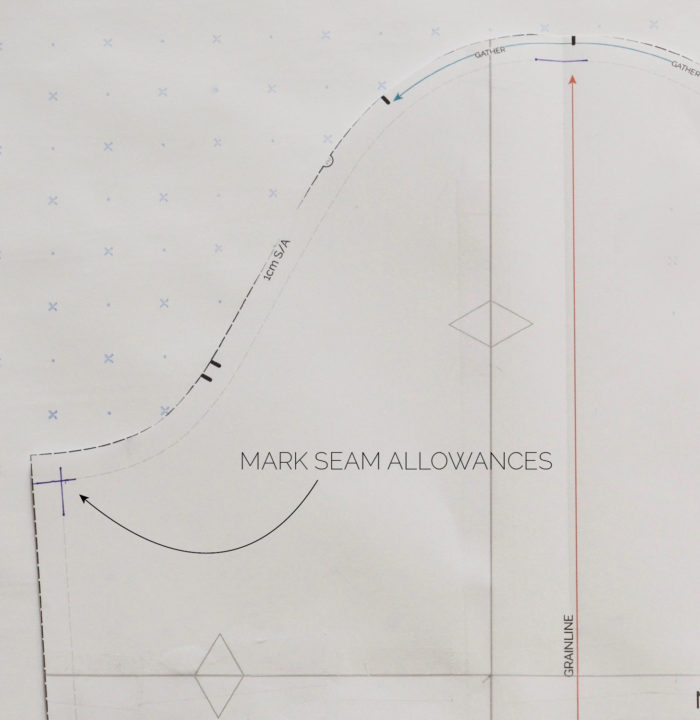
STEP 1: Mark the seam allowances. You can mark the whole pattern piece but you can just do each intersection: at the underarm, sleeve head, hem.

THE BICEP ADJUSTMENT TUTORIAL_MAVEN PATTERNS

STEP 2: Draw a horizontal line joining the underarm points together, this is the BICEP LINE. Halfway along the bicep line (fold the pattern in half to mark it) draw a vertical line at a right angle to the bicep line the entire length of the pattern. It should be parallel (or in the same place as) the grain line.

BICEP ADJUSTMENT TUTORIAL_MAVEN PATTERNS

STEP 3: Cut along the lines up to the seam allowance (NOTE: I’m using the Kitty sleeve pattern that has no hem allowance as it is finished with a binding, so I’ve cut straight through).

MY TIP: I like to work with a larger piece of paper behind my pattern piece and then on it draw a horizontal line (for the bicep) and a vertical line (the dashed orange lines above). It’s a good guide to make sure your sleeve pattern stays square and doesn’t go skew-whiff! Some cutters don’t do this and are happy to just slide a piece of paper behind the pattern and tape in place to fill the gaps later. Each to their own, neither is right or wrong, as always pros and cons for either!BICEP ADJUSTMENT TUTORIAL_MAVEN PATTERNS

STEP 4: Snip from the outside of the pattern, back toward the seam allowance, leaving 2mm of paper, to make a hinge to help pivot the pattern. They do rip apart, it’s not a big deal, just use pins or tape to anchor in place as a backup/alternative to help when pivoting the pattern into position. The large piece of paper is handy to pin to.

NOTE: All the pivoting will be done from the SEAM ALLOWANCE line, not the outside edge of the pattern.
BICEP ADJUSTMENT TUTORIAL_MAVEN PATTERNS

| TO INCREASE THE BICEP |

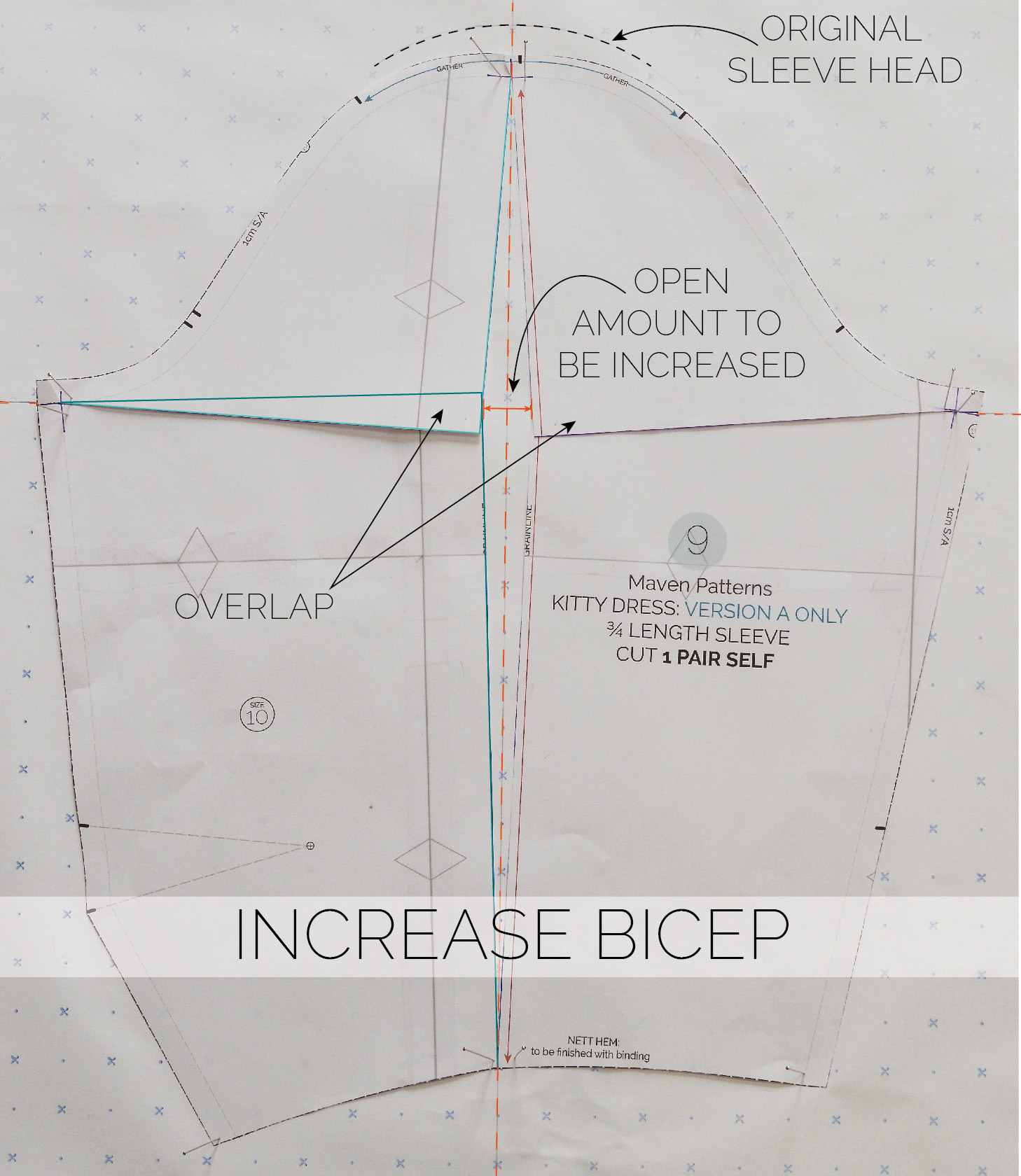
Mark the amount you want to INCREASE the bicep by on the bicep guideline, either side of the vertical line. (I’m going with 2cm = 1cm each side of the line)

Line up the sleeve with the guidelines and then gently slide the underarm points outwards along your guide bicep line until you have gained the extra you need in the middle of the pattern. Anchor them down with a pin or tape.

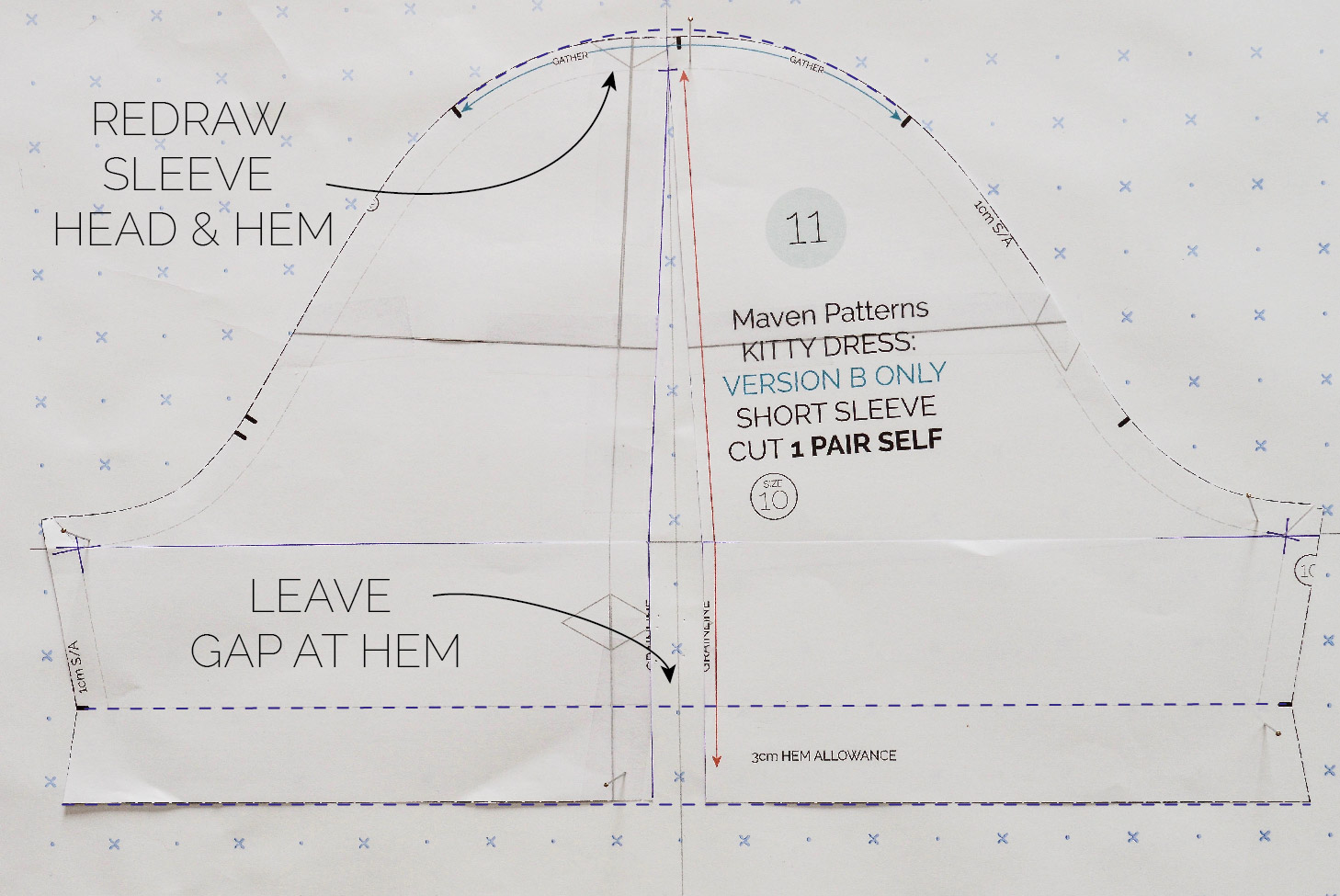
The hinges will help pivot your pattern into place, keep the hem and sleeve head on the vertical line. As the bicep gets wider, the sleeve head will automatically lower and overlap the lower portion of the sleeve. Crucially, the sleeve will still fit into your armhole because the sleeve head is the same measurement. You will probably need to redraw the sleeve head and hem to smooth the line. (See short sleeve picture below).

When you are happy, tape your pattern back together.  You can just tape in that new extra bit in the middle and cut away the excess, or trace off the whole new pattern piece.

THE BICEP ADJUSTMENT TUTORIAL_MAVEN PATTERNSClose up of one section

You can see how the pattern spreads, raises in the centre and lines up with the guidelines.
BICEP ADJUSTMENT TUTORIAL_MAVEN PATTERNS

| DECREASE BICEP |

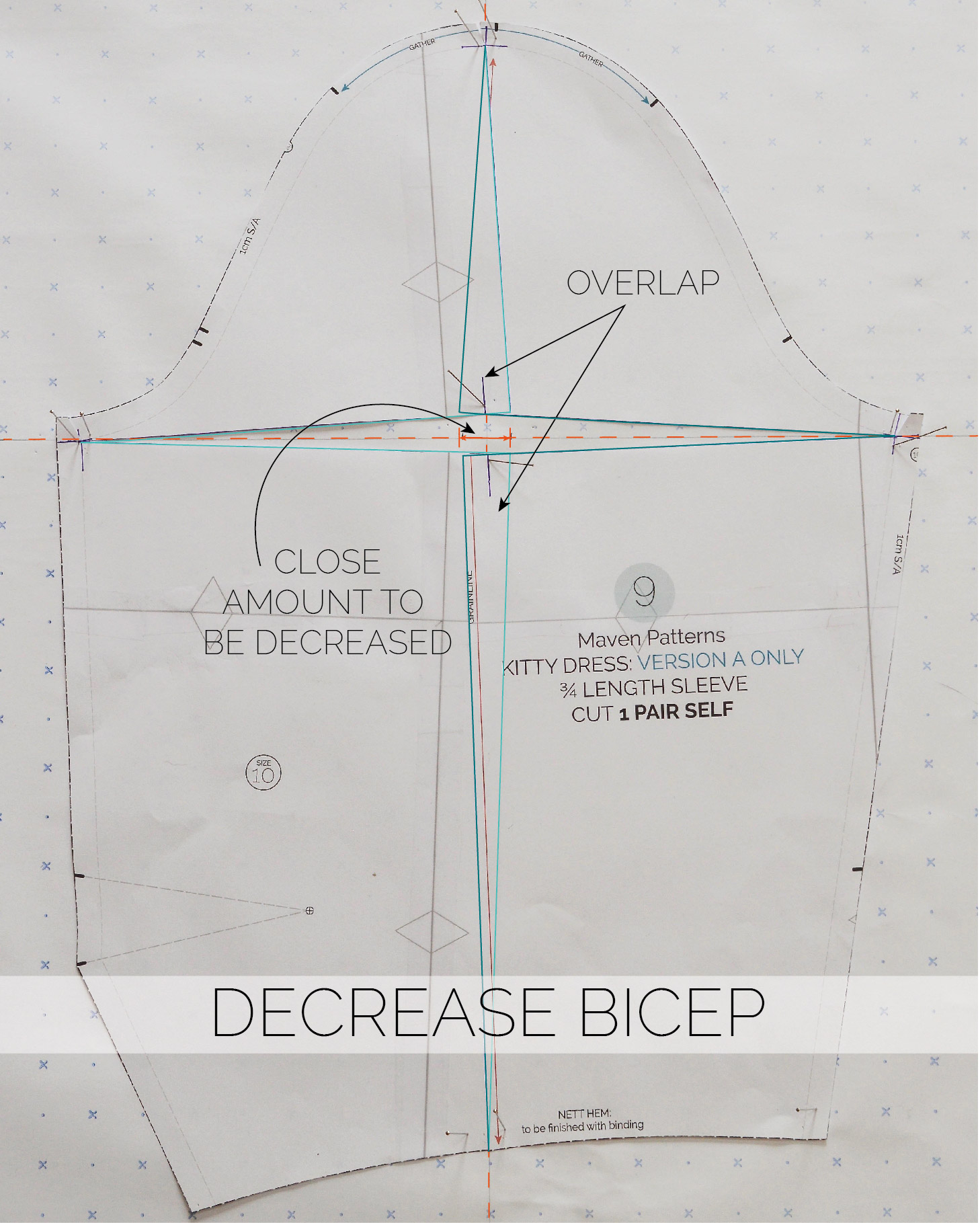
This uses exactly the same principle as before. We just decrease the bicep measurement by OVERLAPPING the pattern at the centre, rather than spreading it apart. When you decrease the bicep measurement, the sleeve head raises in height. Redraw the sleeve head and hem to smooth if necessary. Tape back together or trace off the pattern.
BICEP ADJUSTMENT TUTORIAL_MAVEN PATTERNS

 | SHORT SLEEVE |

Add to your bicep measurement in exactly the same way as the long sleeve.  At the hem, you need to cut through and leave a gap to allow for the extra ease. Mine is pretty much parallel all the way down from the bicep, as I wanted to keep the underarm seam at the same angle. You can also see how I’ve redrawn the sleeve head and hem, it’s not a lot, just enough to create a smooth line.

| RESULTS |

So now you have a new sleeve pattern, with an adjusted bicep. You need to toile (make a test) now, just check it’s working for you. You may need to tweak and add or reduce the bicep again.

Posted on 6 Comments

New Pattern: The Kitty Dress!

THEKITTYDRESS_MAVENPATTERNS-21

It’s August Bank Holiday here in England and traditionally the whole of the UK either queues in traffic on the M5, or does a spot of DIY, falls off a ladder and queues up in the local A & E. Let me save you from all that bother….I have a much better idea. Let’s make a dress instead…

I’m so pleased to announce the release of a new pattern…welcome to The Kitty Dress!THE KITTY DRESS_MAVEN PATTERNS

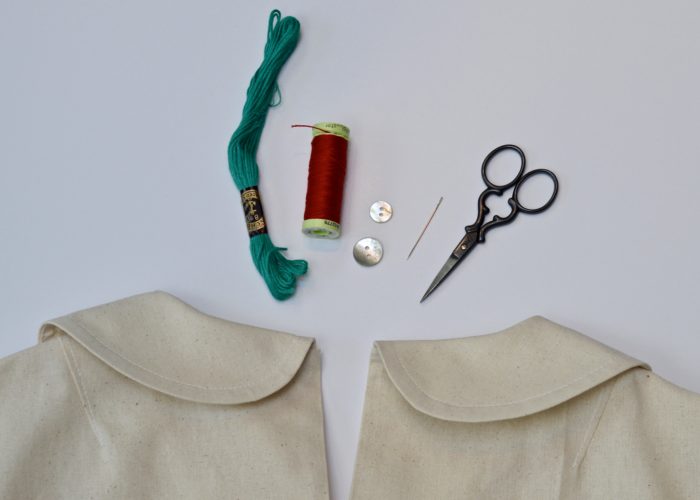
Kitty is a great addition to your wardrobe, a semi-fitted shift style dress with 2 sleeve options – ¾ length with a bound hem or a short sleeve, a Peter Pan collar and bust dart detail. She is fastened at the back neck with a button and loop closure…no zip to sew! (you’re welcome). Oh, and she has in-seam pockets too!

THE KITTY DRESS_MAVEN PATTERNS

The ¾ sleeve version is just perfect for Autumn, just wear her with tights and boots and BOOM! you’re ready to face the winter sun! The ¾ sleeve has elbow darts, one of my favourite details. Topstitching makes a big appearance on Kitty, the darts – bust, elbow and shoulder darts, along with the centre front and back seam are edgestitched and the peter pan collar is footstitched, but you can leave this off if you prefer – the joy of making is you get to decide! (Watch out for an up coming Top stitching Tutorial)

THE KITTY DRESS_MAVEN PATTERNS

Version B is the short sleeve option; both sleeve styles have a gently gathered sleeve head. Having the 2 sleeve options is great, I like to have all wardrobe/weather eventualities covered…I don’t know about where you live but I spent last weekend thinking about cosy jumpers and then it hit 30° on Tuesday! 

And as a little Bank Holiday gift…you can get 20% off The Kitty Dress for the rest of August!

BLOG POST-57

THE KITTY DRESS_MAVEN PATTERNS_COLLAGE


THE KITTY DRESS_MAVEN PATTERNS

KITTY ON ETSY

THE KITTY DRESS_MAVEN PATTERNS_DETAILS

Fabrics: Ruby red organic cotton crossweave from Raystitch (¾ sleeve version)

Denim – Ikea tablecloth(¾ sleeve version)

Indigo linen spot from Guherie & Ghani (short sleeve version)

Teal linen (washed and worn!) from Raystich (currently out of stock) but I’ve also got some from Fabrics Galore

                         Thanks to my lovely model Eve, and photographer Emilie


Posted on

PATTERN HACK…How to make an Off the Shoulder Top!

Off The Shoulder Tops…

THEWENDYARTISANSMOCK_OFFSHOULDERTUTORIAL_MAVENPATTERNS-28


…they’re everywhere this summer, aren’t they? I’m not one to usually bother with fashion trends. I’m not a big fan of buying or especially making clothes unless it’s something I really love and will wear loads. I do, however, like to get the maximum mileage out of a pattern, fabric and mostly out of my time. I thought about this trend for a while and came to the conclusion the off the shoulder top, or The ‘Bardot’ Top (or as my eldest called it Bar-Dot, worth writing a tutorial just for that!), could actually become a holiday summer basic.

I started with The Wendy Artisan Smock pattern and thought this would be a great little pattern hack to share. It does make the most perfect beach cover-up, just lengthen your pattern to get the leg coverage you are after. It would also make a delightful holiday dress with a little tie belt at the waist too. I’ve made it in an embroidered spot voile. Beautiful fabric – but be warned, it is quite sheer in the white if you are going down the dress route!

And I thought I should probably share it now as in England we’ve had more than 3 days of glorious sunshine this summer, and it’s now 50/50 (yes, I know that’s being optimistic) for the rest of August wether we get any more sunshine.

OFF THE SHOULDER TOP TUTORIAL_MAVEN PATTERNS

| SUPPLIES |

Wendy Artisan Top Pattern, Tape measure, Scissors, 1 metre (approx) of 2.5cm wide Elastic, Safety Pin

I recommend, as always, making a toile: it’s a test run in calico or a cheap fabric – you don’t want to waste your favourite fabric on a less the perfect top!

  1. Cut out your pattern using VERSION B (with no centre front neck opening) and don’t cut the binding pattern.
  2. NECKBAND: cut one long rectangle 7.5cm wide  x  SMALL: 123cm long / MEDIUM: 128.5 cm long / LARGE: 134cm long. It can be cut along the selvedge or across the fabric width on the straight grain. 

OFF THE SHOULDER TOP TUTORIAL_MAVEN PATTERNS

Make up your top, following the instructions in the pattern: Attach pockets and sleeves, close side seams.

Cut neckline down by 4cm. Of course you could trim down your pattern pieces before cutting out your garment.

OFF THE SHOULDER TOP TUTORIAL_MAVEN PATTERNS

Press the neckband in half length wise

OFF THE SHOULDER TOP TUTORIAL_MAVEN PATTERNS

Join with a 1cm seam allowance to make the neck band into a loop, press the seam open

OFF THE SHOULDER TOP TUTORIAL_MAVEN PATTERNS

| Attach the band |

Pin neckband to RIGHT SIDE of the body. Depending on your fabric your neckline may ‘grow’ as it’s on the bias grain in places, just ease your garment onto the neckband.

OFF THE SHOULDER TOP TUTORIAL_MAVEN PATTERNS

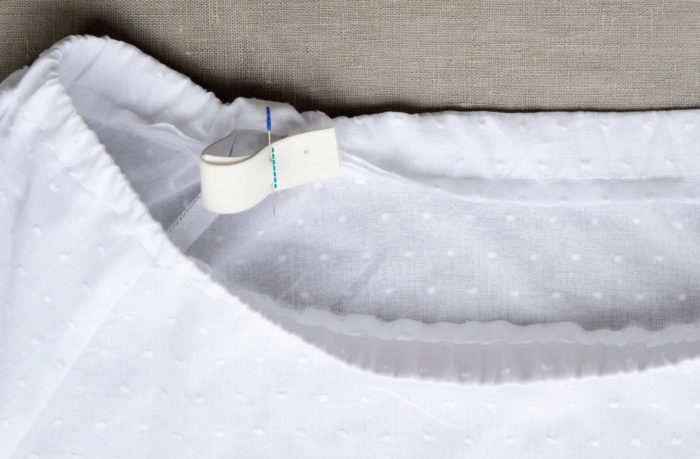
Stitch your band to the body with a 1cm seam allowance. Leave a gap of about 5cm to thread your elastic through.

To get your elastic length: wrap elastic around shoulders where you want your top to sit, pulling slightly so it stretches, and mark. It needs to be tight enough to stay up but not so tight it cuts off the circulation and if it’s too tight it will ride up, too loose and it’ll drop down! Everyone’s measurement will vary as it depends on a lot of outside factors how stretchy is your elastic/ how tight are you comfortable with etc?

OFF THE SHOULDER TOP TUTORIAL_MAVEN PATTERNS

| Thread the elastic |

(This is the same process as the sleeve hem for the Smock) Attach a safety pin to your elastic to help thread it through the neckband channel. Once threaded lay the elastic with the ends flat on top of each other and stitch where you marked it earlier. Try your smock on and see how that elastic feels, now is the time to adjust if you need to. Once you are happy, make sure that elastic is stitched securely, and trim away excess elastic.

OFF THE SHOULDER TOP TUTORIAL_MAVEN PATTERNS

Then just stitch the gap closed, and neaten the raw seam allowance.

OFF THE SHOULDER TOP TUTORIAL_MAVEN PATTERNS


Now just enjoy the sun in your off the shoulder top, like the fashionista you are!