We have a new pattern release to share with all of you lovely sewing ladies…
I’m so pleased to put this style out, I’ve loved working on this new pattern so much!
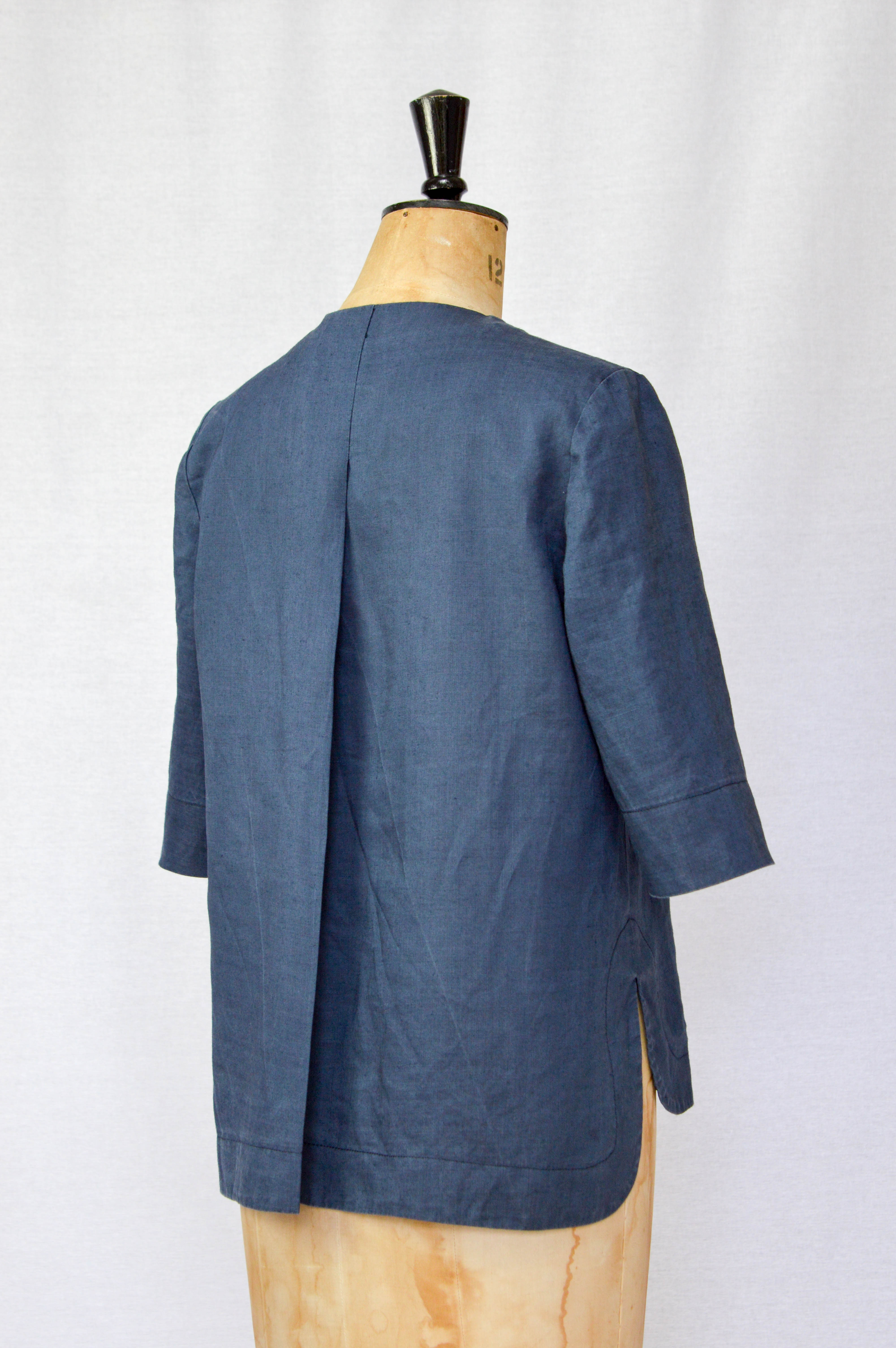
The Rochester has been designed with simple, understated styling in mind. She’s an easy to wear style with a relaxed fit and a slight A-line shape, but fitted at the shoulders for a flattering look. She has a deep centre back pleat, curved hem and side splits with stitched facing and elbow length sleeves.
You have the option to make a top (approx. mid hip length) and a knee length dress. The neckline is elasticated and gathered, so NO ZIP needed – you’re welcome! The top has a small frilled edge on the neckline and the dress has a clean edge but as the pattern is exactly the same and the difference is in the construction they are totally interchangeable – even as you are making them!
We’ve set the sewing skill level as intermediate, the tricky bit is stitching the hem (see the tutorial here) but if you have a little experience and like a challenge, do join in the fun!
DESIGN FEATURES:
SEWING SKILL LEVEL: intermediate
Version A: The Top (mid hip length approx)
Version B: The Dress with tie belt (knee length approx)
Elasticated and gathered front neckline
Elbow length sleeves
Curved hem and side split with feature topstitching
Centre back pleat
In-seam side pockets (dress only)
NO ZIP!
Easy to shorten or lengthen, with guides on your pattern
Unlined
PATTERN FEATURES:
LAYERS FEATURE: select and only print the size(s) you want
MULTI SIZE PATTERN: UK SIZES 8-18
SEE PHOTOS FOR SIZE CHART & FABRIC REQUIREMENTS
Illustrated guide (ENGLISH ONLY) to printing your pattern and sewing your tunic
Fully supported with PHOTO TUTORIALS
Includes seam allowances.
Can be printed on either A4 or US letter paper, using ADOBE ACROBAT READER
A0 copyshop file (2 sheets)
This lightweight linen has worked really well for the top, choose a woven fabric that will be happy to accommodate that gathered neckline…linens, chambrays, lawn or viscose. The dress is made in the most wonderful crepe but it wasn’t happy with the frill – hence the 2nd neck option.
This hem detail is one of my most favourite things – there is a template included in the pattern to give you a topstitch guide line to make life easier! I’ve also added ‘length/shorten your pattern here’ guidelines on the pattern for The Rochester so you don’t have to worry about the curves and the facing if you need to make any length adjustments. The dress is approximately knee length (Eve is 5’4″ as a guide).
Oh and pockets…always need pockets in a dress. Looks good without the tie belt too!
I hope you all love our new pattern, The Rochester, as much as we do xxx
You can get 20% off the usual price until midnight (GMT) on Sunday (21/5/17)
I’m so pleased to be able to share with you Marie-Fleurine’s Kitty dress. As soon as I saw these pictures of Fleurine, wearing her Kitty dress with that contrasting peter pan collar in the snow, I was totally smitten!
She has used a beautiful handwoven cotton from Karlotta Pink, a company with strong ethical views that works closely with weavers in India (and across the world).
These handwoven fabrics are two toned, having used a different colour thread for the warp and weft threads. Fleurine has made the most of these gorgeous fabrics by selecting a blue/mustard for the body of her Kitty dress and a contrasting gold/brown for the peter pan collar and covered button. I have just purchased 3 metres of the green/black colourway, to use for my next pattern. You have no idea how long I have been looking for the perfect green cloth! (only about 2 years….)
I don’t really need to say anything else…I’m going to let Fleurine’s beautiful pictures and the magical Norwegian light do the talking.
A huge thank you to Fleurine for allowing me to share her pictures. You can read Fleurine’s thoughts on The Kitty Dress and sewing her handmade wardrobe on her blog Sew MarieFleur. Impressively she only started sewing in 2015!
I urge you to go and take a peek at Karlotta Pink. Their fabrics are beautiful. Their beliefs are firmly rooted in sustainability, fair trade and empowering women.
How do you do a Full Bust Adjustment with a centre front dart? This tutorial walks you through the slash-and-spread method for adjusting a bodice with a centre front bust dart, so you can add room where you need it while keeping the shoulder, neckline and armhole balanced. It also covers how to measure your bust, find the bust point and reshape the pattern so your finished garment fits more comfortably.
There I said it…does that little phrase strike fear into your heart? FBA – a full bust adjustment tutorial. It’ll be fine….but get comfy…and maybe get some snacks….this is a looong post. Oh, and right up front, I’m going to say – a toile (or two) is going to be your friend for this one, people.
There are actually a gazillion (I counted) tutorials for a Full Bust Adjustment (FBA), all of them great if you have a bust dart at the side seam, or no dart, or princess seams. But I can’t find one for a dress with a dart at the centre front seam like KITTY, but it’s the same principal – slash and spread. And honestly, I have actually never done a Full Bust Adjustment for myself (I’m a B cup) and the patterns I’ve produced for industry for the great British High Street are also drafted for a B cup.
So, while knowing the theory, I had no go-to, tried and personally tested method to recommend. Which has led to a lot of research into this tutorial…and why it’s taken me so long to finish it.
At this point, I would like to say a BIG shouty THANK YOU! to Rachel, Queen of the French Dart Shift, who very kindly confirmed my research for me, when after looking at every FBA tutorial in the Universe I became, what can only be described, as bust blind!
Why would you need to do a full bust adjustment?
Sewing patterns are generally (and there are exceptions) drafted to accommodate a B cup. All Maven Patterns are drafted with a B cup. Unfair I know, but unfortunately, it’s just not possible for us to produce a pattern that will keep every body shape happy, the variations are limitless! Sorry.
So, great if you are a B cup, but not so much if you are bigger (or smaller). In which case you might need to do a Full Bust Adjustment – FBA (or a Small Bust Adjustment – SBA). Today I’m concentrating on the FBA, as that’s the one I’m getting asked about.
Small Bust Adjustment side note: A SBA is basically the same process, but involves overlapping the pattern to reduce instead of spreading the pattern to increase the bust cup size. If you need a Small Bust Adjustment, there will be too much fabric over the bust area, and your bodice will be too long at the centre front.
How do you know if you need a full bust adjustment? Your toile may be gaping at the armhole, will have drag lines pointing to the bust, and probably looks a bit ‘strained’ over the bust, your girls just look a little squashed in there!
What you need is more width and length to your pattern at the right place– to go over and around a fuller cup. The idea is to do this without messing about with your armhole and sleeve too!
You may have already done a FBA and have a good idea of how much to add, feel free to jump straight down to the fun slash and spread bit!
Which cup size are you? Let’s take some measurements.
Measure yourself while wearing the appropriate underwear. If you are going to wear a padded bra under your dress, go put one on first – it will make a difference to the fit.
Importantly, your cup size for a sewing pattern is not the same as your bra cup size. (I’m a B for a pattern, and wear a D bra)
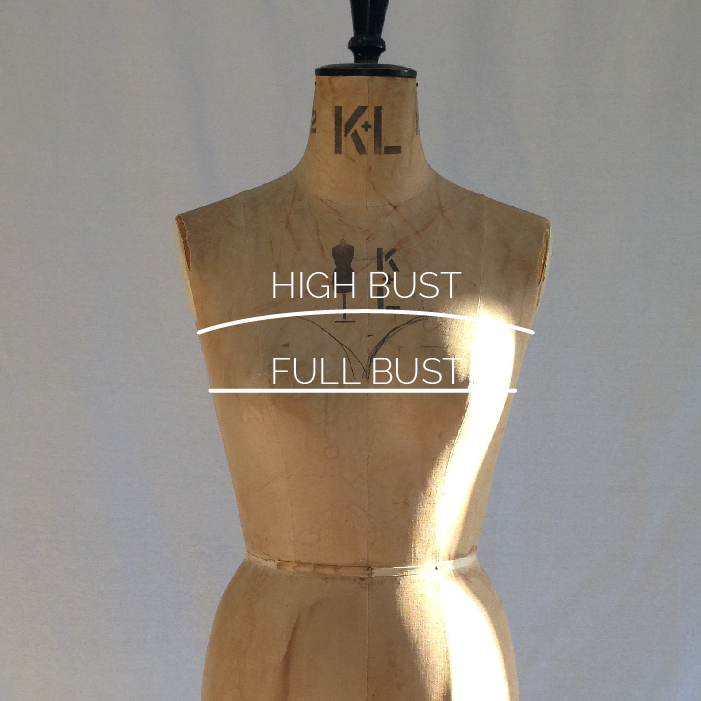
Measure your HIGH bust across your back, under your armpits and above your bust.
Then measure your FULL bust, at the fullest part of your bust.
Note these measurements and the difference between them.
Difference of 1 ½” (4cm) = A cup (SBA)
Difference of 2″ (5cm) = B cup
Difference of 3” (6.5cm) = C cup (FBA)
Difference of 4” (10cm) = D cup (FBA)
Difference of 5” (12.5cm) = DD cup (FBA)
Pick your size
If you are above a B cup you’ll probably need to do a FBA and should select your size by using your HIGH bust measurement in place of your FULL bust measurement.
This is the most common and popular method, by far, because it will give a better fit in the shoulders and neck area, then you just do a FBA and adjust for a fuller bust. If, on the size chart, you have a size 16 full bust, but a high bust measurement of a size 12, chances are the shoulders of a size 16 pattern will be completely out of proportion for you! You may need to adjust or blend between sizes for hips and waist.
The Million Pound Question – How much to add?
There isn’t a definitive answer to this bit, there are more options than those I’ve listed here, but for clarity I’ve chosen these two**. There is not one way to do this alteration (or any alteration). It can be a little test and see, and a lot of getting to know your OWN body and how you like a garment to fit on you.
Take these measurements as a guide. You’ll need to toile and test and tweak your alteration, maybe more than once. Like I said…a toile is your best friend – the fabric doesn’t lie! Also consider the look of the garment, a looser fitting garment might not need as much adding as a very fitted garment. Or you might just decide you want more/less ease and adjust your FBA accordingly.
It is very much trial and error the first couple of times, but once you know what works for you, it’ll be so worthwhile.
**For those interested I have an APPENDIX at the very end of the tutorial with ‘Other Thoughts on The How Much To Add?’ question.
METHOD 1 / Cut open your toile
Make a quick toile (just the body, don’t bother with sleeves, collar etc) and mark your bust point. CUT open your toile and see how much you need. With the Kitty dress having a Centre Front seam you can just open up here and see how much needs to be added at the bust.
Remember when you are adjusting the pattern you are working with HALF a body front, so if you have 1 ½” (4cm) gap at you CF, you’ll need to divide it by 2 and add ¾” (2cm) to each side.
With other styles you could cut a cross in the fabric at your Bust Point / Apex, let it spread open and then measure how much extra you need. (For a SBA, instead of slashing a cross, pin the excess out of the bust)
I like this slash and spread and see what you need method. Pay attention to the neck and shoulders of your toile, and see if they fit or if a size smaller/bigger would look better on you. Or you may need to do a shoulder alteration as well.
METHOD 2 | Maths
Take your FULL bust measurement and minus your HIGH bust measurement = TOTAL amount to add, DIVIDE TOTAL by 2 = the amount to be added to pattern (as we are altering HALF a body front)
For example:
My imaginary friend MARGO has a 34” (86.5cm) high bust, her full bust is 37” (94cm) which is a difference of 3” (7.5cm) making her a C cup.
High bust measurement of 34” places Margo as a UK size 10 on the Maven Body Measurement Chart, so she selects that size. (Her full bust of 37” would put her between a UK 12/14)
The difference between Margo’s HIGH BUST and FULL BUST is 3” (7.5cm), this is the amount she needs to add in TOTAL as a FBA, so she adds 1 ½”( 3.8cm) to half a dress front pattern.
The Fun Slash and Spread Bit
EQUIPMENT:
COPY OF PATTERN PIECE (OR ABILITY TO REPRINT ORIGINAL)
RULER
PENCIL
STICKY TAPE
TAPE MEASURE
PAPER SCISSORS
PATTERN PAPER
TRACING WHEEL (optional, but very useful)
Find the BUST POINT (also called the APEX)
Using a copy of your front pattern mark on the seam allowances so you know where the stitch line is.
Draw a line through the centre of the bust dart, and extend it 1” (2.5cm) the dart tip. That is the bust point of the pattern.
Mark your Bust point (BP) on the pattern (either transfer it from your toile or just hold the pattern up against yourself). (Tips how to measure your BP here)
Compare your BP with the pattern BP. You may need to lengthen/shorten your dart so it aligns with your BP.
If the dart is too high for your bust, don’t worry about lowering the dart yet as the FBA will make the dart drop a little anyway ¼” to ½” (6mm – 12mm) and we can adjust this later. If you are very low busted, you can lower the dart a little now, and then go back and get it perfect later.
Draw the lines
1. LINE 1: Draw a line from the BUST POINT (BP) right down to the hem, parallel with the grain line. Draw a line from the BP to ⅓ of the way along the armhole.
2. LINE 2: Draw a line from BP towards CENTRE FRONT LINE (CF) through centre of the dart.
3. LINE 3: Draw at a right angle from line 1 to intersect CF (not crucial where, I went half way between waist and dart).
4. LINE 4: Draw a line from BP slightly above bust dart intersecting CF
5. Draw in the WAIST: Use the notch on the CF and draw a line straight across to the side seam at a right angle to the grainline.
Cut the lines / slash and spread
6. Cut along LINE 1. Start at the hem and cut towards the armhole. Cut UP TO stitch line but NOT through it. Cut from OUTSIDE of the pattern up to the same point on the armhole stitch line, leaving a 3mm hinge of paper.
*if you hinge your armhole from the outside edge of the pattern instead of the stitch line, your armhole increases in length and then your sleeve won’t fit properly.
7. Cut along LINE 2 through centre of bust dart towards the BP, leaving a hinge at BP.
8. Mark sections A, B, C & D as in diagram
9. Place some paper behind your pattern piece. Anchor down section A with tape or pins. Spread open LINE 1 the amount you need to add for your FBA, pivoting the pattern from the hinges. Keep LINE 1 parallel with each other and the grain line. Let front section slide upwards and allow the bust dart to open wider to keep pattern flat.
Note how the waist is staggered and CF is now too short. Tape section A and B down. Slide a separate piece of paper behind the dart and tape, attaching top dart section back to lower dart in section C.
*When you are taping, be aware that sections C and D still need to move.
10. Cut open lines 3 and 4, no need to leave a hinge this time.
11. Slide section D down so the waist is level again. This creates some extra length in the bodice below the dart.
12. We want a little of that extra length above the bust dart, so slide section C down halfway into that space created at LINE 3, so it is now evenly distributed above and below the dart. Fill any gaps with paper and tape everything down.
13. Redraw your bust dart. Remember, the tip of a bust dart is usually 1” (2.5cm) from the BP, but this can change depending on you – it could be ½” (1.2cm) if you are small busted and up to 3” (7.5cm) if you have a fuller bust.
14. Fold your bust dart as if you are stitching it, with the bulk of the dart downwards, and true your CF seam(redraw your CF line so it is a smooth line). Use a tracing wheel or cut along the edge of your pattern to create your dart extension.
14. Now you get to toile your alteration! You can pin the paper pattern together and try it on to check the dart position first. I like to toile after a major alteration and prefer to see it in fabric.
You may still need to lower your dart, and if you need a little more detailed explanation of truing the pattern and creating a bust dart extension, my Lower a Bust Dart Tutorial will help!
APPENDIX / Other Thoughts on The How Much To Add Question?
I really did do a lot of research for this tutorial, and came across these solutions too.
If we go back to METHOD 2: Maths(The Full bust – High Bust = TOTAL, divided by 2 = amount to add to pattern method) for a minute – which I know for a fact works in the real world – imaginary friend Margo would be adding a total of 3” to her bust area .
At this point I carried on researching because that seems an awful lot of fabric to add in, when Margo’s boobs are only 1” bigger than mine, and I happily wear a UK size 10 with no FBA.
Personally, my HIGH bust is 34”, FULL bust 36”, difference of 2”. While I don’t need a FBA I do in fact wear the size 10, based on my High Bust, for Kitty and The French Dart Shift. I have a regular sized frame across the shoulders and the back and, on me, I prefer the fit in the shoulders of the size 10 rather than that of the size 12. Crucially I also prefer to wear a garment with a more fitted bust area and without too much ease (boxy and shapeless does me NO favours). These things are all worth considering when deciding how much to add.
So….METHOD 2: Maths / OPTION 2: My theory was to take the difference of 3″ and take off the 2” already included in the pattern for a B cup. This gives us a 1” difference (½” on each side) to use for a FBA. This also ties in with several tutorials that have said add ½” per cup size. The Craftsy FBA tutorial says ½” for C cup, increasing by ¼” per cup size. I eventually found this tutorial by Grainline with the same theory. So I’m probably not completely bonkers and if you find you’re adding too much it might be worth a go.
METHOD 3: Don’t use your High Bust to select your size.
That title is not strictly true…Take your high bust measurement and add 2” and select that size to use as you base pattern size, (because that would be the size of your bust if you were actually a B cup, before doing the FBA.) As a pattern cutter, this makes perfect sense!
EXAMPLE: Back to imaginary Margo….34” high bust, 37” full bust and a difference of 3”
34” high bust + 2” for a B cup = 36” means Margo selects a size 12.
37” Margo’s full bust measurement – 36” Maven size 12 body measurement = difference of 1” to add (½” each side).
With Method 3 Margo will be wearing a dress with shoulders and neck one size larger than if she selected her size using Method 2. Margo might want to take this into consideration when she decides which size pattern to use.
You made it to the end, well done! Now, go forth and adjust those busts! Many thanks to my imaginary friend Margo for the use of her imaginary body.
Can you sew the French Dart Shift in jersey instead of woven fabric? Yes, and this post explores how using jersey gives the pattern a softer, more relaxed feel while keeping the clean silhouette that makes the French Dart so wearable. From choosing the right knit fabric to thinking about fit, stretch and finishing techniques, we share how this simple pattern adapts beautifully into an easy everyday piece that feels comfortable, modern and surprisingly versatile.
Firstly, this pattern is not designed for a jersey. So the darts are staying and the knit fabric is more for cosiness and comfort, rather then body con type fit!
Second point…I bought this Ponte online and I’m not a huge fan of it. It feels very acrylic-y but for a toile type garment, it does the job. This particular Ponte reminds me of my girls’ school uniform sweatshirt fabric, although it actually sewed up quite nicely.
I chopped my dress pattern shorter (by 12″) so it would be a hip-length top without pockets and made with a 3/4 length sleeve (tutorial here). I had ideas of looking Audrey Hepburn-esque. I stitched the hem in red so it would show up, but school uniform Ponte combined with red stitching actually makes this top look less Audrey in Paris and a little more like British Airways crew outfit. Enough of the styling tips and on with the tutorial…
SEWING JERSEY TIPS
Always use a ballpoint needle so you don’t get skipped stitches.
I used a walking foot, which helped but I don’t think it was essential.
Use a stretch or ballpoint twin needle to create a faux coverstitch for the hem.
Use a stretch stitch.
Test your stitching on a scrap bit of fabric first. Stitch in both directions, along the selvedge and across the width of the knit, to make sure your stitches don’t crack when you pull them. Tension and stitch settings will vary dependant on your machine and your fabric. Sorry, but you need to get friendly with your manual!
Don’t pull and stretch your fabric as you sew.
If your seam goes a bit wavy after stitching, very gently steam and press flat.
My machine tried to swallow the garment into the footplate at the beginning of a seam, so I placed a piece of paper under the garment before stitching. I had some heavy tissue paper handy but the off-cuts from printed Indie sewing patterns would be perfect!
STITCHES
There are a couple of options for stitching your seams.
TEST YOUR STITCHES ON A SCRAP OF FABRIC FIRST! I have since written a post on SEWING WITH KNITS – HERE.
stretch stitch (sometimes called lightning stitch)
zig zag on a narrow width and 2.5-3mm length (I used this as was quicker than the lightening stitch, and set my stitch width to 0.5 and stitch length to 2).
I also tested just using a straight stitch, and it was OK on this fabric (stretch as you stitch) but probably not very reliable on a stretchier jersey.
Overlocker – you can cut, sew and neaten your seams all in one go. 3 threads are usually just used for neatening seams, 4 (or 5) threads for all in one seam stitching as it makes for a stronger seam. The pattern has 1cm allowances for the body and 6mm at the neckline so be sure not to cut off more than you should!
To neaten your seams either use a zig-zag or overlock together. You could in theory just stitch and leave them raw as the fabric doesn’t really fray, but it seemed a bit lazy.
Sewing The French Dart shift In Jersey
METHOD
RST: right sides together CB: centre back S/A: seam allowance
FDS: French Dart Shift WS: wrong side
Refer to your Maker Instructions for detailed descriptions of general methods.
Pre-wash and press your fabric, lay up and cut out carefully.
The collar would normally be cut on the bias for a woven cloth. For a knit fabric cut instead on the straight of grain with the shortest edge of the pattern parallel to the selvedge.
Tape the neck as described in your FDS Maker Instructions. (This style has a wide neck and we don’t need (or want) it to stretch. If you are ever making a t-shirt style that stretches to pull over the head DO NOT TAPE the neck!)
Make all the darts.
TAPE THE SHOULDERS
Measure a piece of stay tape against your pattern by laying on the shoulder line, including the seam allowances. Pin the shoulders with RST and place the tape in place on the stitch line and stitch the shoulders together through the stay tape. Press the shoulder seam open.
Close the side seams and underarm sleeve seams. Neaten together.
Set in the sleeves.
ATTACH THE COLLAR
Stitch CB collar seam, do not neaten. Press seam open.
Fold collar in half with WS together, so raw neck edges are aligned and the seam allowance is enclosed inside the collar.
With RST pin collar onto the body, align collar and body notches and CB collar seam with CB neck.
Stitch together with a 6mm S/A, neaten and press S/A towards the body.
OPTIONAL
Ready to wear t-shirts and sweatshirts often have a row of stitching at the neckline to hold the seam allowance flat. You can twin needle or edgestitch the neckline to mimic this if you wish. Confession: Proceed with caution, I broke my only twin needle when I hit the CB seam, so I continued with an edgestitch. Both look good!
HEM
The pattern has a 3cm hem allowance, press to the WS.
Twin needle the hem (I overlocked the raw edge first), again follow your machine guideline and test. My machine and a twin needle meant not using the walking foot and sewing at a slower speed.
POCKET
As I made a top it was too short for pockets. Side pockets in jersey generally ring alarm bells for me. It’s perfectly possible to do the pockets but also possible the weight of the jersey bag will be lumpy or droopy under the dress or the pocket mouth will stretch and not sit flat. The final result is really going to depend on your fabric and your sewing skills.
If you made a dress version and want to add pockets, I did a test sample. I’ve followed the basic instructions for the FDS pocket but overlocked the side seam together rather than open. *I also didn’t fuse the pocket mouth, unlike the woven version, just to see what would happen really. It was OK but this Ponte is very stable, although next time I would put a small spot of interfacing at each pivot point for extra reinforcement. Again test your fabric to see what works for your jersey, and remember to use the knitted kind of interfacing.
*If in doubt just interface the pocket as the instructions and you could always add an extra strip for the back pocket mouth if you think your fabric needs it.
Attach the pocket bags to the body, but don’t overlock.
Understitch the front pocket bag
Pin front and back with RST and stitch side seam and around the pocket bag. Reinforce at pivot points.
Neaten the side seam and around the pocket bag together.
Overall I’m rather pleased with sewing The French Dart Shift in jersey. The collar is lovely in knitted fabric and it makes a very cosy and comfortable little top now that Autumn is upon us!