Posted on

PATTERN HACK…How to make an Off the Shoulder Top!

Off The Shoulder Tops…

THEWENDYARTISANSMOCK_OFFSHOULDERTUTORIAL_MAVENPATTERNS-28


…they’re everywhere this summer, aren’t they? I’m not one to usually bother with fashion trends. I’m not a big fan of buying or especially making clothes unless it’s something I really love and will wear loads. I do, however, like to get the maximum mileage out of a pattern, fabric and mostly out of my time. I thought about this trend for a while and came to the conclusion the off the shoulder top, or The ‘Bardot’ Top (or as my eldest called it Bar-Dot, worth writing a tutorial just for that!), could actually become a holiday summer basic.

I started with The Wendy Artisan Smock pattern and thought this would be a great little pattern hack to share. It does make the most perfect beach cover-up, just lengthen your pattern to get the leg coverage you are after. It would also make a delightful holiday dress with a little tie belt at the waist too. I’ve made it in an embroidered spot voile. Beautiful fabric – but be warned, it is quite sheer in the white if you are going down the dress route!

And I thought I should probably share it now as in England we’ve had more than 3 days of glorious sunshine this summer, and it’s now 50/50 (yes, I know that’s being optimistic) for the rest of August wether we get any more sunshine.

OFF THE SHOULDER TOP TUTORIAL_MAVEN PATTERNS

| SUPPLIES |

Wendy Artisan Top Pattern, Tape measure, Scissors, 1 metre (approx) of 2.5cm wide Elastic, Safety Pin

I recommend, as always, making a toile: it’s a test run in calico or a cheap fabric – you don’t want to waste your favourite fabric on a less the perfect top!

  1. Cut out your pattern using VERSION B (with no centre front neck opening) and don’t cut the binding pattern.
  2. NECKBAND: cut one long rectangle 7.5cm wide  x  SMALL: 123cm long / MEDIUM: 128.5 cm long / LARGE: 134cm long. It can be cut along the selvedge or across the fabric width on the straight grain. 

OFF THE SHOULDER TOP TUTORIAL_MAVEN PATTERNS

Make up your top, following the instructions in the pattern: Attach pockets and sleeves, close side seams.

Cut neckline down by 4cm. Of course you could trim down your pattern pieces before cutting out your garment.

OFF THE SHOULDER TOP TUTORIAL_MAVEN PATTERNS

Press the neckband in half length wise

OFF THE SHOULDER TOP TUTORIAL_MAVEN PATTERNS

Join with a 1cm seam allowance to make the neck band into a loop, press the seam open

OFF THE SHOULDER TOP TUTORIAL_MAVEN PATTERNS

| Attach the band |

Pin neckband to RIGHT SIDE of the body. Depending on your fabric your neckline may ‘grow’ as it’s on the bias grain in places, just ease your garment onto the neckband.

OFF THE SHOULDER TOP TUTORIAL_MAVEN PATTERNS

Stitch your band to the body with a 1cm seam allowance. Leave a gap of about 5cm to thread your elastic through.

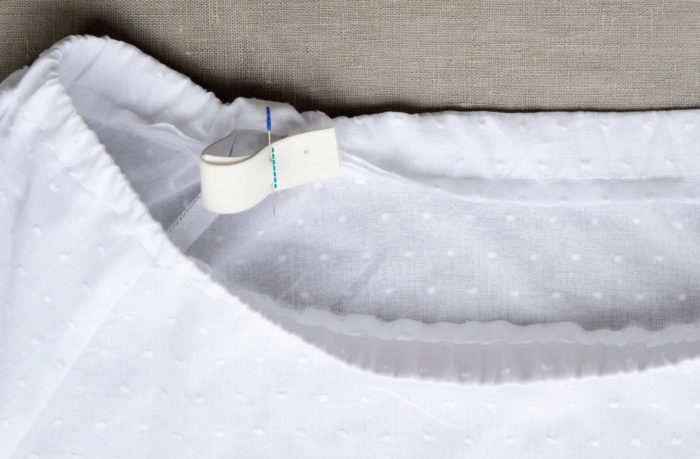
To get your elastic length: wrap elastic around shoulders where you want your top to sit, pulling slightly so it stretches, and mark. It needs to be tight enough to stay up but not so tight it cuts off the circulation and if it’s too tight it will ride up, too loose and it’ll drop down! Everyone’s measurement will vary as it depends on a lot of outside factors how stretchy is your elastic/ how tight are you comfortable with etc?
OFF THE SHOULDER TOP TUTORIAL_MAVEN PATTERNS

| Thread the elastic |

(This is the same process as the sleeve hem for the Smock) Attach a safety pin to your elastic to help thread it through the neckband channel. Once threaded lay the elastic with the ends flat on top of each other and stitch where you marked it earlier. Try your smock on and see how that elastic feels, now is the time to adjust if you need to. Once you are happy, make sure that elastic is stitched securely, and trim away excess elastic.

OFF THE SHOULDER TOP TUTORIAL_MAVEN PATTERNS

Then just stitch the gap closed, and neaten the raw seam allowance.

OFF THE SHOULDER TOP TUTORIAL_MAVEN PATTERNS


Now just enjoy the sun in your off the shoulder top, like the fashionista you are!


Posted on

How to Grade Between Two Sizes

How to Grade Between Two Sizes

We are a unique and amazing bunch of individuals, all different shapes and sizes. Even those of us with the same measurements can be different shapes! You’ll understand them, with the best will in the world, it’s not possible to create a pattern that fits everyone straight off. The best course of action is to arm ourselves with enough fitting knowledge and skills to adjust, as necessary, our patterns to create great fitting garments.

So, what is a girl to do when she falls between different sizes on the size chart? This is where you need to know how to grade between two sizes. This method is also known as blending sizes, and it allows you to use the top half of one size and join to the bottom half of another size.

How do you know?

Once you’ve checked your measurements against the body measurement chart, may well find you cross 2 sizes, perhaps your bust is measuring for the size 12 and your hips are measuring for the size 14.

Take a look at the garment measurement chart – a looser fitting garment may give you that extra you’re looking for. I often find, that for me, this is the case for the waist on a less fitted style – no alteration needed!

You made a toile: perhaps your dress is a little too snug on the hips but great on the bust… then this one’s for you.

WARNING: If your toile is pulling because of a fuller tummy or bottom, or because you actually need to do a full bust adjustment this alteration may not do the trick, this is really just to add a bit of extra wiggle room.

How To Grade Between Two Sizes Tutorial_MAVEN PATTERNS-36

Tools:

  • your nested pattern
  • contrast coloured sharp pencil
  • french curve/pattern master (optional)

GRADE BETWEEN SIZES 01_TUTORIAL_MAVEN PATTERNS-01

If you have a pattern that is layered, use that option to select and print only the sizes you need.

Then all you need to do is draw a line from one size to the next, use a contrasting colour so you can easily see which line to follow later.

In this case I’ve used the bust from the UK size 12 and the hip from the UK size 14.GRADE BETWEEN SIZES TUTORIAL-03

It’s important to make a nice smooth line, remember bodies are rounded, so keep your lines curved rather than joining to each other in a point. A french curve or a Pattern Master is really useful and a good investment for the long term. But, you can also use the pattern as a guide by copying the side seam shape on to a piece of paper, cutting it out and using it as a template between your sizes. It will need pivoting between points, and the line will change but it does give a good starting point.

GRADE BETWEEN SIZES 01_TUTORIAL_MAVEN PATTERNS-01Of course it works the other way, to allow for smaller hips / larger bust combination too (but sadly not instead of a full bust adjustment).

Good To Know:

  • The Chain Effect: Alter all corresponding pattern pieces so they still fit together and the pattern stays balanced.
  • Front and backs need the SAME treatment.
  • This dress has a side seam pocket, as the side seam shape has changed, the pocket pattern needs to be checked against the side seam to make sure it still fits and adjusted if not.
  • Make sure the correct size sleeve pattern is selected, it should be the same size as your selected bust size, so it still fits into the armscye (Fancy word for armhole. Don’t ever get put off by terminology – that is possibly the first time I’ve ever actually used the word armscye , & I’ve been doing this since I was 16!)

NOW CHECK YOUR PATTERN FITS TOGETHER: nice smooth line? side seams the same length? 

Well done – NOW, YOU NEED TO DO ANOTHER TOILE! 

But, it’ll be worth the effort because you are going to have a beautifully fitted pattern you can use again and again, now that you know how to grade between two sizes!


Posted on 11 Comments

Lengthen or Shorten a Sewing Pattern Tutorial

How To Adjust the Length on a Sewing Pattern

This is just about the easiest pattern alteration to do!

You’ve probably noticed, many patterns have horizontal length adjustment lines marked on them to show where to alter the length. I don’t do that on all of my patterns, I prefer a cleaner look. It’s so easy to get in a muddle with too many lines everywhere and so simple to mark any length adjustments only if you need them. This straight forward tutorial will show you how simple it is to lengthen or shorten a sewing pattern, to help achieve a great fit.

TOOLS

  • Your pattern (or copy of your pattern if you don’t want to alter your original)
  • ruler
  • pencil
  • tape
  • paper

Things to be aware of

  • If you are unsure of how much length to add/reduce or even if you need to adjust the length, make a toile first. The silhouette and ease in a garment can make a difference to how long it should be.
  • If you are doing lots of alterations to your pattern, do any length adjustments first.
  • Keep the grainline or “place to fold line” IN A STRAIGHT LINE, do not allow them to stagger.
  • The Chain Effect: when altering one pattern piece, also alter the corresponding pattern piece in the same way and remember to check they still fit together after your alteration. It is very annoying to end up with the front skirt longer than your back skirt!
  • A toile is always your friend if you’ve done lots of (any) alterations!

Step 1

HOW TO LENGTHEN OR SHORTEN A SEWING PATTERN TUTORIAL_MAVEN PATTERNS-01

Once you’ve made a toile, you’ll know how much and where you need to add or subtract length to your garment. You can just change the bodice length, or a skirt length or the sleeve, or all 3!

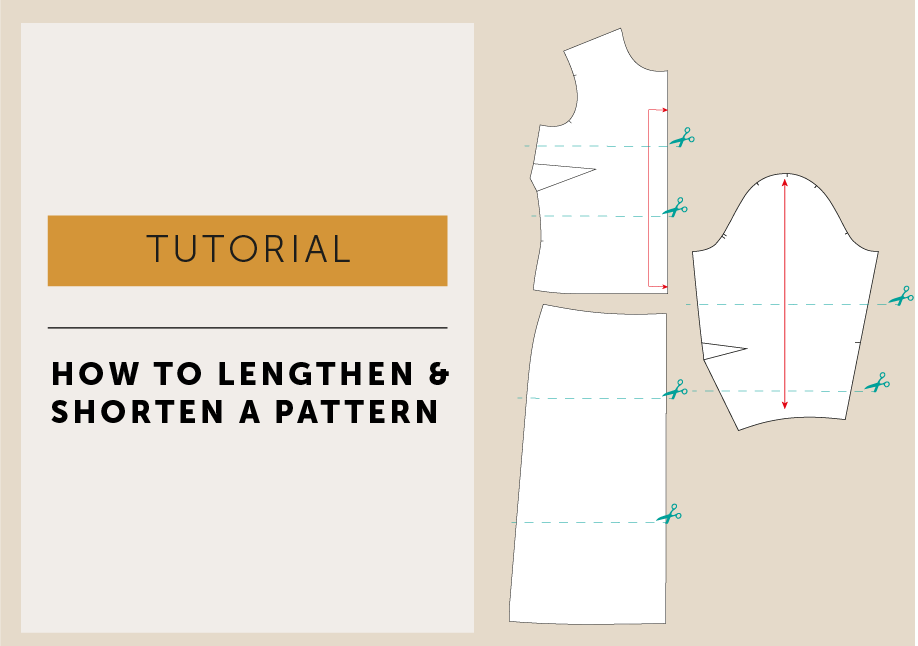
Draw an adjustment line horizontally across your pattern at a right angle to the grainline or to the “place to a fold line”

On a bodice: mark the line above the waist line but below a bust dart, and straight through any waist darts.

On a skirt (or skirt portion of a dress) below the hip line, but avoid any pocket details – no point making life complicated!

On a sleeve: half way along the underarm seam, unless it’s a fitted sleeve or has an elbow dart, then divide between two lines. (See “Good to Know” at the end)

Step 2

Lengthen a pattern

HOW TO LENGTHEN OR SHORTEN A SEWING PATTERN TUTORIAL_MAVEN PATTERNS-02

Cut along the adjustment lines and separate the pattern piece.

Place a piece of paper behind your pattern and tape the top portion of your pattern to it.

Extend the grain line. Draw a line parallel to the your adjustment line the amount you need to lengthen the pattern by. Tape the lower portion of your pattern to the new line, matching up the grainline. Re-draw the seam lines so that they match up again, these may need to be curved or may be straight depending on your pattern piece. It’s quite usual to need to blend the new lines together, adding a bit to one and taking a bit off the other.

Shorten a pattern

HOW TO LENGTHEN OR SHORTEN A SEWING PATTERN TUTORIAL_MAVEN PATTERNS-03

Cut along the adjustment lines.

Place a piece of paper behind your pattern and tape the top portion of your pattern to it. On your pattern, draw a line parallel to the adjustment line the amount the pattern is to be shortened. Overlapping your pattern pieces, tape the lower portion of the pattern to the new line, matching up the grainlines. Re-draw the the seam lines so they match up again, in the same way as lengthening a pattern.

Step 3

Check your pattern pieces still fit together before cutting out your garment. Toile again if you need to!

Good to Know

The Maria Apron: lengthen the straps

HOW TO LENGTHEN OR SHORTEN A SEWING PATTERN TUTORIAL_MAVEN PATTERNS-06

This is a great method to use if you need to alter the length of the straps of The Maria Apron too. Be sure to keep the grainline aligned as before, but you can just chop through the strap, spread the pattern the required amount and re-draw the edges with a straight line – all without changing the length of the angled edge that attaches to your apron! You will need to do exactly the same alteration to both the TOP and UNDER straps.

Changing the length by a larger amount

If you are lengthening or shortening a sewing pattern by a larger amount, you can spread the amount between 2 lines

HOW TO LENGTHEN OR SHORTEN A SEWING PATTERN TUTORIAL_MAVEN PATTERNS-05

On a bodice, for example, take the amount needed to lengthen and place half above the bust dart, and half below the dart, this will of course lower the bust dart a little, so be sure you want it lower!

On a skirt, especially a maxi skirt style, half could go through the skirt in two places, this will lengthen the skirt and keep the hem circumference the same as the original. Alternatively, use one adjustment line and extra length could be added straight to the bottom of the hem, but the hem circumference will get bigger.

For a fitted sleeve: Spread the amount between two lines one above and one below the elbow/elbow dart.

Now, do I always use this method for changing the length of every pattern?

I’m 5’2″ so it’s always shorten, shorten, shorten.

HOW TO LENGTHEN OR SHORTEN A SEWING PATTERN TUTORIAL_MAVEN PATTERNS-04

NOPE, I don’t! If it’s only a little bit, or a boxy shape I’ll just chop it off/add the extra on to the bottom of the pattern. That works just fine too in some cases.

I hope you found this pattern alteration tutorial useful, and now can confidently alter the length of your sewing patterns.

Posted on 3 Comments

#MAVENMAKERS – a jersey surprise!

#MAVENPATTERNS_jersey surprise-36

#MAVENMAKERS – A Jersey Surprise!

I had a Facebook message from a very lovely lady called Elfi from Germany, asking if I had ever made the French Dart Shift in Jersey.

No, I replied, I’d thought about it, but wasn’t sure about the darts. In actual fact I had bought a gorgeous Olive striped cotton jersey with that very intention last November and then made something else because of my stripe/jersey/dart dilemma.

I’m regretting that now – Elfi’s has turned out so beautifully!!!

#MAVENMAKERS_MAVEN PATTERNS

The collar looks great in jersey, but if you’re intending to try this at home, remember to cut it on the straight grain rather than on the bias. The straight grain follows the same direction as the body, so cut your collar out with the shortest length running parallel with the selvedge of your cloth. If you look at Elfi’s you can see the pattern on the collar and body all runs in the same direction. The neck will still need taping of course, to prevent it stretching out of shape. Depending on the fit you want, you may also need to skim in the body a little to make use of the stretch. I’m thinking of making a short version (hip length) to wear more as a semi-fitted sweatshirt sort of feel, with a comfort/cosy factor, rather than a very fitted t-shirt look. But you know the rules, ladies..TOILE FIRST!!!!

UPDATE: If you love the jersey used for this dress, I have some good news…..Elfi has a fabric shop! It’s full of lovely, lovely prints! 

The  BIGGEST of thank you’s to Elfi for sharing her very inspiring French Dart Shift