Posted on 11 Comments

Lengthen or Shorten a Sewing Pattern Tutorial

How To Adjust the Length on a Sewing Pattern

This is just about the easiest pattern alteration to do!

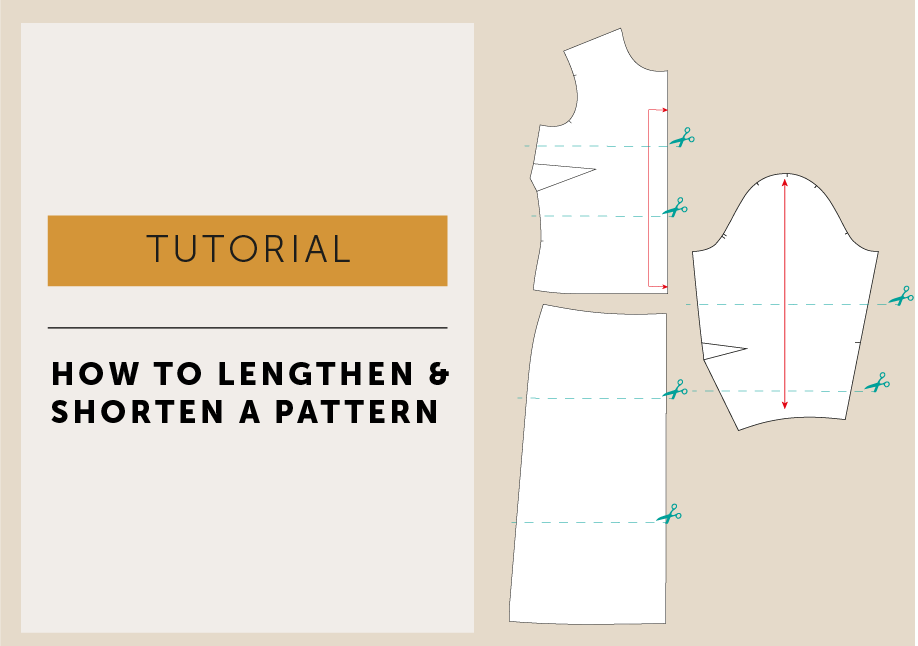
You’ve probably noticed, many patterns have horizontal length adjustment lines marked on them to show where to alter the length. I don’t do that on all of my patterns, I prefer a cleaner look. It’s so easy to get in a muddle with too many lines everywhere and so simple to mark any length adjustments only if you need them. This straight forward tutorial will show you how simple it is to lengthen or shorten a sewing pattern, to help achieve a great fit.

TOOLS

  • Your pattern (or copy of your pattern if you don’t want to alter your original)
  • ruler
  • pencil
  • tape
  • paper

Things to be aware of

  • If you are unsure of how much length to add/reduce or even if you need to adjust the length, make a toile first. The silhouette and ease in a garment can make a difference to how long it should be.
  • If you are doing lots of alterations to your pattern, do any length adjustments first.
  • Keep the grainline or “place to fold line” IN A STRAIGHT LINE, do not allow them to stagger.
  • The Chain Effect: when altering one pattern piece, also alter the corresponding pattern piece in the same way and remember to check they still fit together after your alteration. It is very annoying to end up with the front skirt longer than your back skirt!
  • A toile is always your friend if you’ve done lots of (any) alterations!

Step 1

HOW TO LENGTHEN OR SHORTEN A SEWING PATTERN TUTORIAL_MAVEN PATTERNS-01

Once you’ve made a toile, you’ll know how much and where you need to add or subtract length to your garment. You can just change the bodice length, or a skirt length or the sleeve, or all 3!

Draw an adjustment line horizontally across your pattern at a right angle to the grainline or to the “place to a fold line”

On a bodice: mark the line above the waist line but below a bust dart, and straight through any waist darts.

On a skirt (or skirt portion of a dress) below the hip line, but avoid any pocket details – no point making life complicated!

On a sleeve: half way along the underarm seam, unless it’s a fitted sleeve or has an elbow dart, then divide between two lines. (See “Good to Know” at the end)

Step 2

Lengthen a pattern

HOW TO LENGTHEN OR SHORTEN A SEWING PATTERN TUTORIAL_MAVEN PATTERNS-02

Cut along the adjustment lines and separate the pattern piece.

Place a piece of paper behind your pattern and tape the top portion of your pattern to it.

Extend the grain line. Draw a line parallel to the your adjustment line the amount you need to lengthen the pattern by. Tape the lower portion of your pattern to the new line, matching up the grainline. Re-draw the seam lines so that they match up again, these may need to be curved or may be straight depending on your pattern piece. It’s quite usual to need to blend the new lines together, adding a bit to one and taking a bit off the other.

Shorten a pattern

HOW TO LENGTHEN OR SHORTEN A SEWING PATTERN TUTORIAL_MAVEN PATTERNS-03

Cut along the adjustment lines.

Place a piece of paper behind your pattern and tape the top portion of your pattern to it. On your pattern, draw a line parallel to the adjustment line the amount the pattern is to be shortened. Overlapping your pattern pieces, tape the lower portion of the pattern to the new line, matching up the grainlines. Re-draw the the seam lines so they match up again, in the same way as lengthening a pattern.

Step 3

Check your pattern pieces still fit together before cutting out your garment. Toile again if you need to!

Good to Know

The Maria Apron: lengthen the straps

HOW TO LENGTHEN OR SHORTEN A SEWING PATTERN TUTORIAL_MAVEN PATTERNS-06

This is a great method to use if you need to alter the length of the straps of The Maria Apron too. Be sure to keep the grainline aligned as before, but you can just chop through the strap, spread the pattern the required amount and re-draw the edges with a straight line – all without changing the length of the angled edge that attaches to your apron! You will need to do exactly the same alteration to both the TOP and UNDER straps.

Changing the length by a larger amount

If you are lengthening or shortening a sewing pattern by a larger amount, you can spread the amount between 2 lines

HOW TO LENGTHEN OR SHORTEN A SEWING PATTERN TUTORIAL_MAVEN PATTERNS-05

On a bodice, for example, take the amount needed to lengthen and place half above the bust dart, and half below the dart, this will of course lower the bust dart a little, so be sure you want it lower!

On a skirt, especially a maxi skirt style, half could go through the skirt in two places, this will lengthen the skirt and keep the hem circumference the same as the original. Alternatively, use one adjustment line and extra length could be added straight to the bottom of the hem, but the hem circumference will get bigger.

For a fitted sleeve: Spread the amount between two lines one above and one below the elbow/elbow dart.

Now, do I always use this method for changing the length of every pattern?

I’m 5’2″ so it’s always shorten, shorten, shorten.

HOW TO LENGTHEN OR SHORTEN A SEWING PATTERN TUTORIAL_MAVEN PATTERNS-04

NOPE, I don’t! If it’s only a little bit, or a boxy shape I’ll just chop it off/add the extra on to the bottom of the pattern. That works just fine too in some cases.

I hope you found this pattern alteration tutorial useful, and now can confidently alter the length of your sewing patterns.

Posted on

Pattern Magic – an experiment

MAVEN PATTERNS_PATTERN MAGIC


“Garments we design ourselves appeal to the emotions as well as the eye.

Unexpected shapes and forms can be converted into flat patterns and ultimately into garments. From this new ideas develop, making the process a rewarding one.

I want to copy forms and details that I create unexpectedly onto a flat surface to understand their structure as a pattern.

Patterns are like documents that describe a garment, conveying its structure more eloquently than words. They can even convey the thoughts of its creator.”

TOMOKO NAKAMICHI

Author and creator of Pattern Magic | Professor at Bunka Fashion College

Inspiring and thoughtful words.

The following samples are the result of a workshop in 3D pattern cutting that I attended a while back, and taken from the cult Japanese book Pattern Magic 2.

I’ve had the Pattern Magic books for a few years, and looked but had not really given them the time they deserve. These shapes have played on my mind for the last few weeks, a pattern cutters mind is always trying to find a parallel between creativity and practicality. I’m curious now as to how this little experiment will inform future designs. I’ve found, over the years, patience is usually the key for me. Ideas tend to fight their way to the top and escape when they’re ready and when I’ve made a little space for them.

In the mean time I’m happy with these little toiles and the time taken to play.

MAVEN PATTERNS_PATTERN MAGIC

NYOKITTO | at the front

MAVEN PATTERNS_PATTERN MAGIC

NYOKITTO | at the front

MAVEN PATTERNS_PATTERN MAGIC

NYOKITTO | at the back

further links:

Pattern Magic Community

Pattern Magic: the books 

Posted on 6 Comments

How to add a Lining Tutorial

LINING TUTORIAL_MAVENPATTERNS_

A Dress Lining Tutorial

I wasn’t planning to do a lining tutorial at all, but happily finding 2 metres of the perfectly coloured gold lining in my stash to match this beautiful Barkcloth, set me off on a path….and I thought it might be useful! So, let’s add a lining to The French Dart Shift pattern

SUPPLIES:

You will need The French Dart Shift Pattern (or similar style dress pattern) and the fabric and haberdashery listed plus

  • 1mt lining
  • paper to make a lining pattern (if you don’t have pattern paper, improvise…wallpaper, newspaper, A4 sheets taped together)

LINING TUTORIAL_MAVENPATTERNS_

 STEP 1: PATTERN

Firstly, you need to make a lining pattern. Yep, really you do. You could cheat and just cut the body of the dress in the lining but as lining fabric doesn’t ‘give’ and you may well find that it all gets a little tight across the back. Sometimes you can add a pleat at the back (like inside a jacket, go on take a quick look at one, I’ll wait) but ideally, you don’t want any extra bulk at the back of a dress, just a little extra ease for movement.

So here’s what you do…The finished lining pattern will be WIDER and SHORTER than the main body pattern, and the sleeve is going to stay unlined, so no sleeve lining pattern needed!

LINING TUTORIAL_MAVENPATTERN

Trace off the front and back body pattern, marking all the notches and darts. Extend the shoulder seam by 3mm and mark with a cross.

Next, mark a point half way down the armhole and 5mm OUT from the pattern and again 5mm OUT at the underarm.

Draw a GRADE LINE on the lining pattern 5mm away and parallel to the Centre Front Line (CF).

LINING TUTORIAL_MAVENPATTERNS_

Redraw the armhole: using your original pattern piece as a template to join the points you just marked together.

The side seam needs to move OUT 5mm as well: Take the main pattern and lay on top of the lining pattern. Line up at the underarm (U/A), remember to use the new U/A point on the lining pattern, and the CF with the GRADE LINE (keep the patterns parallel with each other) and re-draw the side seam and bust dart.

LINING TUTORIAL_MAVENPATTERNS_

Make the lining pattern 3cm shorter (which is the hem allowance of the dress) than the main pattern. The lining pattern will have a 1.5cm hem allowance so it will finish 1.5cm higher than the dress hem because you don’t want your lining on display when you strut your stuff!

Repeat all the above for the back pattern.

Check your lining patterns against your originals…line them up at the C/F’s and C/B’s, are the lining patterns wider and shorter?

Do the front and back lining patterns fit together at the side seam? Yes? Good! Label them as your lining pattern, the size, and to cut them on the fold.

Now cut them out in lining.

STEP 2: MAKE

Make the body of your dress as described in your Maker Instructions. (Tape the neckline, make front and back darts, shoulders, pockets and side seams and hem.)

Make and hem the sleeves and put them to one side.

LINING TUTORIAL_MAVENPATTERNS

MAKE THE COLLAR: close the centre back (CB) seam and press open, fold collar in half and pin so raw edges are together. Be sure to line up all notches so the collar is not twisted.

LINING TUTORIAL_MAVENPATTERNS_03

With right sides together (RST) pin the folded collar into the neckline of the dress, align notches to prevent the collar from twisting. Tack in 6mm seam allowance (S/A) to hold.

LINING:

MAKE THE LINING: Stitch and neaten bust darts, make back darts, close and overlock side seams together. Close shoulder seams and overlock open.

FDS LINING TUTORIAL_MAVEN PATTERNS

Double turn hem lining: Press up the hem 1.5cm, and then fold up the hem again so raw edge meets your pressed line, and press in a second line. Re-fold the hem along the pressed lines so the raw edge is enclosed and top stitch the hem.

FDS LINING TUTORIAL-02

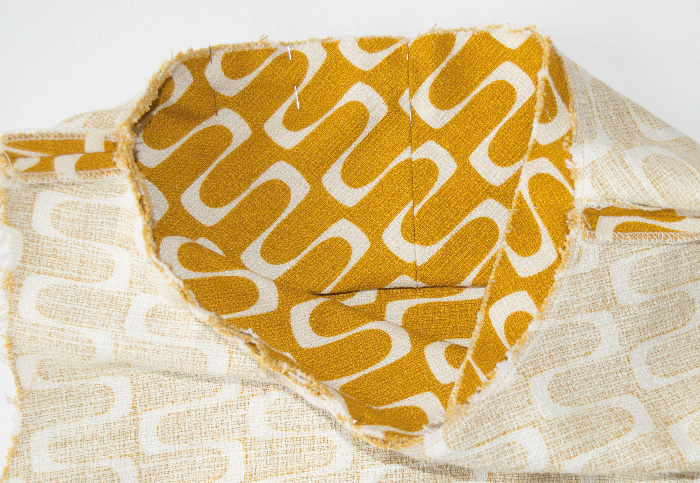
ATTACH LINING AT NECKLINE: With RST, place the lining body inside the main body, align notches and pin. The collar is now sandwiched between the body and lining. Stitch the neckline with a 6mm S/A. Press neckline, with the S/A down and pressed AWAY from the collar. Understitch the lining around the neckline.

LINING TUTORIAL_MAVENPATTERNS_06

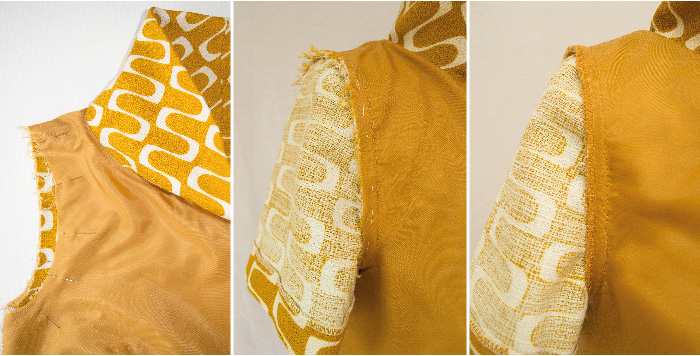
Pin armhole of body and lining together, aligning all the notches. Tack to hold.

Follow the Maker Instructions and set in the sleeves.

Overlock armhole together to neaten, treating all layers (sleeve/body/lining) as one. Give it a press.

That’s it, you’re done…wear and enjoy!


Posted on

In-seam pocket Tutorial

I DO LOVE a side seam pocket. They are nicely hidden in the side seam so unobtrusive and don’t disrupt the line of a fantastically printed fabric. And I find it very annoying not having somewhere to shove my hands!

Our signature In-seam (side seam) pockets are a regular feature on Maven Sewing Patterns.  My pockets may look a little unusual to you, but bear with me, I developed the pattern and technique especially to combat a few of the things that annoy me about pocket construction.

IN SEAM POCKET TUTORIAL_MAVEN PATTERNS-07

Problem 1: Overlocking

So, here’s the thing… you may look at the pocket bags on this pattern and think…Mrs M, really what the ???? I’ll admit they may look a little odd at first glance, with the curvy bit added, but I do have a very good reason: I feel this method gives a much better result.

My problem with the usual way of making pockets that sit at the side seam is you can’t overlock around the pocket bag in one easy motion. Generally, you are told to neaten the edge of each pocket bag separately which just isn’t as strong. And end up having to pull the seam ‘straight’ to catch all of it in the awkward little angle created, which is a pain and eventually the overlocking just pulls away in the wash leaving a raw fraying edge exposed. Mmmm…messy.

Side note – I’m going to say overlocking a lot but replace with zig zag stitch or your preferred seam neatening term.

Problem 2: Snipping

And the other problem, with some methods, was sometimes having to snip into the seam allowance to get them to lie flat in the direction you want. It’s a pet hate, I don’t like doing ‘the snipping’ . in fact, I hate snipping and clipping unless I REALLY have too because it makes a weak point on your seam.

Problem 3: Concealed

I wanted the seam off set from the side seam, so it was less visible.

So what I wanted was a pocket bag I could overlock everything easily and together so it is stronger, and NO snipping into the seam.And the pocket bag is set back a little from the side seam so shows less when being worn. And I wanted to press the side seam open. I thought I was really easy-going until I started writing sewing instructions!

The In-Seam pocket Tutorial

Firstly cut out your garment, make sure you cut 2 pairs of pocket bags (so you have 4 bags in total). Transfer the marker dot positions to your garment (chalk, tailor tacks – whatever works for you. I’ve used neon orange pen so it would show in the photos – I don’t recommend it!)  

Spot fuse the strip of fusible interfacing to the pocket mouth on the FRONT body.

A NOTE ON SEAM ALLOWANCES – Images are shown with 1cm side seam allowance + 6mm seam allowance to attach pocket bag. Some patterns have different seam allowances; 1.5cm side seam allowance + 1cm seam allowance to attach pocket bag which will be shown on your pattern. These are shown in brackets below but the technique is the same!

Step 1

MAVEN PATTERNS_IN SEAM POCKET TUTORIAL

Place the pocket bags to the front and back garment, with right sides of the fabric facing each other, and so the notches on the pocket bags line up with the side seam notches and stitch together with a 6mm (1cm) seam allowance. Overlock (or neaten with your usual method) the raw edge of the pocket bag and garment together, starting and finishing about 3cm either side of pocket bag – (shown in green thread).

UPDATE – On the back seam – rather than starting the overlocking just above the pocket bag – start at the top of the seam and overlock the entire seam right down to the hem.  It’ll save you having to go back and overlocking the rest of that seam later. Which means you’ll have 1 less process to do and save at least 30 seconds – you’re welcome!

Step 2

MAVEN PATTERNS_IN SEAM POCKET TUTORIAL

Press the pocket bags AWAY from the garment and understitch on the front pocket bags.

Step 3

IN SEAM POCKET TUTORIAL 4A-04

SIDE SEAM:

Pin with right sides of fabric facing each other, line up the marker dots on the front body with the corresponding one on the back body.

Take a 1cm (1.5cm) seam allowance, start at the underarm and stitch down to the first marker dot, PIVOT * and stitch from the dot across the pocket bag until you are back at a 1cm (1.5cm) seam allowance on the pocket bag. (The stitch line is marked on the pattern piece, so you could transfer the line across with chalk and a ruler if you wanted).

Carry on around the pocket bag, and stitch TO the next marker dot, PIVOT again and continue down to the hem.

It’s a good idea to reinforce each of the corners at the pivot point as in-seam pockets can take quite a lot of stress. Set your machine to a smaller stitch length and just stitch a second machine row DIRECTLY ON TOP of your first row of stitching about 3cm either side of each marker dot.

Don’t forget to put your stitch length back to your normal setting.

*TO PIVOT – Stitch to the marker dot, leave your machine needle IN your garment, lift your machine foot and turn your work in the direction you want to stitch, drop your foot back down and continue to stitch – makes a nice tidy corner.

Step 4

MAVEN PATTERNS_IN SEAM POCKET TUTORIAL

Press the pocket bags towards the front body.

Press the side seams OPEN above and below the pocket bag, as far as you can. Overlock the front side seam first, all the way around the pocket bag – it’s easier because of the curved shape!!!

THIS NEXT STEP IS FROM THE ORIGINAL METHOD – you can skip this step if you are following the updated method and have already neatened the full length of the back seam. On the back side seam: overlock (shown in pink) from the top of the seam down to the pocket bag and overlap the new overlocking (pink thread) over the original overlocking (green thread), so there are no raw edges. Restart the overlocking below the pocket bag, again being sure to overlap as before, so the entire seam is neatened.

Give the pocket a gentle final press.

MAVEN PATTERNS_INSEAM POCKET TUTORIAL 2016

And from the right side…Tis a thing of beauty!